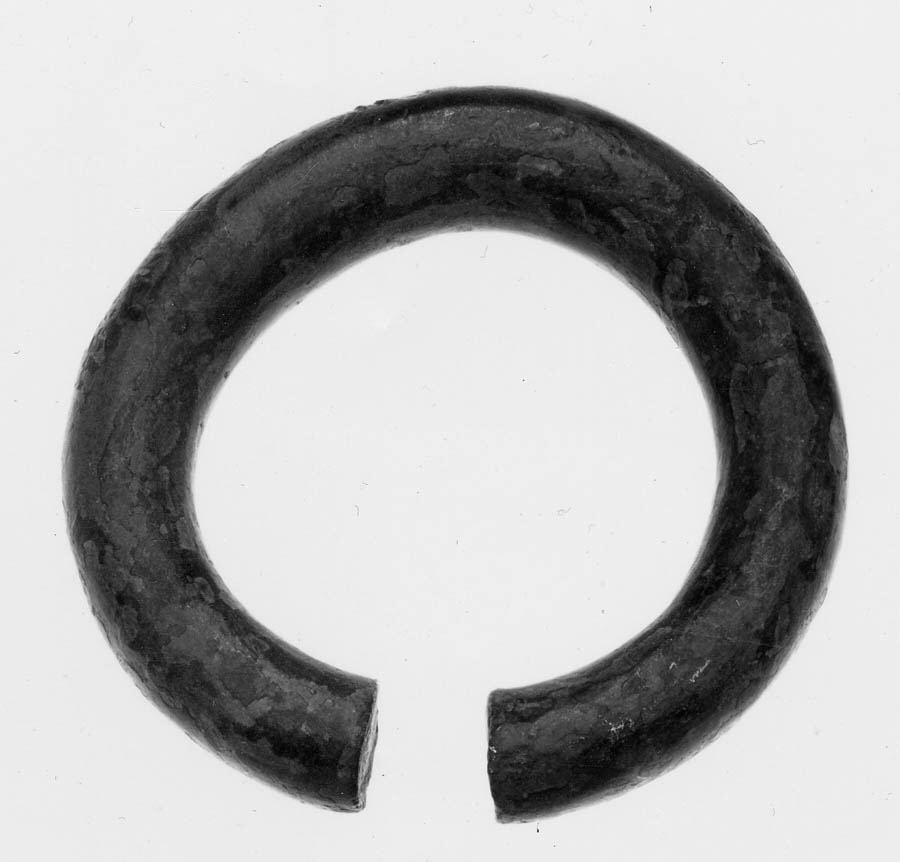
Archaeology of an Armature: The Copper Bangle as a Foundational Silhouette
Within the isolated context of aesthetic archaeology, the object is stripped of its immediate cultural narrative, allowing its pure formal and material language to emerge. The classical Indian copper bangle, when examined through this rarefied lens, ceases to be merely an ornament. It is re-contextualized as a primal architectural form: a closed, perfect circle of oxidized metal. Its elegance is not one of embellishment, but of fundamental geometry and the profound dialogue between material and time. The copper’s surface, marked by a unique patina—a verdigris bloom over a warm, earthy base—tells a silent history of interaction, a natural alchemy that no artisan can fully replicate. This artifact, in its isolated state, presents three core principles for our atelier: the integrity of the circle, the narrative of surface, and the weight of presence. These principles, when translated through the grammar of Haute Couture, provide a radical blueprint for the 2026 silhouette, moving beyond appliqué to inform structure, texture, and movement at the most foundational level.
Structural Translation: From Rigid Circle to Kinetic Sphere
The bangle’s primary assertion is its unbroken circumference, a rigid armature that defines the space it occupies. For the 2026 silhouette, this translates not into literal circular cuts, but into a philosophy of self-referential construction. We deconstruct the circle’s integrity into architectural seaming that follows the body’s own curves only to ultimately reinforce a sculptural, holistic form. Imagine a tailored jacket where the shoulder seam is eliminated, the sleeve cut as a continuous spiral from the bodice, creating a seamless, bangle-like encirclement of the upper arm and torso. This technique demands a mastery of bias and structure to achieve rigidity without compromise, echoing the bangle’s definitive shape.
Furthermore, the circle’s emptiness is its defining feature. This informs a key 2026 silhouette strategy: the framed negative space. Gowns will be engineered with rigid, boned corselets or structured necklines that act as the "bangle," framing vast, unexpected apertures of décolletage or back, or creating a void between the garment and the body at the hips. The silhouette becomes not just the shape of the cloth, but the deliberate, sculptural space between the cloth and the wearer, a direct conceptual lift from the bangle’s central void.
Material Alchemy: The Patina as Textile Genesis
The copper’s materiality is its second archive. Its elegance is inherently temporal, born from oxidation. This patina—a complex, layered, and utterly unique surface—informs 2026 luxury through an advanced philosophy of engineered degradation and tactile stratification. We move beyond static fabrics towards textiles that tell a material story. This involves pioneering techniques such as:
Multi-phase dyeing and finishing: Silks and organic cottons will be subjected to sequential treatments with copper salts, vinegar, and controlled exposure to elements, not to replicate verdigris, but to capture its principle—a beautiful, unpredictable transformation over a stable base. The result is a fabric that possesses a memory of process, with depth and variation impossible to achieve through flat printing.
Hybrid material laminates: Thin, hammered copper foil will be laminated between layers of transparent resin or silk organza, creating a fragile, armored textile. As the garment moves, micro-fractures will naturally occur in the metal layer, initiating a slow, personalized oxidation process unique to the wearer’s movement, making each piece a living archive.
The Weight of Presence: Silhouette as Conscious Load
A substantial copper bangle possesses a tangible heft; its elegance is felt kinetically. This conscious weight is a critical injection for 2026’s often ethereal luxury. Silhouettes will be engineered to impart a dignified, deliberate motion. This is achieved not through literal weight, but through architectural density and strategic balance.
We will utilize dense, compact wools and structured technical felts for outerwear, tailoring them with a rounded, minimal seaming that echoes the bangle’s simplicity, creating a garment that sits with authoritative presence. For evening, the weight is translated into momentum. Hemlines will be weighted with fine, concealed chains or dense silk cording, not for flare, but to create a slow, pendulum-like sway as the wearer moves—a kinetic echo of the bangle’s swing on the wrist. The silhouette communicates through its measured pace, an antidote to the ephemeral.
Conclusion: The Armature of 2026
For Natalie Fashion Atelier, the isolated Indian copper bangle is far more than an exotic reference. It is a primordial design brief recovered through aesthetic archaeology. Its classical elegance, deconstructed, provides a rigorous technical framework for the coming season: the self-referential cut, the narrative textile, and the kinetic silhouette. The 2026 collection will thus present not "Indian-inspired" details, but garments that embody the bangle’s core principles. Clients will encounter the integrity of the circle in a coat’s relentless spiral seam, read the story of patina in a gown’s evolving surface, and feel the weight of presence in the deliberate sway of a skirt. This is the true work of the atelier: to perform a deep, technical translation, transforming an artifact’s isolated elegance into a fully realized, worn architecture for a new era of considered luxury.