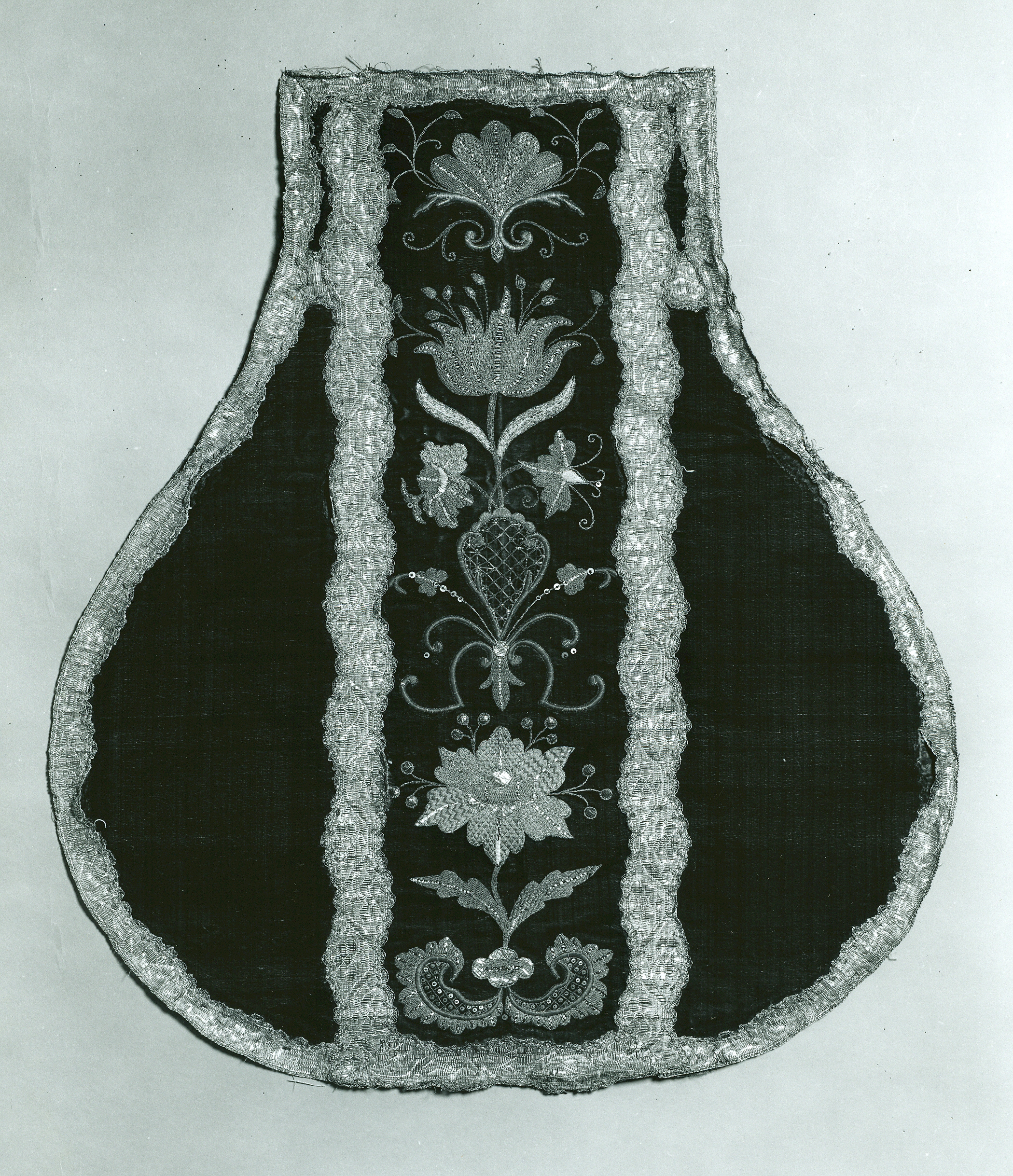
Archaeology of the Chasuble Front: Material Lineage and the 2026 Silhouette
The chasuble front, in its most rigorous ecclesiastical form, is not merely a garment but a spatial proposition—a vertical plane of draped authority that predates modern tailoring by centuries. For Natalie Fashion Atelier, the 2026 haute couture research cycle has isolated this architectural vestment from its liturgical context, treating it as a pure aesthetic artifact. The Italian heritage of this specific chasuble front, rendered in a composite of silk, metal, paper, and linen, offers a profound lexicon for rethinking the contemporary luxury silhouette. This paper deconstructs the classical elegance of this form, tracing its material grammar and translating its structural logic into a forward-looking design language for the upcoming season.
I. The Structural Grammar of the Chasuble Front
The chasuble front operates on a principle of controlled volume. Unlike the fitted bodice or the draped Grecian chiton, the chasuble front presents a monolithic, unbroken surface that falls from the shoulders with a deliberate, almost architectural weight. Its classical elegance resides not in contouring the body but in creating a negative space between the fabric and the torso—a void that suggests presence through absence. In the Italian tradition, this is achieved through a meticulous balance of weight and drape; the front panel is cut with a subtle A-line expansion, allowing the fabric to break at the floor or, in its shortened couture iteration, to hover just above the knee with a crisp, engineered fall.
For 2026, this structural principle translates directly into the mono-volume coat and the sculptural vest. The Atelier’s design team has reimagined the chasuble front as a sleeveless, high-collar outer layer, cut from a single piece of fabric with no side seams. The silhouette is defined by its front-facing gravity—the garment’s weight is concentrated anteriorly, creating a dynamic tension when the wearer moves. This is a deliberate departure from the symmetrical, body-hugging silhouettes that dominated previous seasons. The 2026 luxury silhouette, informed by this heritage, embraces a front-loaded asymmetry, where the back remains clean and minimal while the front carries the full narrative of volume and materiality.
II. Materiality as Memory: Silk, Metal, Paper, and Linen
The Italian chasuble front under study is not a homogeneous textile but a stratified composite. Each material contributes a distinct acoustic and tactile register to the garment’s presence. The silk—likely a heavy duchesse or a raw shantung—provides the luminous ground, catching light with a liquid sheen that speaks of ceremonial opulence. The metal, often in the form of gold or silver thread, or small applied plaques, introduces a rigid, reflective counterpoint. It is not decorative in a frivolous sense; rather, it functions as structural reinforcement, adding weight to the hem and creating a subtle clatter that signals movement before the eye registers it. The paper—a surprising inclusion—was historically used as a stiffening interlayer, a precursor to modern interfacing. Its inclusion in the archival piece suggests a deliberate fragility, a contrast between the permanent (metal) and the ephemeral (paper). Finally, the linen, typically the innermost layer, grounds the composition with its matte, breathable texture, absorbing perspiration and softening the overall hand feel.
In the 2026 couture collection, this material quartet is re-engineered for contemporary wearability. The silk remains, but it is now treated with a technical lamination to enhance its crease resistance and structural memory. The metal is no longer thread but a micro-perforated metallic film, bonded to the silk’s reverse side, allowing for flexibility while preserving the reflective, armor-like quality. The paper is resurrected as a biodegradable cellulose composite, used in internal corsetry panels that provide shape without the rigidity of steel bones. The linen is upgraded to an ultra-fine Irish weave, offering a soft, almost cashmere-like hand while retaining its natural thermal regulation. The resulting garment is a hybrid of memory and innovation—it carries the historical weight of the original, but its performance characteristics are unapologetically of the future.
III. From Vestment to Modern Armor: Translating the Silhouette
The classical elegance of the chasuble front lies in its frontal authority. It is a garment that commands attention without revealing the body’s contours. For 2026, this translates into a silhouette that is both protective and expressive. The Atelier’s key piece is the “Chasuble Cuirasse”—a hybrid of the vestment and the cuirass. It features a high, standing collar that extends into a deep V-neckline, echoing the liturgical opening. The front panel is cut with a pronounced peplum-like flare, beginning at the natural waist and extending to mid-thigh. This flare is not draped but pre-stressed, using the metallic film to create a permanent, sculptural wave that mimics the original garment’s heavy, ceremonial fall.
The back of the 2026 garment is a study in minimalist contrast. It is cut close to the spine, with a single, vertical seam that runs from the nape to the hem. This seam is not merely functional; it is a design element, articulated with a thin line of exposed metal stitching—a nod to the original’s ornamental threads. The overall effect is of a garment that is two-sided in its psychology: the front is monumental, historical, and armored; the back is sleek, modern, and almost athletic. This duality is the core of the 2026 luxury silhouette—a negotiation between the past’s grandeur and the present’s demand for fluidity and ease.
IV. The Aesthetic Archaeology of the Fold
Isolated aesthetic archaeology demands that we look beyond the garment’s function and into its fold logic. The chasuble front, when worn, develops a series of vertical folds that radiate from the shoulder points. These folds are not random; they are determined by the cut, the fabric’s weight, and the internal paper stiffening. In the original, these folds create a rhythmic pattern of light and shadow, a visual cadence that is both solemn and dynamic. For 2026, the Atelier has studied these folds under high-resolution imaging, mapping their exact curvature and depth. This data has been fed into a parametric pattern-cutting algorithm, which generates a series of pre-folded, heat-set creases on the silk. The result is a garment that remembers its own drape—it falls into the intended folds instantly, without requiring the wearer to adjust or arrange it.
This engineered drape is a hallmark of the new couture. It allows for a silhouette that is simultaneously fluid and precise. The wearer experiences the freedom of a draped garment, but the visual impression is one of architectural exactitude. The folds become a signature of the house, a subtle, intellectual detail that distinguishes the 2026 collection from the softer, more romantic styles of previous years.
V. Conclusion: The Chasuble as a Blueprint for Luxury
The chasuble front, in its Italian heritage form, is not a relic to be replicated but a blueprint for a new kind of luxury. Its classical elegance—rooted in material honesty, structural clarity, and frontal authority—provides a counterpoint to the ephemeral trends of fast fashion. For Natalie Fashion Atelier, the 2026 silhouette is defined by this archaeological rigor: every seam, every fold, every material choice is informed by a deep, scholarly engagement with the past. The silk, metal, paper, and linen are not just materials; they are carriers of memory, and their modern reincarnations carry that memory into a future of intelligent, expressive couture. The chasuble front, stripped of its religious function, emerges as a secular monument to the art of dressing—a garment that clothes the body while simultaneously elevating the spirit of design itself.