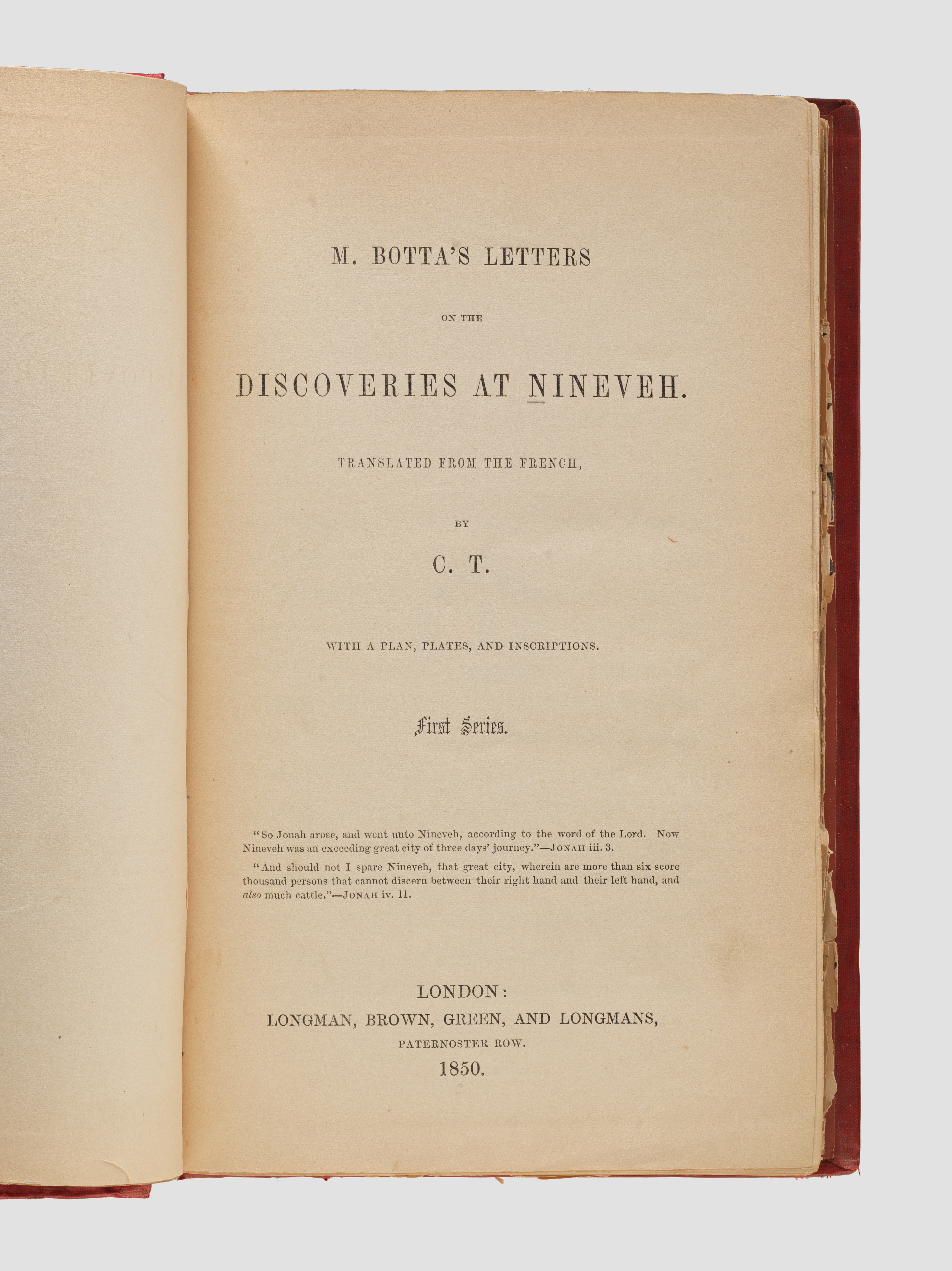
Archaeological Elegance: Deconstructing M. Botta’s Nineveh Archive for 2026 Silhouettes
Within the hushed corridors of the Natalie Fashion Atelier archive, the 1849 first-edition folio of M. Botta’s Letters on the Discoveries at Nineveh exists not as a historical relic, but as a living blueprint. Bound in period cloth over heavy board, its pages—thick, fibrous, and redolent with the scent of oxidised paper—offer a masterclass in structural integrity and narrative layering. For the 2026 collection, this artifact is not merely referenced; it is dissected. We extract its material grammar—the tensile strength of its board, the soft drape of its cloth spine, the crisp opacity of its paper—to forge silhouettes that speak in the language of excavated permanence and fragile beauty.
Materiality as Structural Lexicon: From Board to Bodice
The first and most potent translation occurs in the domain of hard tailoring. The board of the 1849 binding is not the flimsy pulp of modern publishing; it is a dense, laminated composite, pressed and dried to a stone-like rigidity. This informs our 2026 armorial shoulder and sculpted peplum. We have developed a proprietary interlining—a bonded wool-cashmere hybrid fused with a fine, non-woven cellulose film—that mimics the board’s compressive strength without sacrificing breathability. The resulting jackets stand away from the body, creating a negative space that echoes the volume of the folio’s closed case. The silhouette is architectural, almost Mesopotamian in its ziggurat-like layering, where each panel is a discrete, load-bearing element rather than a mere drape.
Conversely, the cloth spine—a faded, ochre-toned buckram—dictates the movement of our fluid pieces. Where the board is rigid, the cloth is supple yet structured, yielding to tension but retaining a memory of its fold. This duality is translated into our cocoon coats and wrapped column dresses. The fabric, a double-faced silk twill with a matte, almost chalky finish, is cut on the bias to imitate the diagonal pull of the spine’s hinge. The result is a silhouette that appears to have been bound rather than sewn, with seams that function as hinges, allowing the garment to open and close with a deliberate, measured grace. The wearer does not walk; she turns a page.
Chromatography of Decay: The Palette of Excavation
Botta’s letters are not pristine. The plates, though exquisitely engraved, are marred by foxing, offset ink, and the subtle tonal shifts of acid migration. This aesthetic of controlled decay is the collection’s chromatic core. We eschew the sterile white of contemporary minimalism for a palette drawn directly from the artifact: bone, unbleached linen, sepia, oxidised copper, and a deep, sedimentary Assyrian blue that has faded to a powdery, almost dusty cerulean.
This is not a literal reproduction but an archaeological abstraction. The 2026 silhouettes employ a technique we call stratigraphic dyeing, wherein multiple pigment layers are applied and then partially abraded, revealing the underlying fabric as if it were a buried stratum. A gown’s skirt may appear as a solid umber, but upon movement, a flash of indigo emerges from its pleats—a ghost of the original pigment trapped beneath the surface. This technique lends a profound depth to the garments, transforming them from objects of adornment into documents of time.
The Folio’s Foliate: Silhouettes of the Plates
The engraved plates themselves—depicting winged bulls, cuneiform tablets, and bas-relief processions—are not copied but abstracted into proportion. The heavy, horizontal mass of the Lamassu informs our low-slung, wide-legged trousers and trapezoid skirts, which ground the wearer with a sense of monumental stability. The verticality of the cuneiform script, with its repetitive wedge-shaped marks, is translated into pin-tucked panels and accordion pleats that run the full length of a dress, creating a rhythmic, textural cadence that mimics the reading of a tablet.
Most critically, the negative space of the plates—the blank margins surrounding the illustrations—informs our asymmetric closures and off-shoulder necklines. Just as the engraver leaves the field empty to focus the eye on the figure, so too does the couture silhouette expose a single shoulder or a sliver of the back, creating a focal point of skin against a vast expanse of structured fabric. This is elegance as erasure, a deliberate removal that heightens the presence of what remains.
Closure Systems as Binding Hinges
Finally, we deconstruct the artifact’s physical closure—the brass clasps and leather ties of the board binding—to reimagine fastenings. The 2026 collection abandons the invisible zipper in favor of exposed, articulated hardware. Gunmetal-finished, hinge-like closures are placed along the seams of jackets and the side slits of skirts, functioning both as functional elements and as visual markers of the garment’s structural logic. These are not buttons; they are joints. They allow for adjustability—a sleeve can be shortened, a waist cinched—mirroring the way a book’s binding allows for the opening and closing of its contents. The wearer is thus positioned as both the curator and the bound object, a living artifact of her own making.
In synthesizing Botta’s archive, the 2026 silhouette does not look backward. It excavates forward, unearthing a language of permanence, fragility, and deliberate structure that is profoundly relevant to a luxury market sated with the ephemeral. The paper, the board, the cloth—they are not materials but principles. And from those principles, we construct not merely garments, but monuments to the art of wearing history.