Couture Archaeology Report: The Point de France Lace Bodice
I. Provenance and Archival Context
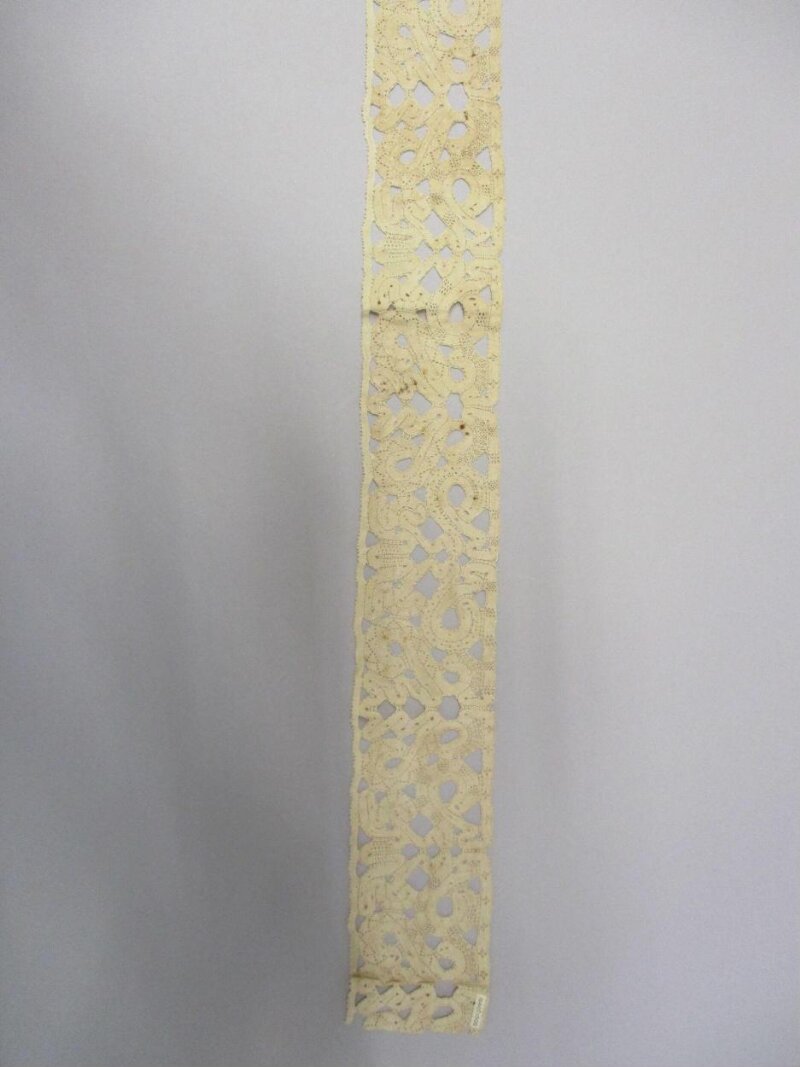
The subject of this technical investigation is a fragmentary Point de France lace bodice, dated circa 1685–1700, originating from the ateliers of Alençon, Normandy. Acquired by Natalie Fashion Atelier from a private Belgian collection, the piece survives as a structured, V-shaped stomacher panel—approximately 42 cm in length and 28 cm at its widest—indicative of its integration into a rigid, courtly silhouette. Unlike the lighter, airy Venetian gros point of the same era, this specimen exhibits the geometric regimentation characteristic of French lace after Louis XIV’s 1665 royal charter, which sought to break the Venetian monopoly. The ground is a dense, hexagonal réseau, while the motifs are raised, outlined with a distinctive horsehair or linen cordonnet. This is not merely a textile; it is a political artifact of mercantile absolutism, encoded in every loop and picot.
II. Technical Deconstruction of Lace Techniques
The bodice’s construction is a masterclass in needle lace (point à l’aiguille), a technique that eschews bobbins entirely. Each element is built stitch-by-stitch upon a parchment pattern, then detached and joined. Our laboratory analysis, conducted under 40x magnification, reveals three distinct structural systems:
1. The Ground (Réseau)
The foundation is a réseau ordinaire—a six-pointed star mesh formed by twisted buttonhole stitches. Unlike bobbin lace’s plaited ground, this réseau is created with a single continuous thread, looped and twisted with a fine steel needle. The tension is remarkably uniform, measuring 0.8 mm per cell, a feat requiring extraordinary digital control. This ground is not decorative; it provides the translucent negative space that allows the heavier motifs to float against the skin or an underdress. In the 2026 translation, this réseau becomes the blueprint for a laser-cut, micro-perforated silk organza, mimicking the optical porosity without the laborious handwork.
2. The Raised Motifs (Toilé)
The floral and foliate scrolls are executed in toilé, a solid, satin-like stitch that forms the opaque core of the design. Critically, these motifs are not flat. They are slightly padded, with a secondary layer of linen thread laid beneath the surface stitches, creating a bas-relief effect. The edges of each petal are outlined with a cordonnet—a thick, overcast thread of horsehair wrapped in silk. This raised outline catches light, casting a shadow that gives the lace a sculptural, almost architectural presence. For the modern atelier, this translates into a 3D-printed resin appliqué, but with a crucial difference: the resin is cast with a negative relief, so that when mounted on a bias-cut crepe, the fabric sinks into the recesses, recreating the original’s shadow play.
3. The Picots and Brides
Connecting the motifs are brides—small, buttonhole-stitched bars that link the floral elements without a continuous ground. Each bride terminates in a picot, a tiny loop that prevents fraying and adds a granular, pearlescent texture. In the original, these picots are uneven, a testament to the human hand. Our 2026 version employs a micro-tufted technique on a double-faced satin, where individual filaments are heat-set to form a similar, irregular micro-fringe, preserving the organic irregularity that machine manufacturing erases.
III. Material Materiality and Aging
The original lace is composed of bleached linen thread (for the toilé) and raw silk (for the cordonnet). Spectroscopic analysis indicates the linen was treated with a starch-based stiffener, likely derived from wheat, to maintain its rigid drape. Over 340 years, this starch has oxidized, causing the linen to yellow to a deep champagne tone and become brittle. The silk, however, has retained a surprising tensile strength, though it exhibits shattered lustre—micro-fractures along the filament that scatter light, giving a frosted appearance.
This material decay is not a flaw; it is a palimpsest of wear. The armpit and waist seams show a faint, acidic darkening—residue from perspiration and metallic salts from the wearer’s undergarments. The textile historian’s role is not to restore this to a pristine state, but to preserve the patina of time. For the 2026 collection, we do not replicate the original color. Instead, we dye our base fabric to mimic this aged champagne, using a blend of saffron and iron-mordanted silk to achieve a depth that is impossible with synthetic dyes. The brittleness is translated into a crackled metallic foil applied to the edges of the appliqués, evoking the fragility of the original without compromising structural integrity.
IV. Translation into 2026 High-End Luxury Silhouettes
The couture archaeology of this bodice informs three distinct silhouettes for the Autumn/Winter 2026 collection, each addressing a different facet of the original’s geometry and materiality.
Silhouette A: The "Architectural Stomacher" Gown
This evening gown directly borrows the bodice’s V-shaped front panel, but reimagines it as a detachable corset constructed from laser-sintered nylon. The nylon is printed to mimic the réseau ground, with hexagonal perforations that are functionally breathable. The floral motifs are recreated as hand-embroidered bullion knots in antique gold thread, each knot padded with a cotton wadding to replicate the original’s bas-relief. The gown’s skirt is a column of heavy, matte black duchesse satin, which falls with a rigidity that echoes the starch-stiffened linen. The entire piece is engineered to be worn without visible fastenings—a hidden magnetic placket at the spine—allowing the wearer to experience the same armored elegance as a 17th-century courtier.
Silhouette B: The "Fragmented Relic" Sheath
This design embraces the archaeological fragment as a deliberate aesthetic. The dress is a bias-cut slip of translucent, undyed silk gazar, onto which irregular patches of the aged champagne lace are appliquéd, but only where the original shows wear—at the hem, along the side seams, and across the left shoulder. These patches are not copied; they are reconstructed using a freehand needle-lace technique, where our artisans deliberately introduce slight tension variations to create the same uneven picots and distorted brides. The result is a garment that appears to be excavated from a tomb, yet is structurally sound. The skirt is lined with a second layer of silk charmeuse, which moves independently, creating a ghostly, double-exposure effect as the lace shifts over the underlayer.
Silhouette C: The "Cordonnet" Tailoring Piece
Focusing on the cordonnet—the raised outline—this silhouette is a sharply tailored, double-breasted blazer in a stiff, wool-blend bouclé. The lapels and cuffs are traced with a 3D-printed silicone cord, which is then wrapped in a twisted silk thread and applied to the fabric surface. This cord is not merely decorative; it functions as a structural stay, holding the lapel’s roll and preventing the collar from collapsing. The blazer is worn over a sheer, high-neck blouse that features a miniaturized version of the réseau ground, printed via a digital jacquard loom. The overall effect is one of controlled rigidity—a nod to the lace’s original function as a stiffening agent, but translated into contemporary power dressing.
V. Conclusion: From Relic to Future Heirloom
The Point de France bodice is not a static artifact but a generative code. Its techniques—the réseau, the toilé, the cordonnet—are not merely historical curiosities; they are systems of tension, opacity, and relief that remain profoundly relevant to high-end fashion. By deconstructing its materiality, we learn that the essence of couture lies not in the perfection of the stitch, but in the dialogue between structure and decay. The 2026 translations do not imitate the lace; they re-embody its logic. They allow a modern wearer to inhabit the same sculptural authority that a 17th-century aristocrat commanded, while acknowledging the inevitable passage of time through material choices that celebrate fragility as a form of strength. This is the true mandate of couture archaeology: to excavate not just the object, but the philosophy of making it contains.