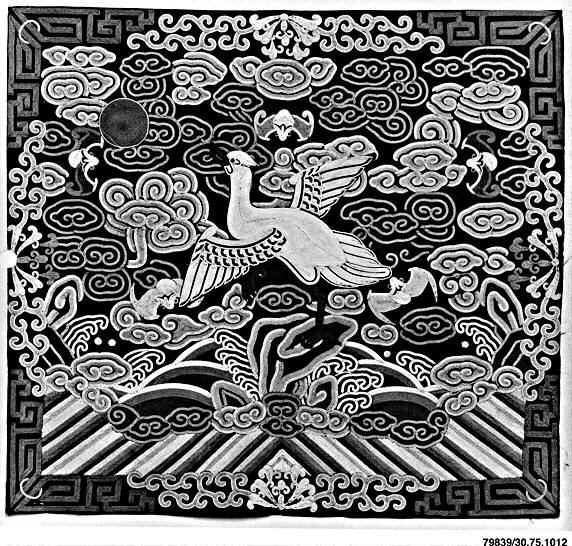
From Imperial Embroidery to Contemporary Draping: The Aesthetic Archaeology of the Woman’s Rank Badge with Egret
Within the hushed archives of Natalie Fashion Atelier, we isolate a singular artifact: a Woman’s Rank Badge with Egret, rendered in silk upon silk. This is not merely a textile; it is a frozen manifesto of hierarchical grace, a microcosm of Qing dynasty aesthetics where every stitch was a deliberate act of political and poetic signification. For the 2026 couture silhouette, this badge offers more than ornamental reference—it provides a structural and philosophical blueprint. By deconstructing its materiality, chromatic logic, and spatial composition, we extract principles that transcend historical costume and inform a new lexicon of luxury: one defined by tactile depth, restrained opulence, and architectural fluidity.
Materiality as Structural Language: The Logic of Silk-on-Silk
The badge’s foundation is a ground of plain-weave silk, its subtle sheen acting as a passive canvas. Upon this, the embroiderer has applied twisted silk threads, creating a relief that is both painterly and sculptural. This is not appliqué; it is a dialogue between two states of the same fiber. The contrast between the matte, absorbent ground and the lustrous, raised embroidery generates a play of light that shifts with the viewer’s position. In 2026, this principle translates directly into silhouette construction. We are moving away from flat, printed surfaces toward dimensional fabrication where the garment’s surface is treated as a topographic map. Consider a column gown where the bodice is cut from a double-faced silk, with the outer layer selectively devoréed to reveal a lower, contrasting weave. The resulting pattern—perhaps a stylized egret feather—emerges not as a print but as a topographical variation in the cloth itself, echoing the badge’s raised embroidery. The silhouette then becomes a study in controlled volume, where the body’s movement activates the surface, making the garment a living, breathing artifact.
Chromatic Restraint and the Power of Negative Space
Historically, the rank badge employed a disciplined palette: deep indigo or black grounds, punctuated by the stark white of the egret, accented with threads of coral, jade, and gold. This is not chromatic timidity; it is strategic austerity. The eye is drawn not to a cacophony of color, but to the symbolic white bird—the emblem of purity and incorruptibility—set against the cosmic darkness of the background. For the 2026 high-end silhouette, this dictates a radical reduction in palette. We propose a collection built on monochromatic foundations with a single, high-contrast focal point. A tailored coat in deep ink-washed wool, for instance, might feature a single egret feather embroidered in white silk floss along the lapel, its placement mirroring the badge’s central motif. The silhouette itself—sharp shoulders, a nipped waist, a flaring hem—remains austere, allowing the embroidered element to function as a jewel of narrative significance. The negative space around the motif is not empty; it is charged with the same tension as the dark silk ground of the badge, creating an aura of quiet authority.
Deconstructing the Egret: From Symbol to Silhouette
The egret itself is a study in elongated, sinuous line. Its neck curves with an almost calligraphic grace; its wings fold into sharp, geometric planes when at rest. We deconstruct these anatomical elements to inform the linear architecture of the 2026 silhouette. The egret’s neck suggests a high, standing collar that sweeps asymmetrically across the shoulder, its edge finished with a hand-rolled hem that mimics the bird’s feathery contour. The wings, when spread, inspire a cape or an oversleeve that is cut on the bias, allowing the fabric to fall in sharp, angular folds that echo the bird’s primary feathers. The tail feathers, long and tapering, translate into a dramatic train or a trailing panel that extends from the hip, creating a silhouette of arrested motion. This is not literal costuming; it is a morphological translation. The garment does not depict an egret; it embodies the bird’s structural elegance through cut and drape.
The Stitch as Signature: Handcraft in the Age of Acceleration
The rank badge’s embroidery is not uniform; it exhibits the subtle irregularities of the human hand. Each stitch is a testament to hours of focused labor, a form of slow luxury that modern manufacturing cannot replicate. For 2026, this becomes a crucial differentiator for the atelier. The silhouette may be modern, but its execution must be archaic in its precision. We propose that the interior seams of our garments—the invisible architecture—be hand-finished with a silk thread that echoes the badge’s embroidery. This is not visible ostentation; it is a private pleasure, a secret signature known only to the wearer and the artisan. Furthermore, the weight and fall of the fabric are engineered to mimic the hand of the embroidered silk. We are exploring new weaves that incorporate a subtle, irregular slub, creating a surface that catches light in a manner reminiscent of the hand-twisted threads of the original. The garment thus becomes an heirloom in waiting, its value embedded in the time and skill required to produce it.
Archival Synthesis: A 2026 Silhouette Manifesto
The Woman’s Rank Badge with Egret is not a relic; it is a provocation for the future of couture. Its lessons are clear. First, luxury is a matter of material intelligence, not surface decoration. Second, silhouette is an expression of inner structure, not external imposition. Third, restraint is the ultimate form of power—in color, in ornament, and in line. The 2026 collection will therefore feature a series of gowns and tailored suits that adhere to these principles. A floor-length gown in midnight-blue silk gazar will feature a single, oversized egret feather embroidered across the back, its form suggesting the wings of the bird in flight, while the front remains starkly minimal. A tailored suit, cut from a charcoal wool crepe, will incorporate a high, wing-like collar and a single, hand-embroidered feather at the cuff. Each piece will be constructed with an internal corsetry that references the badge’s rigid structure, providing a sculptural foundation beneath the fluid exterior. This is the new couture: a synthesis of historical depth and forward-thinking design, where the past does not dictate but informs, and where the wearer is not costumed but empowered by the weight of a silent, elegant history. The egret, once a marker of rank, now becomes a marker of individual discernment and aesthetic autonomy—the only rank that matters in the contemporary world.