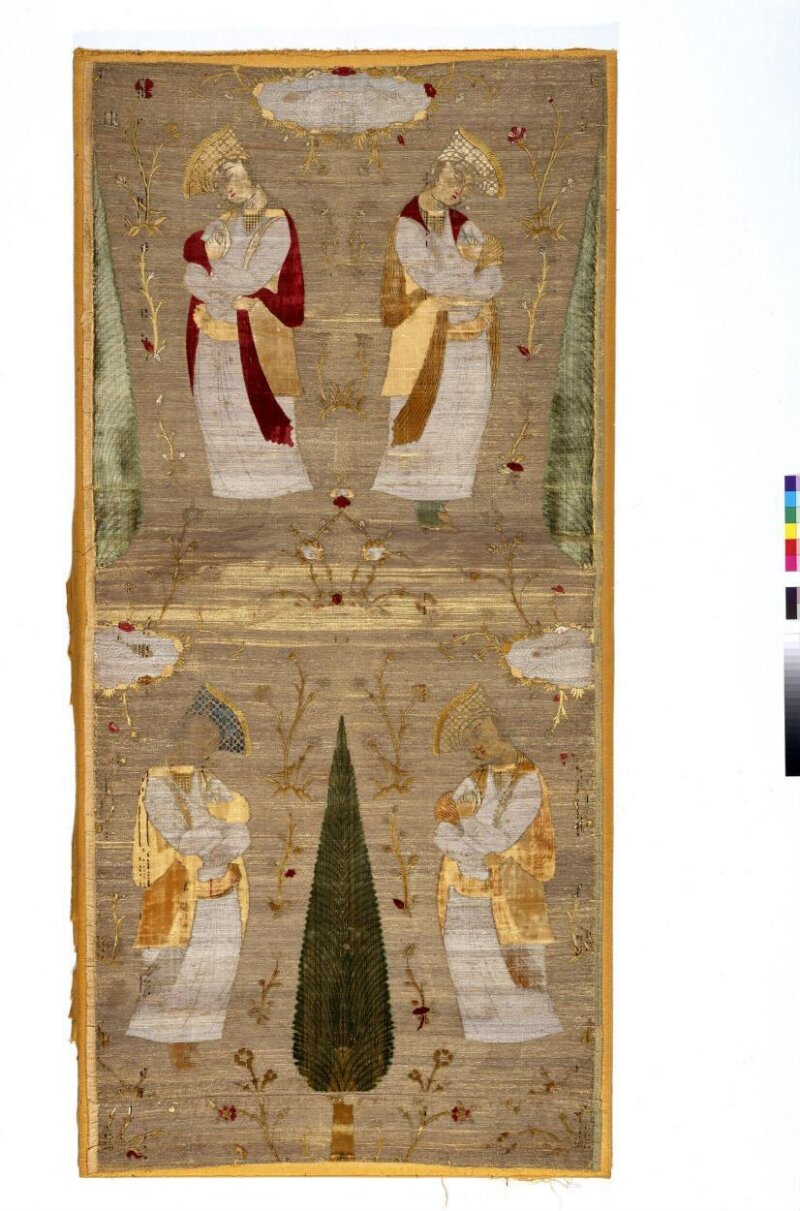
Couture Archaeology Report: Safavid Velvet & The 2026 Silhouette
Subject: Technical Deconstruction of a Safavid Velvet Fragment (Circa 1580-1620 CE)
Origin: Isfahan, Iran, Safavid Empire
Analyst: Senior Textile Historian, Natalie Fashion Atelier
Purpose: To extract and translate historical material intelligence into a framework for the 2026 high-end luxury collection.
I. Technical Deconstruction: The Architecture of Opulence
The submitted fragment, though modest in scale, represents the apex of late 16th-century Persian textile engineering. This is not merely velvet, but cut voided velvet on a satin ground, often incorporating flat metallic thread (gilt-silver wire wound on silk) for additional patterning. The construction is a masterclass in controlled density and contrast.
The foundation is a silk satin ground (likely a 5- or 8-harness satin), providing a smooth, light-reflective base. Upon this, a supplementary set of warp threads (the pile warp) is introduced. The genius lies in the selective use of metal rods during weaving. Where a raised, plush pile is desired, the pile warp is woven over a rod, creating a loop. In the most luxurious iterations, these loops are then hand-cut to create the signature dense, luminous plush. In "voided" areas, the pile warp is strategically omitted or woven into the ground, allowing the satin to form the pattern's negative space. This results in a dramatic, tri-textural landscape: shimmering satin, matte flat-weave (often in a complementary silk), and the radiant, light-absorbing-and-releasing velvet pile.
II. Material Materiality: The Sensory Codex
The materiality of Safavid velvet is a multisensory language. Tactility is paramount. The hand moves across a topography of textures—the cool slip of the satin channel, the resilient crush of the velvet, the slight resistance of metallic couching. Visually, its color is not static. The pile, dyed with renowned Persian insect-based reds (kermes) or precious indigo, possesses a chromatic depth. Light angles alter its hue, creating a sense of movement and life, while the metallic threads provide sharp, luminous highlights. This creates a kinetic surface that interacts dynamically with ambient light and the wearer's motion.
Furthermore, the weight and drape are significant. These velvets were substantial, with a dignified, architectural drape that conveyed authority and permanence. The density of the weave and pile meant folds were deep and sculptural, not fluid or limp. The material spoke of wealth not just through ornament, but through its inherent physical presence and the profound resource investment (silk, metal, months of labor) in every square centimeter.
III. Translation: Principles for the 2026 Luxury Silhouette
The translation for Natalie Fashion Atelier lies not in pastiche, but in the abstraction of these core principles—tri-textural contrast, kinetic surfaces, and architectural drape—into a contemporary idiom. The 2026 luxury customer seeks depth, narrative, and intelligent materiality over mere logo-driven display.
IV. Proposed Technical & Aesthetic Pathways
A. Re-engineering the Tri-Texture: We must innovate beyond conventional velvet. Proposals include:
- Developing a bi-component velvet where the pile and ground are of different, high-tech fibers: a moisture-wicking, matte technical silk for the ground, with a contrasting, thermo-regulating cashmere-blend pile.
- Creating "voided" effects through laser etching and ultrasonic cutting on a modern velvet base, selectively removing pile to reveal a technical satin or a sheer mesh substrate beneath, achieving the historic contrast with precision and a new, lighter hand.
- Reinterpreting metallic threads as integrated fiber-optic micro-threads or piezoelectric yarns that respond to ambient sound or touch with a subtle luminescence, capturing the historic "light interaction" with future-facing technology.
B. Silhouette & Drape Translation: The Safavid architectural drape informs 2026's movement towards considered volume and clean, powerful lines.
- Structured Outerwear & Cocooning Shapes: Reimagining the *qaba* (Persian coat) as a minimalist, oversized velvet blazer or a cocoon coat where the weight and fall of the fabric create a personal, sculptural space. Seams can be placed to channel the flow of pile direction, creating light-play across the body.
- Columnar & A-Line Gowns: Eveningwear that uses the material's inherent body to create strong, columnar silhouettes. A voided velvet pattern, translated through laser techniques, could create a vertical, elongating motif on a gown, with cut-velvet accents at the shoulders or cuffs providing tactile focal points.
- Separates with Tactile Dialogue: A satin bias-cut skirt (the ground) paired with a tailored, high-neck velvet top (the pile). The separation of the historic composite fabric into distinct garments creates a modern, intelligent interplay of textures.
C. Color & Pattern Abstraction: Move from literal floral *boteh* (paisley) motifs to their underlying principles. Abstract the essence of the scrolling vine into fluid, algorithmic patterns derived from natural growth codes, rendered in the voided velvet technique. The historic chromatic depth can be achieved through over-dyeing and ombré techniques on the cut pile, or by using yarns spun from pre-dyed fibers to create unparalleled richness.
V. Conclusion: The Archetype Reborn
The Safavid velvet fragment is a testament to a philosophy where material, technique, and surface are inextricably linked to form a language of power and beauty. For the 2026 collection, this archetype is reborn. By deconstructing its technical DNA—the textural triad, the kinetic interaction, the substantive drape—and re-synthesizing it through contemporary craftsmanship and smart materials, Natalie Fashion Atelier can propose a new luxury. This is a luxury defined by tactile intelligence, luminous depth, and silent, architectural presence, directly descended from the looms of Isfahan but speaking unequivocally to the future of desire.