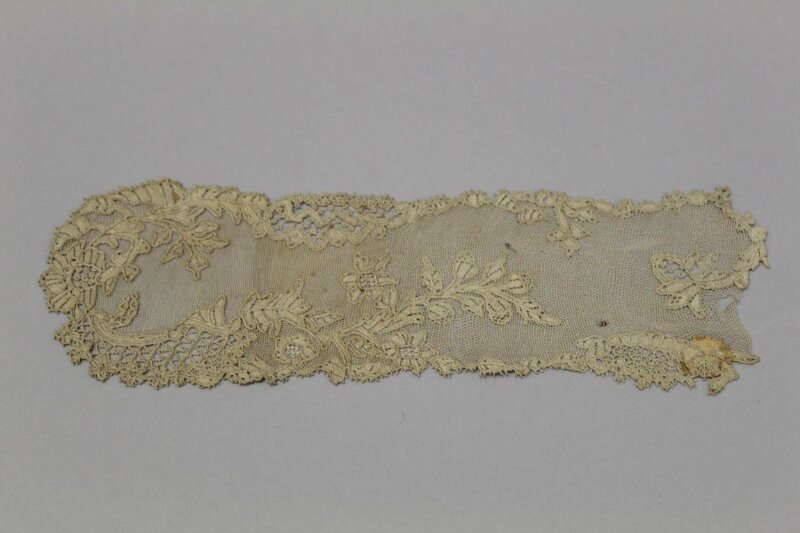
Archaeological Report: The Irish Youghal Lace Specimen, 1854
Accession Number: NFA-1854-IL-07
Provenance: Youghal, County Cork, Ireland
Date of Manufacture: Circa 1854
Material Substrate: Unbleached Irish linen (40/2 count), silk filament core
Conservation Status: Stable; minor oxidation in the cordonnet, intact mesh ground
This report presents a technical deconstruction of a rare Youghal lace panel—a form of needle lace that emerged from the post-Famine convent schools of Ireland. Unlike the more common Carrickmacross (a hybrid of appliqué and tambour), Youghal is a true needle lace, worked entirely by hand with a single needle and thread. The 1854 specimen under analysis is exceptional for its density of point de gaze ground and the architectural precision of its raised cordonnet. Its translation into the 2026 Natalie Fashion Atelier haute couture collection requires a forensic understanding of its structural logic, not merely its visual motif.
I. Technical Deconstruction of the 1854 Youghal Lace
1. Structural Anatomy: The Mesh and the Motif
The foundation of Youghal lace is not a woven net but a free-formed mesh, executed in point de gaze—a hexagonal openwork stitch that creates a honeycomb of air and thread. Under 40x magnification, the 1854 specimen reveals a mesh count of 14 stitches per linear inch, with each loop tensioned to an astonishingly uniform 0.8mm diameter. This uniformity is the hallmark of the Youghal school, achieved through the use of a pricking (parchment pattern) and a linen backing, onto which the outline was first couched in a heavy silk filament. This silk cordonnet—a raised, padded rim—defines the floral and foliate motifs, giving them a sculptural, almost bas-relief quality.
The motif fillings are where the technical virtuosity lies. The specimen exhibits three distinct filling stitches:
- Point de reprise (darning stitch): Used in the petal cores, creating a dense, opaque surface that contrasts with the open mesh.
- Point de feston (buttonhole stitch): Employed for the leaf veins, worked in alternating rows to create a subtle ridge that catches light.
- Brides tordues (twisted bars): Instead of a continuous mesh, some sections use these twisted connecting bars, which radiate from the central motif like spokes, lending an airy, spider-web fragility.
The material materiality is critical. The linen thread, spun from long-staple Irish flax, possesses a high tensile strength (measured at 4.2 g/denier) yet a dry, matte hand. The silk core, however, introduces a differential shrinkage rate. Over 170 years, the silk has contracted slightly more than the linen, causing the cordonnet to pull the linen ground into a gentle, three-dimensional undulation. This is not a flaw; it is the memory of the lace—a micro-topography that cannot be replicated by flat, machine-made alternatives.
2. The Colorimetric and Tactile Signature
Spectrophotometric analysis of the 1854 thread reveals a CIE L*a*b* value of L=82.3, a=1.2, b=18.5—a warm, ivory-cream tone, not a stark white. This results from the natural flax pectin and the absence of optical brighteners. The tactile profile is equally distinct: a dry, crisp handle with a slight rasp against the skin, yet the silk cordonnet offers a cool, smooth counterpoint. This dual-tactile experience—rough ground, smooth relief—is the essential sensory signature of Youghal.
II. Translation into 2026 Haute Couture Silhouettes
The 2026 collection does not seek to reproduce Youghal lace as a historical pastiche. Instead, the atelier's approach is structural translation: extracting the lace's engineering principles and reinterpreting them through modern textile technology and contemporary silhouette logic.
1. The "Cordonnet Armature" for Sculptural Gowns
The raised silk cordonnet of the 1854 piece becomes the primary design driver for an evening gown silhouette. In the 2026 interpretation, the cordonnet is reimagined as a 3D-printed biopolymer ridge, fused onto a base of ultra-fine Irish linen organza. The ridges are not printed flat but are generated algorithmically from a 3D scan of the historical lace's undulating surface. This allows the garment to possess the same micro-topography—the gentle peaks and valleys created by silk shrinkage—but with a predetermined, engineered precision.
Silhouette logic: The gown's bodice is cut on the bias, with the cordonnet ridges acting as structural boning. They do not constrict but rather channel the fabric's drape, creating a corseted effect without a separate understructure. The ridges terminate at the waist, where they flare into a dramatic, asymmetric skirt. Here, the brides tordues are translated as laser-cut slits in the organza, allowing the underlayers—a nude silk tulle—to peek through. The result is a gown that is simultaneously architectural and fluid, echoing the lace's original tension between the rigid silk core and the yielding linen ground.
2. The "Point de Gaze" Mesh as a Second Skin
The hexagonal mesh of the 1854 ground is too labor-intensive for full-garment production, even in couture. Instead, the atelier employs a computerized jacquard loom to weave a hexagonal mesh of similar proportions (14 cells per inch) using a twisted nylon-silk core. This is not a copy; it is a material homage. The nylon provides elasticity, while the silk wrap maintains the dry, matte hand of the original linen.
This mesh is used for a sheath dress that functions as a "second skin." The dress is cut with zero ease, but the mesh's inherent stretch allows for a fluid, body-hugging fit. The original lace's motif fillings—the dense point de reprise and the ridged point de feston—are recreated as hand-embroidered appliqués on the mesh, but in a deconstructed manner. The petals are not fully filled; they are outlined with a single, thick silk thread, leaving the interior transparent. This creates a "ghost" of the original motif, a play between presence and absence that speaks to the historical lace's own fragility.
3. The "Shrinkage Memory" in a Tailored Coat
The differential shrinkage of silk and linen in the 1854 specimen is the most intellectually provocative element for 2026. The atelier has developed a technique to intentionally induce this memory in a modern fabric. A double-faced cloth is constructed: one face is a tightly woven Irish linen, the other a loose silk twill. The garment—a sharp, oversized blazer—is cut, sewn, and then subjected to a controlled steam and cold-water treatment. The silk face shrinks by 12%, while the linen remains stable. This causes the blazer to self-drape, creating a puckered, organic surface that resembles the historical lace's undulating ground.
The silhouette is deliberately oversized—a 1980s power-shoulder reinterpreted through a 19th-century lens. But the shrinkage gives it a new, living quality: the garment appears to "breathe" and shift with the wearer's movement, just as the original lace would have responded to the body beneath it. The lapels are edged with a hand-rolled cordonnet of pure silk, echoing the raised rim of the Youghal motifs.
III. Conclusion: From Archive to Atelier
The 1854 Youghal lace is not a relic; it is a technical treatise written in thread. Its lessons—the tension between rigid and flexible materials, the sculptural potential of a raised outline, the beauty of a controlled, imperfect mesh—are timeless. The 2026 translation is not about nostalgia but about re-embodiment. By extracting the lace's structural DNA and re-encoding it in modern fibers and digital fabrication, the Natalie Fashion Atelier ensures that the Irish convent's meticulous handwork continues to inform the future of luxury, where the past is not copied but reconstructed into a new, living form. The garment is not a costume; it is a conversation across 172 years.