The Javanese Foliate Ring: An Aesthetic Archaeology of Chromatic Restraint
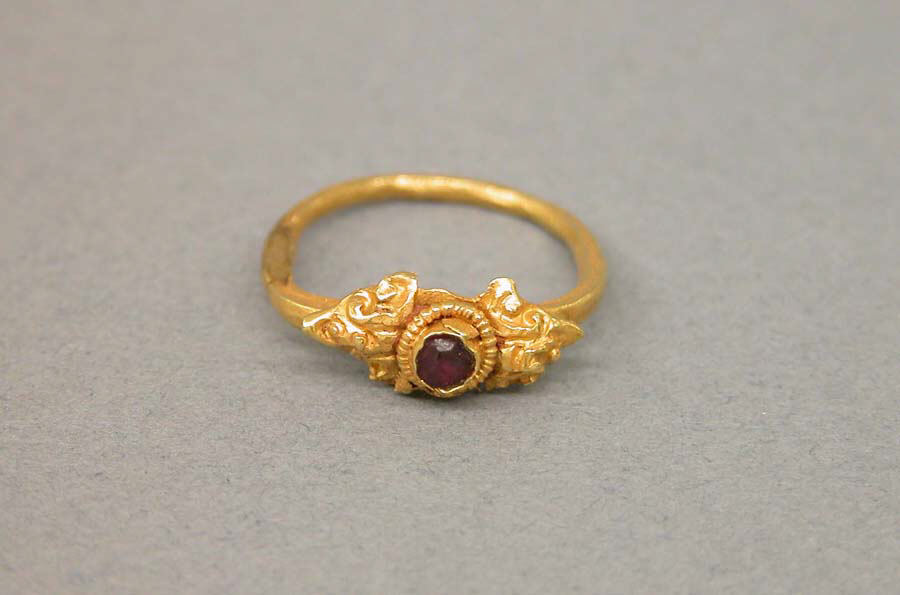
The artifact under examination—a gold ring set with a singular purple stone, encircled by foliate filigree—presents a compelling paradox for the contemporary couture house. Within the framework of aesthetic archaeology, this object is not merely a jewel but a compressed treatise on balance, material hierarchy, and the semiotics of color. Originating from the Javanese archipelago, its design language predates colonial interpolation, speaking instead to a sophisticated local understanding of negative space and organic geometry. For the 2026 silhouette, this ring offers a blueprint for moving beyond the current vogue for aggressive maximalism toward a more refined, internalized luxury—one that privileges chromatic isolation and structural tension over ornamental excess.
Material Dialectics: The Weight of Gold, The Whisper of Purple
In Javanese courtly tradition, gold (mas) functions as a cosmic metal, signifying the immutable and the divine. However, the ring’s genius lies not in the gold’s dominance but in its subordination to the stone. The purple hue—likely a spinel or amethyst—is not a loud proclamation but a concentrated focal point. This establishes a critical principle for 2026: the primary material must serve as a sonic chamber for the accent. The haute couture translation is immediate. We are moving away from all-over embellishment toward a silhouette that utilizes structural fabric—heavy duchesse satin or sculpted faille—in a monochromatic shell, only to introduce a single, violent slash of color at a precise anatomical juncture. The ring teaches us that the value of the purple stone is amplified by the sheer volume of unadorned gold surrounding it. Thus, the 2026 gown will feature vast expanses of untextured, matte silk, creating a 'gold field' against which a single jewel-toned panel—perhaps a deep violet train or a bodice insert—achieves maximum optical resonance.
Foliate Filigree as Structural Cartography
The foliate designs are not mere decoration; they are a map of tensile strength. The leaves and vines, rendered in delicate gold wire, do not obscure the stone but rather channel the eye toward it. This is a lesson in directional seam engineering. For the atelier, this translates to the use of appliqué and embroidery as a force vector, not as surface texture. In 2026, we will see seams that mimic this foliate logic—curved, organic darts that wrap the torso, guiding the gaze to a central 'stone,' which might be a sculptural bustier or a precisely placed cutout. The filigree’s openwork quality also suggests a new approach to opacity. The 2026 silhouette will incorporate strategic transparency—not for sensuality’s sake, but to create a sense of architectural depth. Laser-cut leather or horsehair braid, arranged in leaf-like patterns over a contrasting underlayer, will replicate the ring’s ability to be solid yet visually permeable.
Chromatic Isolation: The 2026 Purple Protocol
Purple, in the Javanese context, is a color of transition—the twilight hour, the space between the mundane and the spiritual. The ring’s use of this single stone suggests a rigorous editing process. For the 2026 collection, we propose the 'Purple Protocol': the strict limitation of high-chroma hues to one, and only one, element per look. This is a direct counterpoint to the digital-era tendency toward visual noise. The silhouette becomes a study in restraint. A column gown in ivory wool crepe, cut with severe precision, gains its entire narrative from a single amethyst-toned opera glove or a pair of violet silk boots. The foliate ring informs this by proving that the most potent luxury is the confidence to stop. The gold-to-stone ratio becomes a design equation: 80% neutral, 20% narrative color, with the latter placed at the point of highest kinetic energy—the wrist, the nape, the ankle.
Silhouette Translation: From Finger to Frame
Deconstructing the ring’s profile—a low dome with a raised center—yields a direct architectural principle for the 2026 shoulder and hip. The ring’s silhouette is convex yet grounded. We will see this in the reintroduction of the basque waist and the peplum, but executed with a new rigidity. The hip will be extended not with padding, but with structural under-layers of molded coutil and horsehair, creating a smooth, unbroken curve that mimics the ring’s band. The 'stone'—the purple element—will rise from this base like the ring’s central gem, perhaps as a high collar or a sculptural shoulder piece that appears to float above the gold-toned base fabric. This is not a nostalgic revival; it is a biomimetic adaptation of a historical object’s ergonomics to the human frame.
Conclusion: The Archaeology of Future Elegance
The Javanese ring, isolated from its original context, functions as a pure design algorithm. It teaches that elegance is not the accumulation of detail, but the orchestration of focus. As we project toward 2026, the Natalie Fashion Atelier will adopt this principle as a foundational ethos. The silhouette will be defined by its negative space, its material honesty, and its disciplined color narrative. The gold is the garment; the purple stone is the gesture. The foliate is the invisible engineering that connects the two. In this, the ancient ring becomes the most modern of muses, proving that true couture innovation often lies dormant in the artifacts of the past, awaiting a new hand to release its structural poetry.