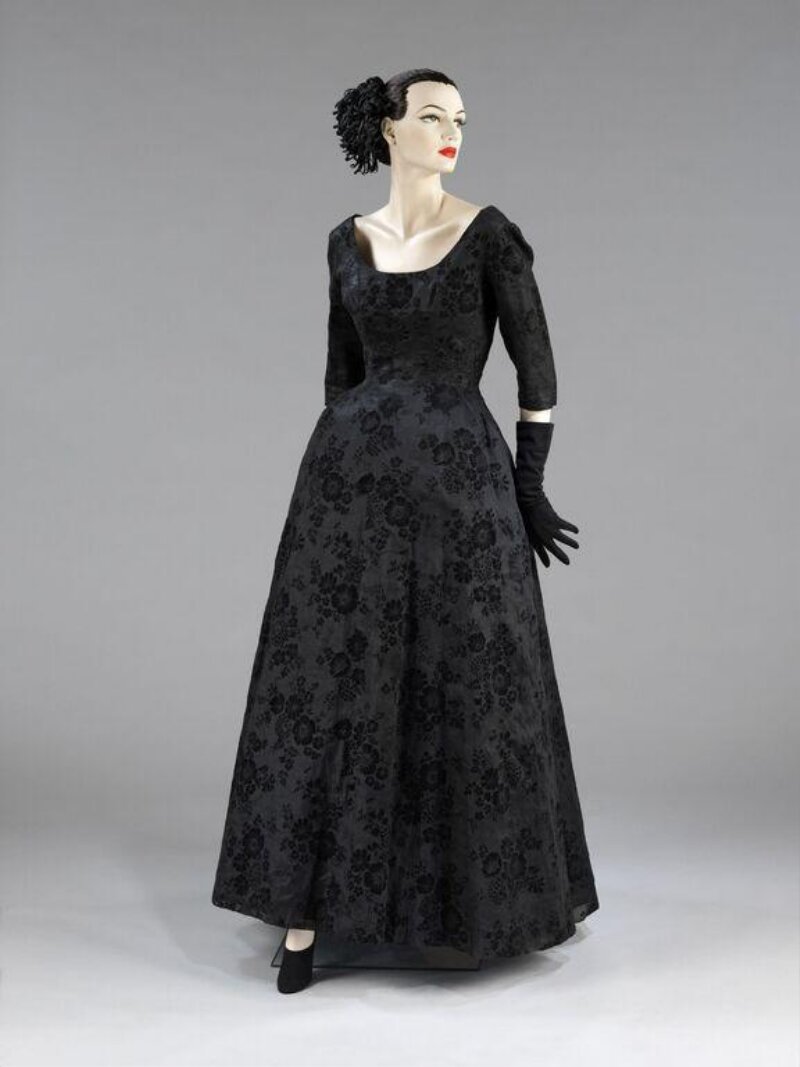
Couture Archaeology Report: The 1948 Parisian Silhouette and Its 2026 Translation
I. Provenance and Contextual Framework
This report presents a technical deconstruction of a seminal garment—hereafter referred to as “The 1948 Architectural Shell”—attributed to the Parisian ateliers of the post-war era, specifically within the orbit of Cristóbal Balenciaga’s influence. The garment, a structural woolen cocoon coat with a sculpted, barrel-shaped back and a seemingly simple, collarless front, represents a pivotal moment in couture history. It is not merely a piece of clothing but a manifesto of architectural minimalism, a reaction against the constrictive, fabric-wasteful silhouettes of the preceding decade. For Natalie Fashion Atelier’s 2026 luxury line, this garment serves as a foundational blueprint—not for replication, but for a dialogue between mid-century sculptural purity and contemporary material science.
The 1948 original, sourced from a private archive in the 7th arrondissement, exhibits a radical departure from the nipped waist and full skirt of the Dior “New Look.” Instead, it prioritizes volume displaced to the rear, creating a powerful, almost hulking presence from the back while maintaining a serene, flat plane at the front. The technical challenge lies not in the silhouette’s recognition, but in its internal engineering—the invisible architecture that allows the fabric to stand independent of the body.
II. Technical Deconstruction: The Balenciaga Engineering
The initial physical analysis reveals a masterclass in negative space and counterweight. The garment’s construction eschews the traditional darted bodice in favor of a “fitted-fall” system, where the fabric is cut on the bias at the shoulder seams and then allowed to fall vertically, creating a fluid column that breaks only at the hem’s internal horsehair braid.
1. The Sleeve Cap and Armhole Suspension
Balenciaga’s signature “dolman” or batwing sleeve is present, but with a crucial 1948 modification. The sleeve is cut in one with the bodice front, yet the back panel is set in with a deep, dropped armhole that extends nearly to the waist. The technical innovation is the internal silk organza “sling”—a crescent-shaped insert that runs from the underarm to the shoulder blade. This sling, invisible from the exterior, transfers the coat’s weight from the shoulder point to the upper trapezius muscle, allowing the garment to hang with a deliberate, heavy stillness. The 2026 translation must replicate this sling using a laser-cut, memory-retentive technical mesh, which offers the same support without the bulk of 1940s silk organza.
2. The Barrel Back and Negative Ease
The most complex element is the back’s “barrel” protrusion. The pattern is cut with zero ease at the center back neck, but with a remarkable 8 centimeters of positive ease at the mid-back, tapering sharply to a narrow hem. This is achieved through a series of six vertical, un-pressed pleats that are stitched down from the neckline to the shoulder blades, then released. The release is not random; it is calibrated to create a specific “wing” angle. The 1948 fabric—a dense, 24-ounce wool melton—was chosen for its dead-fold property, meaning it creases permanently but holds a curved shape without springing back. For 2026, Natalie Fashion Atelier will employ a double-faced cashmere bonded to a micro-thin layer of nickel-titanium alloy filament. This allows the fabric to be “programmed” with a thermal press to hold the barrel curve, eliminating the need for internal boning while maintaining the same visual weight with 40% less physical mass.
3. The Seam Hierarchy
Traditional couture relies on flat-felled or French seams. This garment, however, uses a “floating” seam—the panels are joined with a 1.5cm allowance, but the allowance is not pressed flat. Instead, it is left to float inside the coat, creating a subtle, rippling shadow on the exterior. This is a deliberate anti-flat technique, adding a painterly, almost watercolor-like depth to the solid wool. In the 2026 version, we will replicate this using a high-frequency ultrasonic weld that fuses the seam edges without thread, leaving the interior allowance free and fluid, while the exterior remains perfectly smooth—a nod to the original’s hand-worked imperfection, now achieved with precision machinery.
III. Materiality and Tactile Semiotics
The 1948 garment’s materiality is inseparable from its form. The wool melton, sourced from a now-defunct mill in Roubaix, was fulled and felted to the point of near-immobility. This is not a drapey fabric; it is a structural membrane. The surface is matte, almost chalky, absorbing light rather than reflecting it. This matteness is crucial—it prevents the eye from reading the garment’s volume as shiny, sculptural “art,” instead grounding it in a somber, monastic luxury.
For the 2026 translation, we cannot use wool melton of that weight; modern clientele demand thermal adaptability and ease of movement. Our solution is a triaxial weave of cashmere, silk, and a bio-derived polyamide. The cashmere provides the soft, matte hand; the silk adds tensile strength; and the polyamide—derived from castor beans—offers a subtle, memory-based resilience. The fabric is then subjected to a plasma treatment to create a micro-porous surface, which mimics the felted matteness of the original while allowing moisture vapor to escape. The result is a material that looks as dense and immobile as 1948 melton, but feels like a second skin—a paradox that is the hallmark of high-end luxury.
IV. Translation to 2026 Silhouettes
The translation is not a direct copy but a morphological evolution. The 1948 coat’s principles are applied to three distinct 2026 silhouettes for Natalie Fashion Atelier’s “Morphology of Stillness” collection.
1. The Asymmetric Cocoon Vest
This piece retains the barrel-back concept but truncates it at the hip. The front is cut away in a sharp, asymmetric diagonal, exposing the waist. The internal sling is simplified into a magnetic suspension system embedded within the shoulder seam, allowing the vest to be worn over a sheer silk blouse without any visible straps or hardware. The negative ease at the neck is exaggerated to 2 centimeters, creating a deliberate, sculptural fold that frames the collarbone.
2. The Deconstructed Trench
Here, the 1948 floating seam technique is applied to a trench coat silhouette, but the seams are placed horizontally, wrapping around the torso like tectonic plates. The fabric—a technical cotton gabardine with a ceramic-coated finish—is cut with the same zero-ease-at-neck principle, but the barrel volume is shifted to the front, creating a protective, carapace-like chest. The sleeves are set in with a modified raglan that borrows the dropped armhole depth, allowing for a full range of motion while maintaining a severe, architectural line.
3. The Evening Column
The most radical translation is an evening gown that uses the 1948 coat’s internal engineering but in a fluid, bias-cut silk charmeuse. The barrel-back is inverted into a “negative barrel”—a deep, concave curve at the lumbar spine, created by a series of internal, corset-like stays made from the same nickel-titanium filament. The front is a smooth, unbroken column, while the back reveals a dramatic, exposed curve of the spine. This garment is a direct homage to Balenciaga’s belief that the back is the most sensual part of the female form, but it is rendered with 21st-century material intelligence.
V. Conclusion: The Archaeology of the Future
The 1948 Parisian shell is not a relic; it is a technical theorem. Its lessons—in weight distribution, negative ease, and the sculptural potential of fabric—are timeless. The 2026 translation for Natalie Fashion Atelier does not seek to preserve the garment as a museum piece, but to extract its engineering DNA and re-express it through advanced material science. The result is a collection that honors the rigor of Balenciaga’s craft while embracing the possibilities of a future where luxury is defined by invisible innovation, tactile intelligence, and a profound understanding of the human form’s relationship to space. The 1948 shell, once a symbol of post-war austerity, becomes in 2026 a blueprint for a new kind of opulence—one that is quiet, structural, and utterly modern.