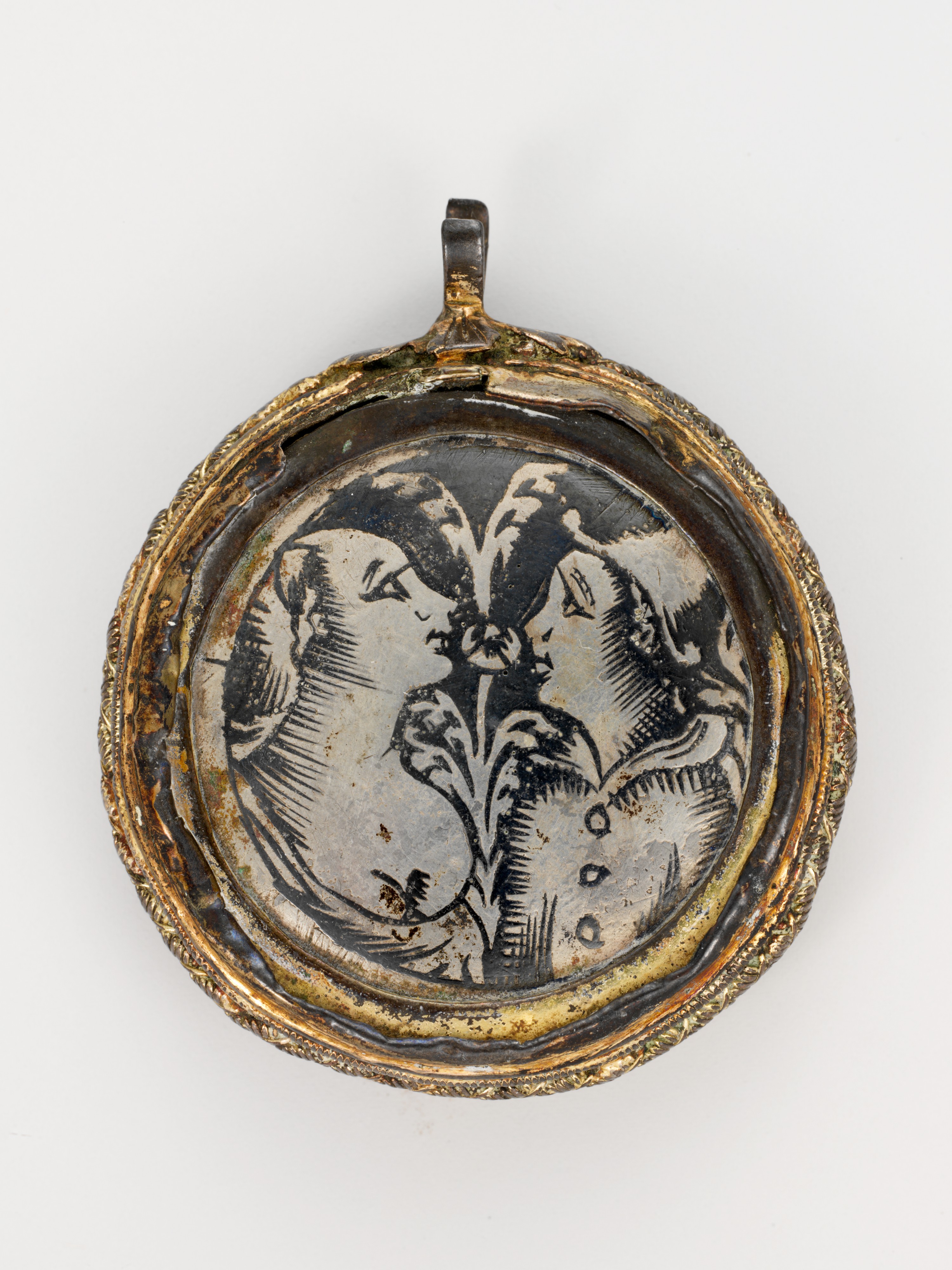
Deconstructing the Niello Pendant: An Aesthetic Archaeology for 2026 Silhouettes
Within the hushed archives of Natalie Fashion Atelier, the study of a singular artifact—a pendant of silver, niello, and gilt silver—offers more than a historical footnote. It presents a masterclass in material dialectics and structural restraint. Isolated from its original cultural context, this object of Global Heritage operates as a pure signifier of craftsmanship, its visual language transcending geography to speak directly to the contemporary couture ethos. For the 2026 season, this pendant is not merely an inspiration; it is a technical blueprint. Its interplay of matte darkness and luminous gilding, its dense ornamental core, and its suspended weight inform a new architectural approach to the female form, one defined by controlled opacity, strategic luminosity, and sculptural gravity.
Material Dialectics: The Niello Principle in Fabrication
The pendant’s primary aesthetic power derives from the violent contrast between its materials. Niello—a black metallic alloy of sulfur, copper, silver, and lead—is inlaid into the incised silver ground, creating a surface of profound depth. This is not a printed pattern; it is a negative space carved into positivity. The 2026 silhouette translates this technique through a radical reimagining of fabric manipulation. We move away from surface-level embellishment toward integrated textile architecture.
From Etching to Embroidery: The Shadowed Ground
The couture atelier will employ a technique we term inverse broderie. Instead of adding thread to a base cloth, we will remove and compress. Using high-density viscose and matte silk faille, artisans will cut away layers to create recessed channels, which are then filled with a micro-beaded, almost granular, black jet. This is not embroidery in the traditional sense; it is metallurgical inlay applied to cloth. The resulting fabric possesses a chiaroscuro effect, where light is absorbed by the jet-filled recesses and reflected by the raised, unadorned silk. This directly mirrors the niello’s absorption of light against the silver’s reflection. For 2026, the primary evening dress silhouette will be a column of this fabric, its surface a topographical map of light and shadow, creating a monolithic yet deeply textured presence.
Gilt Accents: The Strategic Placement of Lustre
Where niello provides the shadow, gilt silver provides the illumination. The pendant uses gilding not as a full coverage, but as a precise accent—a highlight on a specific motif, a thin border, a delicate filigree. This principle of selective luminosity is paramount. In our 2026 construction, this translates to the strategic placement of metallic thread and polished metal mesh. We will not gild the entire garment. Instead, a liquid gold lamé will be used as a structural underlay, visible only through deliberate slits and engineered gaps in the dark outer shell. The effect is a kinetic reveal—as the wearer moves, the gilt flashes from within the niello-like darkness, creating a sense of interior wealth and hidden power. This is a departure from overt opulence; it is an elegance of concealment and revelation, a nod to the pendant’s intimate scale.
Structural Grammar: The Pendant’s Suspension and Weight
Beyond its surface, the pendant’s physical construction informs the silhouette’s drape and balance. The object is designed to hang, its weight distributed from a single point of suspension. This creates a specific tension in the chain or cord, a vertical pull that elongates the neck and torso. The 2026 collection will exploit this principle through a radical rethinking of the neckline and the upper back.
The Suspended Collar: A New Architectural Neckline
We are developing a signature silhouette called La Suspension. This is not a collar that rests on the shoulders, but one that appears to be hung from the nape of the neck. Constructed from a rigid, corseted structure of horsehair canvas and boning, the collar is anchored at a single, central point at the back, mirroring the pendant’s bail. From this anchor, the structure flares forward, creating a dramatic, open frame around the décolletage. The fabric of the dress is then attached to this frame, falling with a weight that mimics the pendant’s gravitational pull. The result is a silhouette that stands away from the body, creating an aura of negative space between the fabric and the skin. This is not a dress that clings; it is a dress that is suspended, its movement dictated by the architecture of its own weight.
Asymmetrical Gravity: The Off-Center Fall
Observing the pendant’s design, one notes the intentional asymmetry in its ornamentation. The heavier motifs are not centrally balanced; they pull the eye to one side, creating a dynamic tension. This principle of off-center gravity will define the 2026 daywear silhouette. We will construct a tailored jacket where the entire volume is shifted to one shoulder. The opposite side will be cut clean and close to the body, creating a severe, minimalist line. This is not a casual asymmetry but a calculated imbalance, a deliberate architectural choice that forces the viewer to engage with the garment’s structure. The jacket’s lapel will be treated as a niello field, with a dark, matte wool base and a single, sweeping line of gilt metal piping that cascades from the high shoulder down to the hip, echoing the pendant’s central filigree.
Ornamental Density: The Motif as a Macro-Structure
The pendant’s intricate, dense ornamentation is not merely decorative; it is a structural component. The niello and gilt patterns create a rigid, cohesive surface that gives the object its form. Translating this to a human scale requires a shift from micro-embellishment to macro-patterning.
Geometric Purity and the Illusion of Complexity
Upon deconstruction, the pendant’s complex pattern reveals a foundation of simple, repeating geometric shapes—interlocking circles, stepped diamonds, and linear bands. The complexity is an illusion of accumulation, not a chaos of forms. For 2026, we apply this logic to the construction of a full-length opera coat. The coat’s silhouette is a simple, severe A-line. However, its surface is constructed from hundreds of individual, laser-cut panels of leather and suede, each one a geometric shape. These panels are then assembled in a mosaic-like configuration, with matte black suede (the niello) and polished, metallic leather (the gilt) interlocking to form a pattern that appears infinitely complex from afar but is rigorously logical up close. This approach creates a garment of immense visual weight and presence, a true object of couture, rather than a simple piece of clothing.
Negative Space as a Luxury Material
Finally, the pendant teaches us that the space between the elements is as important as the elements themselves. The incised lines of the niello are voids, yet they define the silver’s form. In 2026, negative space becomes our most precious material. We will employ surgical cutouts in unexpected places—a precise, circular aperture at the small of the back, a linear slit along the forearm. These are not sensual reveals in the traditional sense; they are architectural voids that allow the garment to breathe and to interact with the body’s movement. They are the modern equivalent of the niello’s dark lines, cutting through the silver surface of the fabric to define its true form. This is the ultimate luxury: the confidence to remove, the mastery of restraint, and the understanding that true elegance lies in the dialogue between what is shown and what is deliberately, exquisitely, withheld.