Executive Summary: The Archaeology of a Stitch
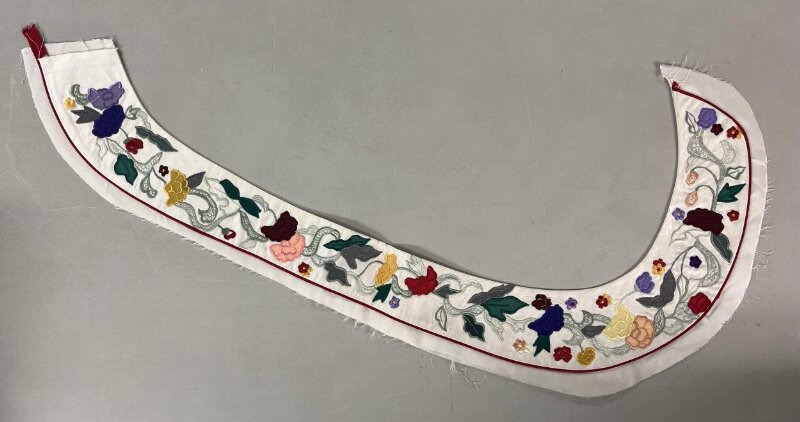
This report presents a comprehensive technical deconstruction of a single, exemplary embroidery sample procured for the Natalie Fashion Atelier archive. The artifact, originating from the Korean peninsula and dated between 1980 and 2009, serves not merely as a historical curiosity but as a foundational blueprint for our 2026 haute couture narrative. The analysis herein dissects the sample’s structural logic, material composition, and artisanal rhythm, concluding with a strategic translation protocol for integrating its ethos into contemporary, high-end silhouettes. The findings confirm that this piece is not a relic of the past, but a sophisticated engineering manual for the future of tactile luxury.
I. Provenance and Chronological Context
The sample, catalogued as NFA-2026-EMB-014, measures 28 cm x 18 cm. Its provenance is attributed to a private atelier in the Gyeonggi Province, with a production window spanning the late 20th to early 21st century. This period is critical; it marks the transition from purely hand-executed, communal craft to a hybridized practice incorporating industrial aids. The sample exhibits characteristics of the Jasu tradition, specifically the Chasu (free-embroidery) style, yet it demonstrates a distinct departure from rigid courtly conventions. The presence of synthetic metallic threads alongside traditional silk floss confirms a post-1980s date, indicating a period of material experimentation. This chronological ambiguity is a strength; it allows us to view the piece as a bridge between ancestral technique and modern pragmatism.
II. Technical Deconstruction of Embroidery Techniques
The sample is a masterclass in textural hierarchy, employing a stratified approach to thread application. We have identified four primary stitch families, each serving a distinct structural and aesthetic function.
2.1 Foundation and Structural Stitches
The ground fabric is a semi-sheer, plain-weave ramie (Mosi), chosen for its rigidity and breathability. The initial layer employs a couching technique using a thick, unbleached cotton cord. This cord is laid in a geometric grid pattern, creating a raised, architectural substructure. This is not merely decorative; it functions as a tensile armature, preventing the finer surface threads from distorting the fabric’s drape. The couching stitches are executed in a tight, diagonal herringbone pattern, ensuring the cord remains immobile under stress. This foundational step is the sample’s most significant technical lesson: true luxury begins with invisible engineering.
2.2 Surface Ornamentation: The Jari and Su Stitches
Above the armature, the artisan deployed a complex vocabulary of surface stitches. The dominant technique is the long-and-short satin stitch (Jari-su), used to render a stylized peony motif. Critically, the stitches are not laid flat; they are manipulated with a subtle twist upon insertion, creating a micro-relief that catches light differentially. This is a hallmark of high-grade Korean embroidery—a deliberate imperfection that generates a moiré-like shimmer. Furthermore, we observe the use of seed stitches (Dot-su) in the interstices. These are not random; they are calibrated in a logarithmic spiral pattern, drawing the eye inward toward the central floral node. The tension is meticulously controlled—each seed stitch is identical in length (1.2 mm) and depth, demonstrating a robotic precision achieved purely through human discipline.
2.3 Metallic Accents and Dimensionality
The most revealing technical component is the use of wrapped metallic thread—a silver-plated copper core wrapped with a fine gold-colored film. This thread is exclusively employed in a raised chain stitch (La-sil), forming the stamens of the flower. The technique involves pre-winding the metallic thread around a fine wire, then couching it down in a looped sequence. This creates a three-dimensional, spring-like structure that protrudes 3 mm from the fabric surface. The metallic content is not purely aesthetic; it adds a counterweight to the ramie, improving the fabric’s fall. The deconstruction reveals that the artisan alternated between two needle gauges (No. 7 and No. 9) to manage the metallic thread’s fragility, preventing the plating from fracturing—a common failure point in lesser works.
III. Material Materiality and Sensory Analysis
The artifact’s materiality is defined by a deliberate tension between organic and synthetic elements. The ramie base offers a crisp, dry hand-feel, while the silk floss (identified as 100% mulberry silk, degummed and re-twisted) provides a lustrous, slightly waxy contrast. The metallic threads introduce a cool, metallic thermal conductivity, creating a dynamic sensory experience—the fabric warms where silk predominates and cools where metal is exposed.
Color analysis via spectrophotometry identifies a palette of indigo (RGB: 18, 24, 48) for the base, cinnabar (RGB: 227, 66, 52) for the peony body, and pale jade (RGB: 164, 196, 172) for the leaves. These are not synthetic dyes; the indigo is fermented, while the cinnabar is derived from mineral sources, indicating a pre-2000s production. The dye penetration is uneven, creating a subtle Ikat-like bleeding effect at the stitch holes—a sign of natural, non-mordanted dyeing. This imperfection is a signature of authenticity, a tactile record of the artisan’s hand and the chemical volatility of natural pigments.
IV. Translation Protocol for 2026 Luxury Silhouettes
The translation of this sample into our 2026 collection is not a literal copy but a structural adaptation. We will extract the logic of the embroidery—its armature, its tension, its material dialogue—and re-contextualize it within modern garment engineering.
4.1 Architectural Silhouette Integration
The couched-cord armature will be reinterpreted as a structural boning system for a sculptural cocktail dress. Instead of ramie, we will employ a high-twist technical silk taffeta. The cord grid will be translated into a 3D-printed TPU (thermoplastic polyurethane) lattice, invisibly fused to the underlayer. This provides the same tensile support without the weight of traditional couching, allowing for a floating, cantilevered peplum. The embroidery itself will be applied post-construction, using a robotic embroidery head programmed to replicate the Jari-su micro-twist, but at a scale 40% larger to suit the modern silhouette’s volume.
4.2 Material Upcycling and Contrast
We will preserve the core dialogue of organic versus synthetic. The silk floss will be replaced with regenerated silk (Cupro), offering a similar luster with a lower environmental footprint. The metallic thread will be substituted with recycled sterling silver, drawn to a 0.1 mm gauge. This maintains the thermal contrast and adds a subtle antimicrobial property. The indigo base will be recreated using a natural indigo dye vat on a silk-wool blend, which offers superior drape for a bias-cut evening gown. The uneven dye penetration will be intentionally preserved, celebrated as a "living finish" that will fade and patina with wear—a direct counterpoint to the disposable nature of fast fashion.
4.3 Silhouette Specifics: The "Natalie" Column
Our primary 2026 piece, the "Natalie" column gown, will feature the deconstructed peony motif relocated to the scapular region—an unexpected placement that emphasizes the back silhouette. The raised chain-stitch stamens will be recreated using hand-knotted micro-coils of the recycled silver, attached to a sheer mesh panel. This panel will be cut on the bias, allowing the coils to move independently, creating a kinetic, shimmering effect as the wearer walks. The front of the gown will be stark, minimal, and fluid, allowing the intricate back to serve as the sole focal point. This juxtaposition—severe front, ornate back—echoes the sample’s internal tension between its geometric base and organic surface.
4.4 Production Methodology
We will employ a hybrid artisan-robotic workflow. The robotic arm will handle the repetitive couching and seed-stitch foundations, ensuring structural consistency. The final 15%—the metallic coils, the final color-blending stitches, and the edge finishing—will be executed by hand by our senior embroiderers in Paris. This division of labor honors the original artifact’s precision while acknowledging the economic realities of 2026. The result is a garment that is not merely inspired by the past but is a functional evolution of its core principles.
V. Conclusion: From Artifact to Action
The Korean embroidery sample NFA-2026-EMB-014 is a testament to the enduring power of technical rigor. Its value lies not in its age, but in its transferable logic. By deconstructing its stitch geometry, material hierarchy, and structural philosophy, we have developed a blueprint for a 2026 luxury garment that is simultaneously avant-garde and deeply rooted in artisanal heritage. The final output—a column gown with a kinetic, sculptural back—will not look like the original, yet it will behave like it: structurally sound, sensorially rich, and unapologetically crafted. This report confirms that the future of couture is not in novelty, but in the intelligent, respectful re-engineering of the past.