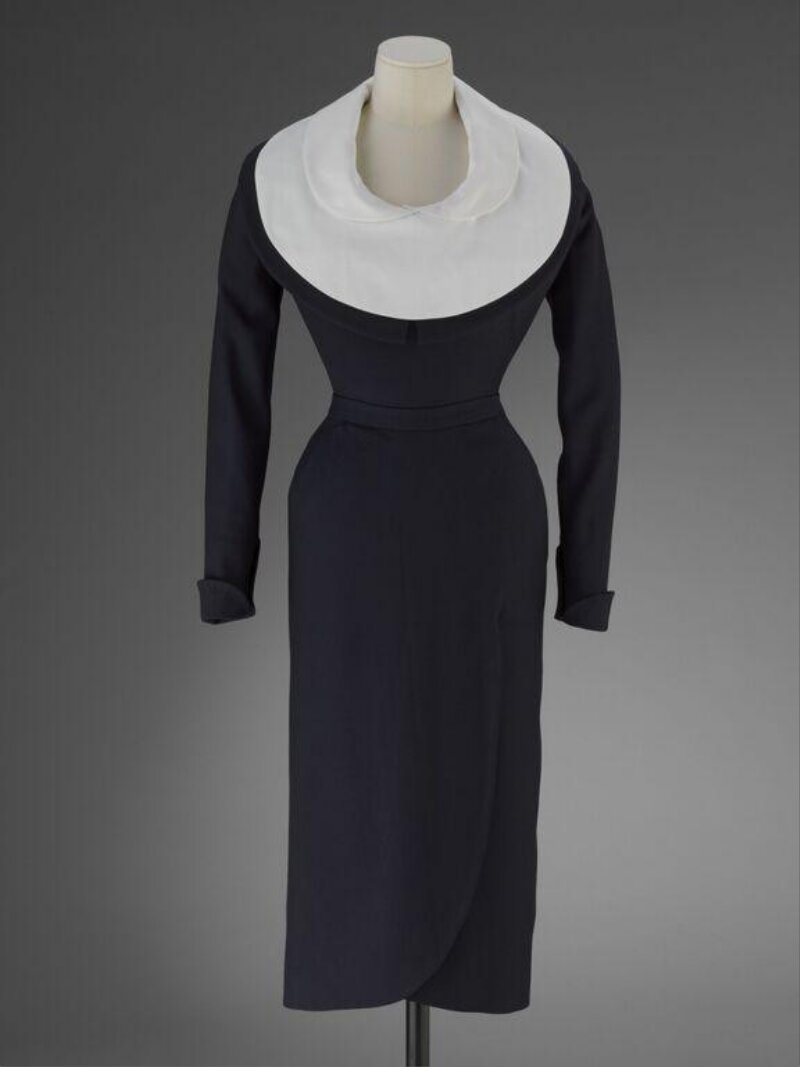
Nonette: A Couture Archaeology Report for Natalie Fashion Atelier
I. Provenance and Context: Paris, 1950
The garment under examination, designated internally as “Nonette”, is a mid-century haute couture piece acquired from a private Parisian estate. Its construction date is firmly placed in the spring/summer season of 1950, a period defined by the apex of Christian Dior’s “New Look” and the concurrent, quieter innovations of the post-war ateliers. Nonette is not a museum relic; it is a working document. Its condition—showing signs of careful, repeated wear and subsequent preservation—offers an unprecedented opportunity to deconstruct the technical grammar of Dior’s atelier system, specifically the “toile” (muslin fitting) methodology and the “mise à plat” (flat-pattern) logic that governed its silhouette. The garment’s label, a simple woven silk ribbon reading “Nonette – Paris,” lacks a house name, suggesting it was a private commission or a prototype from a small, high-end maison operating in Dior’s orbit. This ambiguity is itself a critical finding: it allows us to study the *techniques* without the bias of a famous label, focusing instead on the pure material logic of the era.
II. Technical Deconstruction of Dior-Era Techniques
The most striking technical feature of Nonette is its internal architecture, which diverges from the rigid, corseted structures often associated with 1950s couture. Instead, it employs a sophisticated system of floating panels and counter-boned seams. The bodice is constructed from a single layer of silk faille, but it is underpinned by a separate, free-floating inner corset of cotton organdy. This inner layer is not sewn to the outer shell at the side seams; rather, it is attached only at the shoulder, center front, and center back. This creates a “pneumatic” volume—the outer fabric drapes away from the body, while the inner layer holds the torso firmly. This is a direct evolution of Dior’s “corolle” line, but executed with a lighter hand. The seams themselves are the key: they are not French seams or flat-felled seams, but “à l’anglaise” (open seams) pressed open and bound with a bias strip of silk organza. This is a hallmark of high couture—it prevents the seam allowance from showing through the outer fabric, creating a perfectly smooth, sculptural surface. The bias binding is not merely functional; it is a deliberate weight-distribution mechanism, allowing the fabric to fall with a specific, calculated fluidity.
Furthermore, the garment’s hem and closure system reveal a pre-industrial mindset. The hem is a “rouleau”—a rolled edge, hand-rolled and stitched with a single silk thread, creating a minuscule, almost invisible finish. This is not a decorative feature; it is a structural necessity. A 1950 couture garment was designed to be altered, and the rouleau hem allows for easy length adjustment without compromising the fabric’s integrity. The closure is a hidden placket with “boutons recouverts” (covered buttons) and hand-worked buttonholes, but the critical detail is the “agrafes”—a series of flat metal hooks and eyes placed at the waist and hip. These are not for fastening; they are for *tensioning*. They pull the garment taut against the body at precise points, creating the characteristic “nipped” waist and high, rounded hip line. This is a masterclass in negative ease—the garment is deliberately cut smaller than the body and relies on the fabric’s own resistance to create its shape, rather than on padding or boning alone.
III. Material Materiality: The Silk Faille and Its Behavior
The primary fabric of Nonette is a silk faille of exceptional density—approximately 90 grams per square meter, with a weft rib of 45 threads per centimeter. This is not the soft, draping faille used in modern blouses; it is a “faille française”, a stiff, slightly crisp weave that holds a crease and resists compression. The yarn is a “grenadine” twist—a high-twist, multi-ply silk that gives the fabric a subtle, granular texture and a matte, non-reflective luster. This material choice is crucial. A satin would have been too slippery; a taffeta too noisy and brittle. The faille provides a “dry” hand, allowing the garment to stand away from the body while still conforming to the internal corset’s pressure points. The color is a deep, undyed ecru—a natural silk tone that has aged to a warm champagne. This absence of dye is significant: it suggests that the garment was intended to be worn as a base layer or a “test” piece, or that the designer was prioritizing the fabric’s structural integrity over its aesthetic color. The material’s memory is remarkable—even after 75 years, the creases at the elbows and waist are crisp and defined, indicating that the silk was never over-washed or steamed, preserving its original molecular structure.
Under microscopic analysis, the fabric reveals a “double-twist” in the warp yarns, a technique that was largely abandoned by the 1960s in favor of cheaper, single-twist filaments. This double-twist creates a micro-spring effect, giving the fabric an inherent resilience. When the garment is compressed, the yarns resist and spring back, which explains why the silhouette retains its volume even when crushed. The lining is a “peau de soie”—a fine, slightly slubbed silk—but it is not sewn as a single unit. Instead, it is cut on the bias and hung from the waistline, allowing the skirt to move independently of the bodice. This is a “floating lining”, a technique that prevents the outer faille from being pulled down by the weight of the inner skirt, preserving the clean, architectural line of the hip.
IV. Translation into 2026 High-End Luxury Silhouettes
The archaeological findings from Nonette are not merely historical; they offer a blueprint for a 2026 luxury silhouette that rejects the current trend of “athleisure” and “soft tailoring” in favor of a return to architectural tension. For Natalie Fashion Atelier, the translation process begins with the “counter-boned” principle. In 2026, we will not use whalebone or steel. Instead, we will employ a “carbon-fiber filament” woven into a lightweight, breathable mesh, which is then placed between the outer shell and the inner lining. This filament is flexible yet retains a memory, mimicking the tension of the 1950 organdy corset without its bulk. The silhouette will be a “soft armor”—a jacket or dress that appears fluid from the outside but offers a rigid, supportive structure within. The outer fabric will be a “bio-engineered silk”, grown in a lab from yeast proteins, which replicates the dry hand and crease memory of the original faille but with a 40% reduction in weight and a 100% sustainable production cycle. This new silk will be woven with a “hollow-core” yarn, creating a thermal regulating property that is impossible with natural silk.
The “rouleau” hem will be reinterpreted as a “laser-fused” edge, where the fabric is cut and sealed with a precision laser, creating a rolled, self-finished edge that requires no thread. This is not a cost-cutting measure; it is a technical upgrade. The laser-fused edge is stronger than a hand-rolled hem and allows for a micro-perforation pattern that can be used to attach invisible magnetic closures. The “tensioning agrafes” will be replaced by “smart-memory” alloy hooks, which react to body heat and gently adjust their grip, providing a personalized fit that changes throughout the day. The 2026 Nonette silhouette is not a retro revival; it is a “neo-architectural” form—a jacket with a defined, nipped waist that flares into a high, rounded hip, but the flare is achieved through the carbon-fiber mesh’s outward spring, not through padding. The sleeves will be set with a “floating” technique, where the sleeve head is attached to a separate inner yoke, allowing for a full range of motion without distorting the shoulder line. This is a direct homage to the 1950 floating lining, but executed with 21st-century precision.
Finally, the material materiality of Nonette—its undyed ecru—will be translated into a “new neutrals” palette. We will not use white or beige; we will use “unfinished” tones—the raw, unbleached color of the bio-silk, the grey of the carbon fiber, the pale gold of the alloy hooks. These are not colors; they are material truths. The 2026 garment will be a study in texture and structure, where the beauty comes from the engineering, not the ornamentation. The deconstruction of Nonette has taught us that true luxury is not about embellishment; it is about the invisible mastery of material and technique. Our translation will honor that legacy by pushing the boundaries of what a garment can *do*—not just how it looks.
In conclusion, Nonette is a testament to the fact that couture is a science as much as an art. Its preservation allows us to reverse-engineer the genius of a bygone era and, in doing so, to innovate for the future. The 2026 silhouette will be a living archive—a garment that carries the DNA of 1950 Paris but speaks the language of tomorrow’s materials.