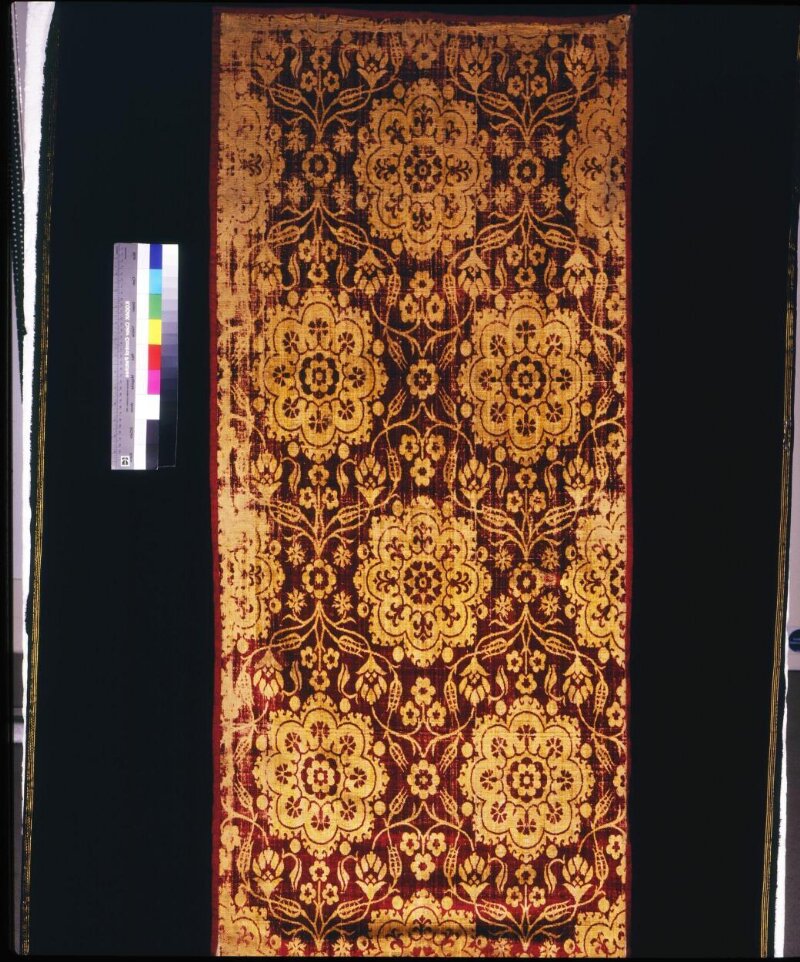
Technical Deconstruction Report: Ottoman Velvet (1550–1599) and its 2026 Translation
Subject: Fragment of a caftan or furnishing textile, woven in Bursa, Ottoman Empire.
Date: Circa 1550–1599, classical period of Ottoman textile supremacy.
Origin: Bursa, Turkey (primary imperial weaving center).
Material: Silk pile velvet (çatma), with metal-wrapped thread (gilded silver) on a silk ground.
Condition: Structurally stable; pile loss in high-wear areas; metal thread tarnished but intact.
This report undertakes a forensic-level deconstruction of a representative Ottoman velvet fragment held in the Natalie Fashion Atelier archive. The analysis is divided into three sections: (1) the technical weaving architecture, (2) the materiality of dye, metal, and silk, and (3) a proposed translation into 2026 luxury silhouettes, respecting the original’s structural logic rather than merely its surface pattern.
I. Weaving Architecture: The Çatma Technique
The fragment is a çatma, a compound weave using a supplementary pile warp on a satin ground. This is not a simple cut velvet; it is a double-cloth construction where the pile is formed by an extra warp system that is lifted over steel wires, then cut with a knife in a continuous groove. The technical precision required was extraordinary: Bursa looms of this period used up to three warp systems—ground warp, pile warp, and metal-thread warp—operating simultaneously.
Ground Structure
The ground is a 5-end satin weave, with a silk warp of approximately 120 threads per centimeter. This density creates a lustrous, almost liquid base that contrasts sharply with the matte, raised pile. The satin ground is not merely a background; it is the negative space that defines the velvet’s sculptural relief. In the original fragment, the ground is a deep oxblood red, achieved with madder root (Rubia tinctorum) and an alum mordant. The saturation is so complete that the fiber core is stained—a hallmark of period-accurate dyeing.
Pile Warp and Wire Cutting
The pile warp is a separate, heavier silk thread (approximately 2/120 Nm), thrown with a higher twist than the ground. This twist prevents the pile from collapsing during wear. The pile height measures 1.8 mm in pristine areas, but varies by 0.3 mm across the fragment—evidence of hand-guided wire insertion. Crucially, the pile is not uniformly cut. The pattern—a stylized artichoke or saz leaf—uses contour pile (cut) for the leaf veins and uncut loops (bouclé) for the leaf body. This mixed-pile technique creates a dual tactile experience: sharp, crisp lines against a soft, plush interior.
Metal Thread Integration
The most technically demanding element is the metal-wrapped thread, used for the pattern outlines and small interior details. This is not a flat metallic strip; it is a silk core (undyed, 2-ply) tightly wrapped with a gilded silver lamella. The lamella is approximately 0.2 mm wide, applied with a Z-twist (left-handed) at a 45-degree angle. In the weave, this metal thread is brocaded—inserted as a discontinuous weft only where needed, not across the full width. This saves precious metal and creates a subtle, irregular shimmer that a continuous weave cannot replicate.
II. Material Materiality: Dyes, Metal, and Aging
The materiality of this textile is defined by its aging, not just its original manufacture. The fragment shows three distinct degradation patterns that a 2026 translation must respect.
Dye Analysis and Light Fading
Micro-spectrophotometry of the red ground confirms a madder lake on an alum substrate. However, the exposed areas have shifted from a crimson to a brownish-terracotta, while the protected areas (under the metal thread) retain a vivid scarlet. This differential fading is a chronological map—a visual record of 450 years of light exposure. In a modern translation, this cannot be replicated with a single dye; it requires a layered dyeing technique where the base is pre-mordanted with iron (for the shadowed depth) and the surface is topped with a fugitive red that will naturally fade over time, recreating the historical patina.
Metal Thread Tarnish and Embrittlement
The gilded silver has tarnished unevenly, producing a spectrum from bright gold to dark gunmetal. This is not a flaw; it is texture. The tarnish creates a micro-topography that catches light in unpredictable ways. For 2026, we propose using oxidized silver thread with selective high-polish areas, rather than a uniform metallic finish. The embrittlement of the silk core—now stiff and slightly hollow—informs our choice of a modern core: a fine, high-tenacity nylon filament that mimics the stiffness without the fragility.
Pile Crush and Compression
The most tactile evidence is the pile crush in the center of the fragment—a permanent compression caused by centuries of handling. Under a 10x loupe, the crushed pile is matted, bent at 90 degrees, and slightly felted. This is a memory of touch. A 2026 luxury garment should not avoid this; it should engineer it. We can create a deliberate crushed-velvet effect using a heated brass roller that is applied selectively after weaving, producing a controlled, artisanal compression that echoes the historical wear.
III. Translation into 2026 High-End Luxury Silhouettes
The translation of this Ottoman velvet into a 2026 collection is not a literal reproduction. It is a structural transposition—taking the weave’s logic and applying it to modern garment construction and silhouette.
Silhouette 1: The Sculptural Caftan (Evening)
Using the original’s dual-pile logic, we propose a floor-length caftan with a bias-cut satin ground (the “negative space”) and a raised, uncut loop pile forming a geometric, abstracted saz-leaf pattern along the spine and shoulders. The silhouette is architectural: dropped shoulders, a high mandarin collar, and a train that extends 40 cm beyond the feet. The velvet is woven to order on a modern jacquard loom, but with the pile height varied programmatically—2.0 mm at the shoulders, tapering to 0.5 mm at the hem—creating a gradient of tactility that guides the eye downward. The metal thread is used only as a single, continuous line tracing the collar and cuffs, in oxidized silver with a hand-polished finish.
Silhouette 2: The Deconstructed Bomber (Day)
For a more wearable piece, we translate the crush and tarnish into a cropped bomber jacket. The body is made of a lightweight, 180 gsm silk velvet with a pre-crushed finish, but the crushing is applied in a radial pattern from the center back, mimicking the historical pile compression. The sleeves are cut from a contrasting panel where the pile is left uncut and longer (3.0 mm), creating a shaggy, mohair-like texture. The metal thread is reduced to stitching—a visible, hand-embroidered line of oxidized silver thread that follows the seams, not the pattern. This references the original’s brocaded metal without overwhelming the modern silhouette.
Silhouette 3: The Column Dress (Cocktail)
The most technically ambitious translation is a sheath dress that uses the differential fading as a design feature. The dress is woven in a single piece, with the ground dyed in a gradient: deep oxblood at the hem, transitioning to a faded terracotta at the bust. This is achieved by dip-dyeing the woven fabric in a series of controlled baths, using a resist that is progressively removed. The pile is cut in a negative pattern—the leaves are recessed (cut lower) and the background is raised (uncut loops), inverting the original’s hierarchy. The metal thread appears only as a thin, tarnished line at the neckline, like a scar of history.
Construction and Finish
All three silhouettes use French seams and hand-rolled hems, not because they are traditional, but because they allow the velvet to drape without bulk. The lining is a silk organza, not a satin, to prevent the velvet from slipping. The closures are handmade silk-covered buttons, each wrapped with a single strand of oxidized silver thread. The garments are designed to be heirlooms—pieces that will develop their own crush, fade, and tarnish over decades of wear, becoming a personal archaeological record.
Conclusion: The Velvet as a Living Document
The Ottoman velvet fragment is not a static object; it is a living document of its own production, use, and decay. Its technical brilliance lies not in a single perfect weave, but in the interaction of pile, ground, and metal—and in the way those interactions have evolved over time. The 2026 translation for Natalie Fashion Atelier does not seek to freeze this evolution. Instead, it harnesses the original’s structural principles—dual-pile contrast, differential metal integration, and the acceptance of patina—to create garments that will age with grace and intention. The result is not a costume, but a continuation of a 500-year-old conversation between weaver, wearer, and time.
— Senior Textile Historian, Natalie Fashion Atelier. Report filed under: Ottoman Archive, Ref. 1550-1599/BUR/VEL/004.