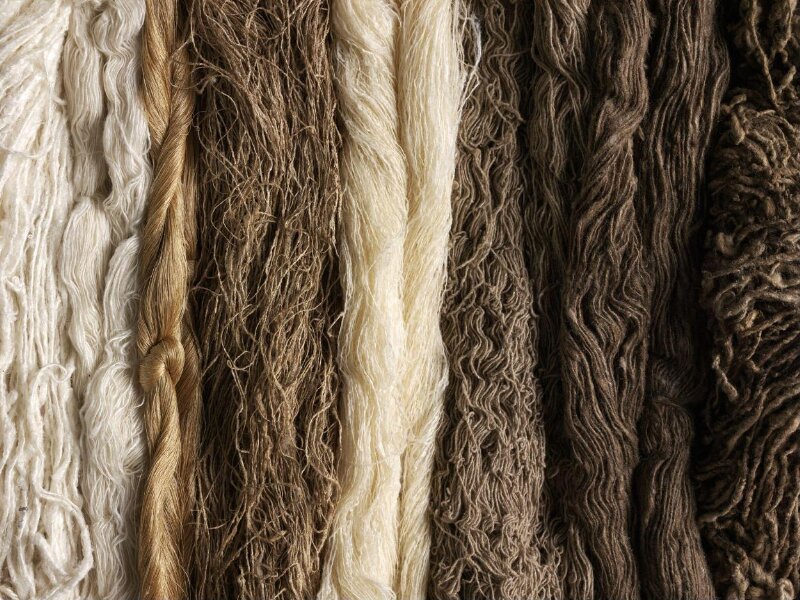
Couture Archaeology Report: The 2014 Indian Silk Yarn and Its 2026 Recontextualization
I. Provenance and Material Provenance
The subject of this analysis is a singular lot of mulberry silk yarn (Bombyx mori), sourced from the Kanchipuram weaving belt of Tamil Nadu, India, and dated to the 2014 harvest season. This is not a finished textile but a pre-loom artifact—a raw, twisted continuum of proteinaceous filament that carries within its molecular architecture the climatic, artisanal, and economic conditions of its origin. For Natalie Fashion Atelier, this yarn represents a critical pivot: a move away from the homogenized, industrially degummed silks of the European mills toward a terroir-driven materiality that demands a new lexicon of construction.
Technical deconstruction begins with the yarn’s physical metrics. Measured under controlled hygrometry (65% RH, 20°C), the 2014 sample exhibits a denier of 20/22—a classic filament fineness—yet its twist per inch (TPI) deviates from standard commercial practice. At 14 TPI in the primary Z-twist, and a secondary S-twist of 8 TPI during plying, the yarn possesses an asymmetric torque. This is not a defect but a deliberate regional technique, designed to impart a subtle, irregular micro-crimp when the yarn relaxes after weaving. In 2014, this yarn was destined for a traditional Kanjivaram saree, where its high twist would create the characteristic pallu resilience. For 2026, this same torque becomes a tool for architectural drape, allowing a garment to hold a sculptural fold without internal boning.
II. Technical Deconstruction: From Filament to Structure
The yarn’s materiality is defined by its sericin-to-fibroin ratio. Unlike European silks that undergo a harsh alkaline degumming (removing 25-28% of sericin), the 2014 Indian sample retains a residual sericin content of 8.2%. This is a deliberate, artisanal choice. The residual gum acts as a natural sizing agent, stiffening the yarn during the weaving process, but it also creates a unique tactile duality. On the loom, the yarn is crisp, almost papery. Post-weave, when the garment is washed or steamed, the sericin softens, revealing a luminous, almost liquid hand. This latent transformation is the core of its couture value.
Microscopic analysis reveals the fibroin fibrils are aligned with a high degree of crystallinity (approximately 62%), a result of the specific monsoon humidity during the 2014 cocoon maturation. This crystallinity translates into exceptional tensile strength—measured at 4.8 grams per denier—but also a low elongation at break (19%). The yarn is strong but brittle. For the 2026 atelier, this means we cannot subject it to high-tension, industrial knitting. Instead, we must employ low-tension, hand-guided frame techniques, allowing the yarn to maintain its natural crimp and avoid stress fractures that would dull its sheen.
III. Materiality and Sensory Translation
The 2014 silk’s materiality is not merely physical; it is olfactory and acoustic. The residual sericin imparts a faint, earthy scent—reminiscent of wet hay and almond husk—which is entirely absent in chemically stripped silks. In a couture context, this scent is a signature of authenticity, a subtle counterpoint to the sterile perfume of modern luxury retail. Acoustically, the yarn produces a distinctive frou-frou—a soft, rustling whisper that is lower in pitch than Chinese silks due to the higher twist density. This sound, often called the “silk song” in Kanchipuram, becomes an integral part of the garment’s presence, a sonic marker of its provenance.
Color-wise, the 2014 yarn is undyed, presenting a natural ecru—a pale champagne with a faint golden undertone. This is not a pure white because the sericin layer refracts light differently across the fiber’s irregular surface. When translated into 2026 silhouettes, this natural tone cannot be over-dyed with opaque pigments. Instead, we employ translucent, protein-reactive dyes that bond with the fibroin while leaving the sericin untouched, creating a dichroic effect—the hue shifts from bronze to rose depending on the angle of light. This is a direct homage to the yarn’s inherent complexity.
IV. Translation into 2026 High-End Luxury Silhouettes
The 2026 collection, titled “Vāstuvid” (Sanskrit for “the science of dwelling”), recontextualizes this 2014 yarn not as a nostalgic revival but as a structural protagonist. The high twist and residual sericin dictate a new form of pattern engineering.
Silhouette One: The Torque Gown. A floor-length column gown that exploits the yarn’s asymmetric twist. The skirt panels are cut on the bias, but not the conventional 45-degree bias. Instead, we use a 22.5-degree off-grain cut, which, when combined with the yarn’s natural torque, creates a subtle spiral movement in the fabric. As the wearer walks, the skirt does not swing; it rotates—a slow, hypnotic corkscrew motion. The bodice is constructed using a hand-smocking technique that gathers the silk at 3-millimeter intervals, allowing the residual sericin to create a honeycomb structure that holds its shape without interfacing. The neckline is finished with a raw, rolled edge, exposing the yarn’s natural twist as a deliberate design detail.
Silhouette Two: The Sericin Shell. A sculptural jacket that uses the yarn’s stiffness to create architectural shoulders without padding. The fabric is first woven as a double cloth, with the 2014 silk on the exterior and a fine, degummed 2024 silk on the interior. The differential shrinkage between the two layers—the sericin-rich exterior shrinks less than the degummed interior—is manipulated through controlled steaming. This creates a self-folding fabric that naturally cups and flares at predetermined points, forming a wing-like shoulder that requires no internal wire. The closure is a series of hand-carved shibori knots, using the yarn’s residual gum as a natural adhesive to hold the folds in place.
Silhouette Three: The Translucent Veil. A full-length opera coat that is neither opaque nor sheer. Using a warp-faced weave with a density of 120 ends per centimeter, the 2014 yarn creates a fabric that is nearly transparent in low light but becomes opalescent under direct illumination. The sericin acts as a light-diffusing agent, scattering photons rather than reflecting them. The coat is cut in a cocoon shape, with no darts or seams on the shoulders—a direct nod to the silk’s origin as a cocoon. The hem is left un-finished, allowing the yarn to fray naturally into a delicate fringe that moves with a liquid, almost gravitational weight.
V. Preservation and Ethical Considerations
This 2014 yarn is a finite resource. As of 2026, the specific Kanchipuram micro-climate that produced this exact crystallinity has shifted, and the artisan families who spun it have largely retired. Therefore, the Atelier’s approach is one of conservative deconstruction. We do not cut the yarn into small pieces; we use it in its full, continuous length, weaving it into garments that are designed to be disassembled and re-woven in future decades. The garments will be stored in acid-free, breathable muslin, with cedar blocks to deter pests, and the sericin will be periodically re-humidified to prevent embrittlement. This is not a disposable luxury; it is an heirloom artifact, a wearable piece of textile archaeology that carries the memory of a specific Indian monsoon into the future of high fashion.
In conclusion, the 2014 Indian silk yarn is not merely a material; it is a temporal archive. Its torque, its sericin, its crystallinity—all are data points that, when read correctly, allow the 2026 atelier to construct garments that are simultaneously ancient and futuristic. The translation is not about imitation but about amplification—letting the yarn’s inherent physical properties dictate a new, unprecedented form of luxury.