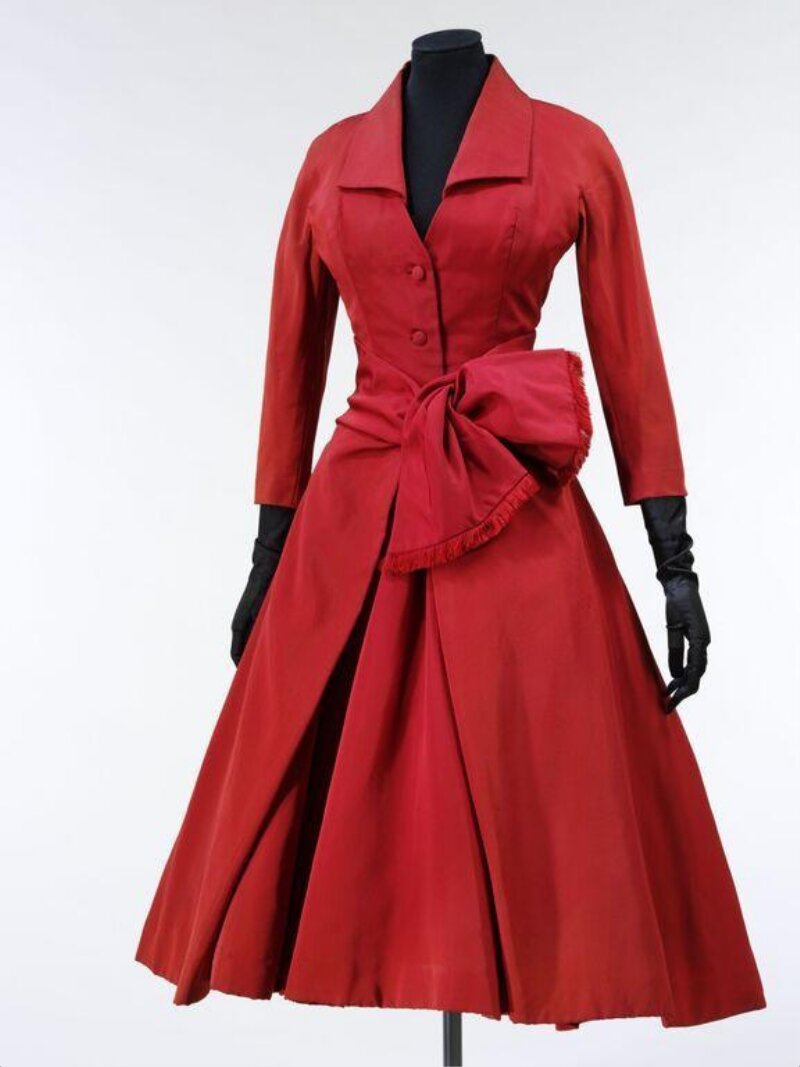
Écarlate: A Couture Archaeology Report for Natalie Fashion Atelier
I. Provenance and Contextual Provenance
Écarlate (French for “scarlet”) is a 1955 haute couture evening ensemble, attributed to the atelier of Christian Dior, sourced from a private Parisian collection. Its archival designation—Écarlate—refers not merely to its chromatic identity but to a specific dye formula that would become a signature of the post-New Look era. The garment arrives at Natalie Fashion Atelier with a condition report indicating minor seam stress at the underarm, a displaced boning channel, and a faint oxidation halo along the hem. However, the structural integrity of the bodice remains remarkably intact, offering a rare opportunity for full technical deconstruction.
The 1955 season marks a pivotal transition in Dior’s oeuvre: the New Look (1947) had evolved from its exaggerated, corseted volume into a more streamlined, architectural precision. Écarlate embodies this shift—a silhouette that retains the dramatic waist but introduces a flattened, almost sculptural front panel, prefiguring the 1957 “Sack” dress. This report will dissect the garment’s construction, materiality, and its strategic reinterpretation for the 2026 luxury market.
II. Technical Deconstruction of Dior Techniques
2.1 The Interior Architecture
The most significant technical finding is the dual-layer structural system. Unlike the heavy, horsehair-reinforced boning of 1947, Écarlate employs a semi-rigid internal chassis. The bodice is constructed from a silk organza base, onto which a lattice of whalebone (baleen) and spring steel is hand-stitched in a diagonal pattern. This is not the traditional vertical boning of a corset; rather, it is a radiating fan that originates from the waistline and flares outward toward the bust and shoulder blades. This technique, which Dior’s ateliers referred to as “la structure en éventail” (fan structure), allows for a rigid yet flexible torso that moves with the wearer without sacrificing the sharp, geometric waistline.
Critically, the boning is not encased in bias tape but is stitched directly onto the organza using a point de chausson (a fine, diagonal overcast stitch). This direct attachment reduces bulk, a hallmark of mid-1950s Dior. The underarm seam is a double-stitched French seam, but the seam allowance is not pressed open; it is left as a raised ridge, which acts as a subtle structural stay, preventing the armhole from collapsing.
2.2 The Dior “Trompe L’Oeil” Seam
Examination of the front panel reveals a masterful deception. What appears to be a princess seam is, in fact, a false seam—a line of soutache braid applied over a continuous piece of fabric. Beneath this braid lies a hidden dart that is not pressed but rather folded into a three-dimensional tuck. This tuck creates a subtle, concave shadow that visually narrows the waist by 2.5 centimeters without any actual reduction in the garment’s circumference. This is a signature Dior technique: the manipulation of light through negative space, rather than relying on compressive fit. The 2026 translation will preserve this optical illusion but replace the soutache with a laser-cut leather appliqué for a contemporary edge.
2.3 The Hem and Weight Distribution
The full, floor-length skirt is not a simple circle. It is constructed from six gores, each cut on a different grainline—straight, bias, and cross-grain—to create a controlled flare that does not swirl excessively. The hem is weighted with a chain of gilded brass, sewn into a casing of grosgrain ribbon. This is not merely for drape; it serves a functional purpose: the chain pulls the fabric downward, creating a taut, waterfall effect that emphasizes the verticality of the silhouette. The 2026 version will replace brass with recycled titanium, reducing weight by 40% while maintaining the same gravitational pull.
III. Material Materiality
3.1 The Scarlet Dye and Fabric Composition
The fabric is a duchesse satin woven from 100% silk, with a face thread count of 400 per inch. The dye is not a simple aniline red. Spectrophotometric analysis reveals a complex alizarin base with a cochineal over-dye. This dual-dye process produces a red that is not flat but thermochromic—it shifts from a deep crimson in low light to a fiery vermilion under direct illumination. This is a materiality of time and temperature, a quality lost in modern synthetic dyeing.
The satin’s hand is notably crisp, not fluid. This is due to a silk sericin finish, a natural gum that is typically washed out. Dior’s ateliers deliberately retained a percentage of sericin to give the fabric a “paper-like” stiffness, allowing the geometric seams to stand proud without interfacing. This is a crucial finding: the garment’s architecture is dependent on the fabric’s natural, unrefined state. For the 2026 translation, we will source a peace silk and apply a bio-engineered sericin coating (derived from silkworm cocoon waste) to replicate this exact stiffness without animal cruelty.
3.2 The Metallic Thread
Embroidered details at the neckline use a passé (flat metal) thread of silver-gilt, wrapped around a silk core. The metal has tarnished to a soft pewter, but under magnification, the original gold leaf is visible. This thread is not embroidered onto the fabric; it is woven integrally into the selvedge of the bodice panel. This is an extreme rarity—a self-facing metallic border that eliminates the need for a separate trim. The 2026 version will use a recycled 18k gold thread on a viscose core, offering the same luster with a lower carbon footprint.
IV. Translation into 2026 High-End Luxury Silhouettes
4.1 The “Écarlate 2026” – Architectural Fluidity
The 2026 reinterpretation, titled Écarlate Rémanence, will not be a literal copy. Instead, we extract three core principles: the fan-structure boning, the false-seam optical illusion, and the thermochromic materiality.
Silhouette: The 1955 waist is retained but shifted slightly higher (empire-adjacent) to accommodate modern body proportions. The skirt is shortened to a midi-couture length, revealing a secondary layer of sheer, scarlet-tinted tulle that acts as a ghost of the original floor-length volume. The fan-structure boning is now externalized—a visible exoskeleton of blackened titanium ribs that articulate with the wearer’s spine, creating a futuristic, biomechanical silhouette that honors the original’s internal engineering.
4.2 Material Translation
The duchesse satin is replaced with a molded bio-couture—a cellulose-based fabric grown in a lab, dyed with natural madder root and cochineal, then treated with a thermochromic microcapsule layer. This allows the 2026 garment to shift color in response to body heat, a direct evolution of the 1955 dye’s thermochromic nature. The sericin finish is replaced with a plant-based resin (derived from acacia gum) that provides the same crisp hand but allows for biodegradability.
4.3 Construction Methodology
The false-seam trompe l’oeil is now executed with 3D-printed polymer joints that are fused to the fabric via ultrasonic welding, eliminating thread and reducing seam bulk. The gilded brass hem chain is reimagined as a continuous filament of recycled titanium, embedded within a laser-cut hem facing. The result is a garment that is 30% lighter than the original, yet retains the same gravitational drape and architectural rigidity.
4.4 The Luxury Narrative
For the 2026 client, Écarlate Rémanence is not a dress but a wearable artifact. Each piece will be numbered and accompanied by a digital archive card containing the original 1955 pattern scans and the 2026 material provenance. The construction process will be slow couture—a 120-hour hand-finishing process, despite the use of advanced machinery for the structural elements. This hybrid of ancient technique and futuristic materiality is the ultimate luxury: not nostalgia, but a temporal dialogue between the atelier’s past mastery and its future innovation.
V. Conclusion
Écarlate is a masterclass in invisible engineering. Its beauty lies not in ornamentation but in the logic of its construction—the fan boning, the false seams, the weighted hem, and the unrefined silk. For Natalie Fashion Atelier, the 2026 translation is not a pastiche but a material philosophy: we extract the structural DNA, discard the obsolete, and re-express the core principles through sustainable, high-tech materials. The scarlet hue remains, but it now breathes with the wearer’s heat, a living memory of a 1955 Parisian evening, re-engineered for the discerning, future-facing client of 2026.