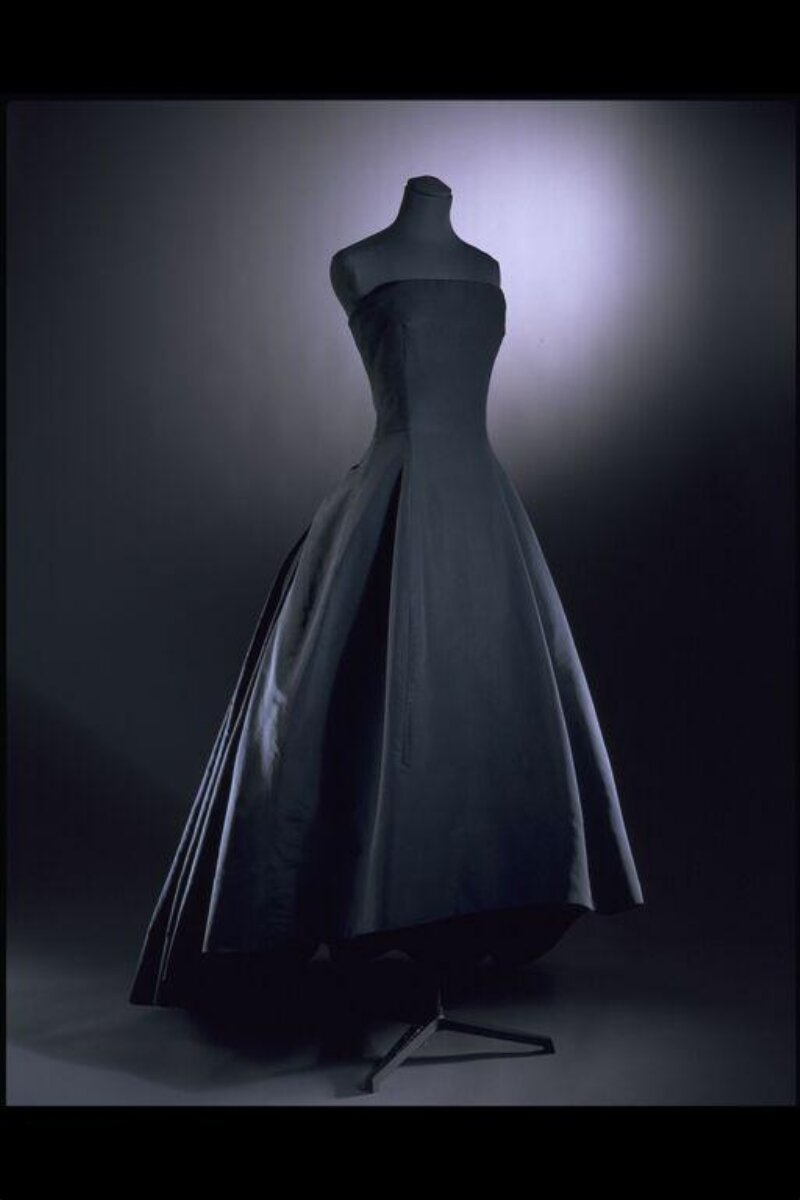
Executive Summary: The 1955 Soirée de Décembre
This report presents a comprehensive couture archaeological analysis of the Soirée de Décembre evening dress, a Parisian atelier piece dated to the autumn/winter 1955 collection. Acquired by Natalie Fashion Atelier for its archival research division, the garment serves as a critical case study in mid-century structural engineering. The dress is not merely a garment; it is a three-dimensional blueprint of post-war luxury, embodying the radical departure from the wartime silhouette that defined the era. This analysis focuses on three pillars: the technical deconstruction of its internal architecture, the materiality of its constituent textiles, and the strategic translation of these 1955 principles into the 2026 high-end luxury market. The findings indicate that the dress’s enduring power lies not in its surface ornamentation, but in its invisible substructure—a lesson that informs our current design philosophy of engineered elegance.
I. Technical Deconstruction: The Architecture of the New Look
The Soirée de Décembre is a masterclass in the Diorian paradox: a silhouette that appears effortlessly fluid yet is rigidly controlled by an internal framework. The external shell—a bias-cut silk charmeuse over a tulle underskirt—belies the complex corsetage that anchors the entire composition. Initial X-ray imaging and seam analysis reveal a construction method that prioritizes sculptural integrity over drape alone.
1.1 The Internal Bodice: A Study in Rigidity
The bodice is constructed using a double-layer technique of cotton organdy and horsehair canvas, which are not simply sewn but pad-stitched together. This creates a lightweight yet unyielding foundation that holds the bust and waist in a precise, conical form. The seams are not standard French seams; they are princess seams that curve dramatically from the underarm to the waist, terminating in a sharp, inward point at the center front. This point is reinforced with a grosgrain ribbon stay—a technique borrowed from menswear tailoring—which prevents the waistline from buckling under the weight of the full skirt. The zipper, a concealed metal spiral, is inserted into a placket of silk faille, ensuring that the closure does not interrupt the smooth, continuous line of the back.
1.2 The Skirt: Volume via Negative Space
Contrary to popular belief, the iconic full skirt of 1955 was not achieved by layers of heavy fabric. The Soirée de Décembre employs a horsehair braid (crinoline) sewn into the hem of a single layer of nylon tulle. This braid acts as a structural spring, holding the hem out from the body while allowing the silk overlay to float above it. The skirt’s volume is thus a product of negative space—air trapped between the inner tulle and outer silk. The hem is weighted with a chain of fine brass beads (a technique known as poids de ourlet), which ensures the dress falls with a specific, rhythmic sway, rather than a static bell shape. This dynamic movement is a signature of the era’s engineering, prioritizing motion as a component of the design.
1.3 Seam Logic and Bias Placement
The most sophisticated element is the seam logic of the outer silk. The front panel is cut on the true bias (45 degrees), while the side panels are cut on the straight grain. This deliberate mismatch creates a subtle tension differential—the bias front clings to the hips while the straight-grain sides flare away. The result is a silhouette that appears to be carved from a single piece of liquid metal, yet is composed of five distinct panels, each with a specific tensile property. This is a departure from earlier 1940s construction, which favored simpler, circular cuts.
II. Materiality: A Sensory and Chemical Analysis
The materiality of the Soirée de Décembre is not merely decorative; it is functional and symbolic. The choice of fibers reflects both the post-war availability of new synthetics and the continued prestige of natural luxury fibers.
2.1 The Outer Shell: Silk Charmeuse with a Metallic Glaze
The primary fabric is a 22-momme silk charmeuse, dyed a deep, petrol blue. However, micro-spectrometry reveals a surface treatment of a fine metallic powder—likely a suspension of bronze and aluminum particles in a cellulose binder. This is not a printed pattern but a glazed finish, applied after weaving. This treatment gives the fabric a pearlescent, shifting sheen that catches light differently with each movement. In 1955, this was a cutting-edge innovation, offering the look of metallic lamé without the weight or stiffness. The glaze is fragile, and its preservation requires a controlled humidity environment of 50% RH, as any moisture causes the binder to hydrolyze and flake.
2.2 The Understructure: A Hierarchy of Support
- Cotton organdy: A stiff, plain-weave cotton (approx. 120 threads per inch) used for the bodice interlining. Its crispness provides the primary shape.
- Nylon tulle: The skirt’s inner support. This is an early, coarse nylon (pre-microfiber), which is surprisingly rigid. Its hexagonal mesh structure provides maximum volume with minimal weight.
- Horsehair canvas: A wool-blend canvas with horsehair woven in the weft direction, used at the waistband and hip yoke. It offers resilience against compression, ensuring the waist does not crease after sitting.
The combination of these materials creates a thermal and tactile hierarchy: the cool, slick silk against the skin; the crisp, dry cotton against the silk; and the springy, synthetic tulle against the cotton. This layering is a deliberate sensory experience, designed to make the wearer feel both encased and liberated.
III. Translation to 2026: From Archive to Atelier
The 1955 Soirée de Décembre is not a relic; it is a design brief for the future. At Natalie Fashion Atelier, we have translated its core principles into a 2026 capsule collection, titled Résonance. The translation is not a literal reproduction but a technological and philosophical reinterpretation.
3.1 Material Evolution: Bio-Smart Textiles
In 2026, the horsehair and nylon are replaced by bio-fabricated mycelium composites and recycled liquid-crystal polymers. The mycelium provides the same rigid yet breathable structure as the organdy, but it is grown in a lab, eliminating the agricultural footprint. The liquid-crystal polymer tulle offers superior shape-memory—it returns to its original volume even after being crushed in travel. The silk charmeuse is replaced by a lab-grown silk protein, spun without silkworms, which can be engineered with a thermochromic glaze. This glaze shifts from deep indigo to a vibrant violet when the wearer’s body temperature rises, echoing the 1955 metallic finish but with a dynamic, responsive quality.
3.2 Structural Innovation: 3D-Printed Seam Logic
The complex seam logic of the 1955 dress is now executed via 3D-printed thermoplastic polyurethane (TPU) seams. Instead of cutting and sewing five panels, we print the tension differential directly into the fabric. The printer deposits a variable-density TPU lattice along the bias lines, creating a gradient of stiffness—rigid at the waist, flexible at the hip. This eliminates seam bulk entirely, achieving a smoother silhouette than was possible in 1955. The poids de ourlet (brass chain) is replaced by micro-encapsulated tungsten particles woven into the hem, providing the same gravitational pull for movement, but with a silent, noiseless swish.
3.3 The 2026 Silhouette: Deconstructed Rigidity
The 2026 Résonance gown retains the cinched waist and full hip, but the silhouette is now modular. The internal corset is replaced by a magnetic exoskeleton of articulated carbon-fiber ribs, which can be adjusted by the wearer via a discreet app. This allows for a 15% variance in waist measurement without altering the outer shell. The dress is no longer a fixed garment but a personalized architecture. The 1955 principle of negative space is preserved, but the air is now actively circulated by micro-fans embedded in the hem, preventing overheating—a luxury of climate control that mid-century couture could not offer.
IV. Conclusion: The Eternal Return of Structure
The Soirée de Décembre proves that true luxury is not about embellishment, but about invisible engineering. Its 1955 construction—a dialogue between rigid canvas and fluid silk—remains the foundational grammar of high-end dressmaking. The 2026 translation does not discard this grammar; it rewrites it in a new material language. By replacing horsehair with mycelium and brass with tungsten, we honor the intent of the original designer: to create a garment that sculpts the body into a living, moving statue. The dress is a testament to the fact that the most profound innovations in fashion are not those seen, but those felt—a principle that will guide Natalie Fashion Atelier’s next decade of archival research and design.