The Gilded Vessel: Deconstructing Ptolemaic Faience for the 2026 Silhouette
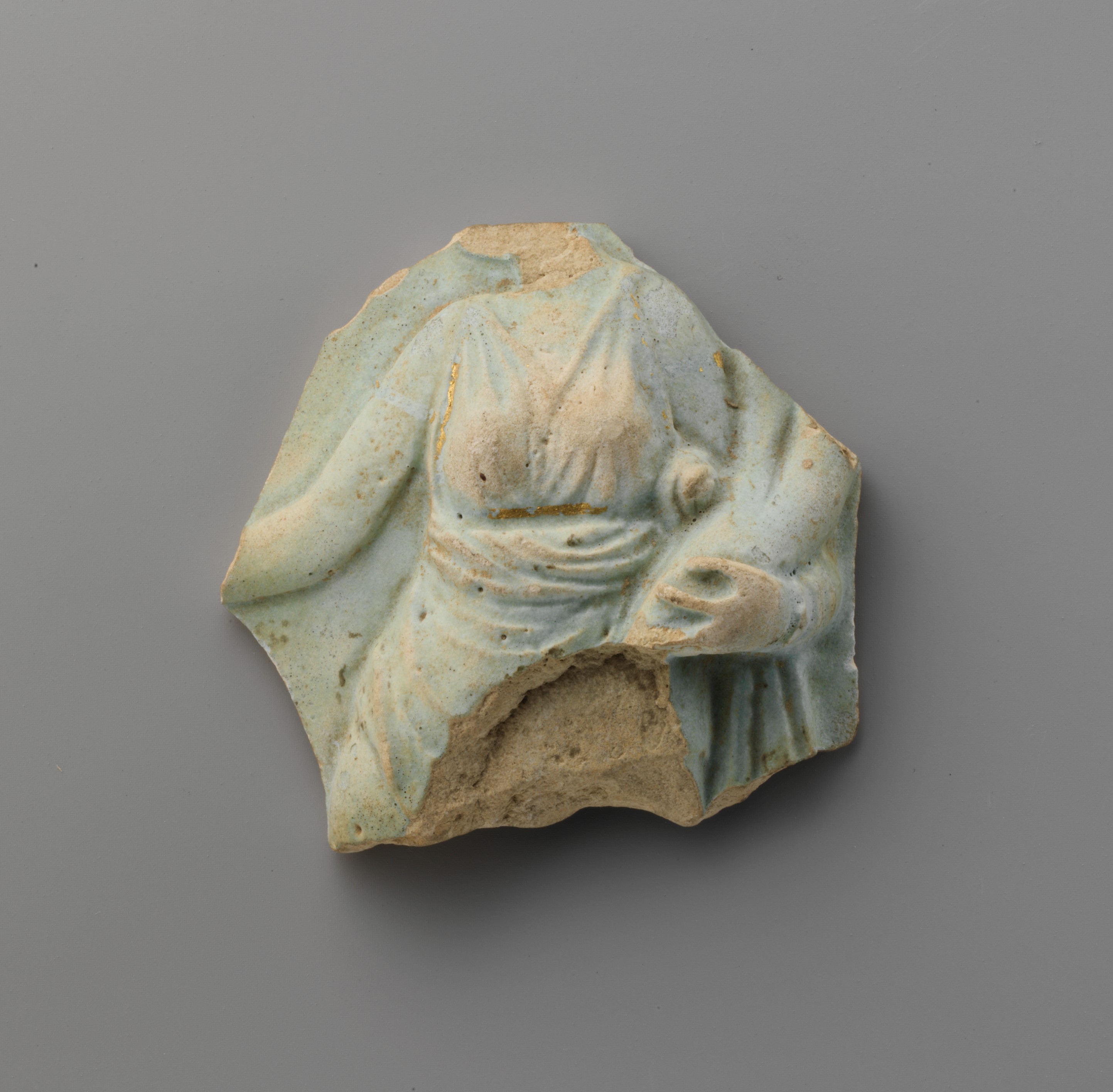
Within the hushed vaults of the Natalie Fashion Atelier archive, a singular fragment commands attention: a gilt faience oinochoe shard from the Ptolemaic period. This is not merely a relic of libation rituals, but a dense matrix of aesthetic intelligence. The faience body—a self-glazed siliceous ceramic—captures light with a synthetic, almost aquatic luminosity, while the applied gold leaf introduces a deliberate rupture: a moment of metallic excess against a matte, cool ground. For the 2026 couture season, this fragment serves not as a literal template, but as a structural and chromatic thesis. We are extracting a grammar of form from its curves, a logic of surface from its glaze, and a philosophy of ornament from its gilding. The resulting silhouettes are not historical costumes; they are architectural translations of a vessel’s breath, engineered for the contemporary female form.
I. The Architectural Logic of the Oinochoe: From Vessel to Bodice
The oinochoe’s defining characteristic is its trefoil mouth and the sweeping, continuous curve that descends from the lip to a stable, narrow foot. This is a study in controlled volume. The belly of the jug is not a passive sphere; it is a pressurized chamber whose outward swell is counterbalanced by the strict verticality of the neck and the anchoring mass of the handle. In our 2026 construction, this translates directly into the primary bodice architecture.
The Pressurized Torso and the “Faience Rib”
We have developed a silhouette we internally term the Oinochoe Line. This is not a draped or fluid form; it is a molded, structural shell that mimics the ceramic’s internal tension. The bodice is cut with a pronounced, almost exaggerated seam-to-seam curvature, commencing at a high, sculpted shoulder and descending into a pronounced, rounded hip that flares outward before being abruptly cinched at the waist by a rigid, boned cummerbund. This cummerbund is not decorative; it is the functional analog to the vessel’s foot, providing a visual and physical anchor. The material logic here is paramount: we employ a double-faced silk gazar, stiffened with a micro-couture horsehair canvas, to achieve the necessary compressive volume without visible darts. The garment appears to have been thrown on a wheel, not sewn.
Furthermore, the trefoil mouth of the oinochoe informs the neckline geometry. Instead of a conventional round or V-neck, the 2026 collection introduces the Trefoil Collar—a three-lobed, asymmetric cut that folds inward like a pinched lip. This creates a dramatic, sculptural frame for the clavicle and throat, echoing the functional spout of the original vessel. It is a silhouette that demands a regal posture, a nod to the ceremonial nature of the jug’s original purpose.
II. The Materiality of Light: Faience Glaze and Surface Strategy
The faience material itself is a miracle of ancient chemistry—a body of crushed quartz or sand, bound with natron, and fired to produce a self-glazing surface. The result is a depthless, vitreous sheen that mimics the Nile’s turquoise, yet possesses a mineral, chalky undertone. This dual nature—simultaneously wet and dry, luminous and matte—is the cornerstone of our textile development for 2026.
Chromatic Layering and the “Nile Bloom” Finish
We have rejected simple metallic brocades. Instead, our atelier has engineered a “Nile Bloom” finish via a complex process of over-dyeing and surface abrasion. A base of silk organza is dyed in a deep, mineral turquoise, then over-printed with a micro-dot pattern of a slightly lighter, almost white-green. The fabric is then passed through a heated calendering process that partially melts the synthetic filaments, creating a subtle, irregular topography—a tactile echo of the faience’s craquelure. The result is a surface that appears to hold light within its fibers, rather than reflecting it off a flat plane. This is the “wet-stone” effect, a signature of the collection.
For evening wear, this glaze is intensified. We have developed a liquid metal lamé that is not woven but cast onto a stretch mesh. This is not a shiny fabric; it is a matte, burnished metal with a granular, almost sandy texture, mimicking the unglazed core of the faience where it meets the gold. The gilding on the original fragment is not a smooth leaf; it is applied in irregular, thick patches. We replicate this through hand-applied sequins of antique brass and unpolished gold, placed asymmetrically along the seams and hems, creating a sense of archaeological discovery—as if the garment is emerging from the earth, revealing its precious metal only in specific, strategic zones.
III. The Grammar of Ornament: Gilding as Structural Accent
In the Ptolemaic context, gilding was not mere decoration; it was a theological statement, a transubstantiation of the vessel into a divine object. Our 2026 approach treats gilding with similar reverence—as a load-bearing aesthetic element, not an appliqué. We have abandoned the notion of embroidery as a floral or pictorial motif. Instead, we employ gold as a linear, architectural tracer.
The “Handle” Strap and the Gilded Seam
The oinochoe’s handle—a thick, vertical loop—is reimagined as a functional, gilded strap that wraps from the back of the shoulder, under the arm, and across the torso, mimicking the vessel’s structural support. This strap is constructed from a rigid, gold-lacquered leather, but it is not smooth. It is etched with a linear, cuneiform-like pattern derived from the fragment’s surface wear, creating a textural contrast against the fluid faience silk. This is not jewelry; it is exoskeletal architecture that defines the garment’s drape and movement.
Furthermore, the primary seams of the Oinochoe Line are not hidden. They are exposed and piped with a fine, twisted gold cord, functioning as a drawn line that delineates the volume of the body beneath. This is a direct reference to the potter’s wheel marks on the faience, celebrating the process of construction as the primary ornament. The gilding thus becomes a map of the garment’s engineering, a visible skeleton of its couture DNA.
IV. Synthesis: The 2026 Silhouette as a Contemporary Artifact
The final synthesis for Natalie Fashion Atelier’s 2026 collection is a silhouette that is simultaneously archaic and futuristic. It is a form that understands the body as a vessel, a container of presence and power. The Oinochoe Line is not about softness or fluidity; it is about controlled tension, sculptural volume, and the deliberate placement of precious material. The garments are heavy, structured, and imbued with a sense of ceremonial weight. They are not for the passive observer; they are for the woman who commands a room, who understands her own body as a work of art.
This is the essence of our aesthetic archaeology: we do not copy the past, but extract its structural principles—its logic of volume, its material alchemy, its grammar of ornament—and re-engineer them through the lens of contemporary couture technique. The gilt faience fragment is not a source of inspiration; it is a blueprint for a new form of classical elegance, one that is rigorous, intellectual, and deeply, powerfully feminine. The 2026 silhouette is, in effect, a new artifact, one that carries the memory of the Nile but speaks the language of the future.