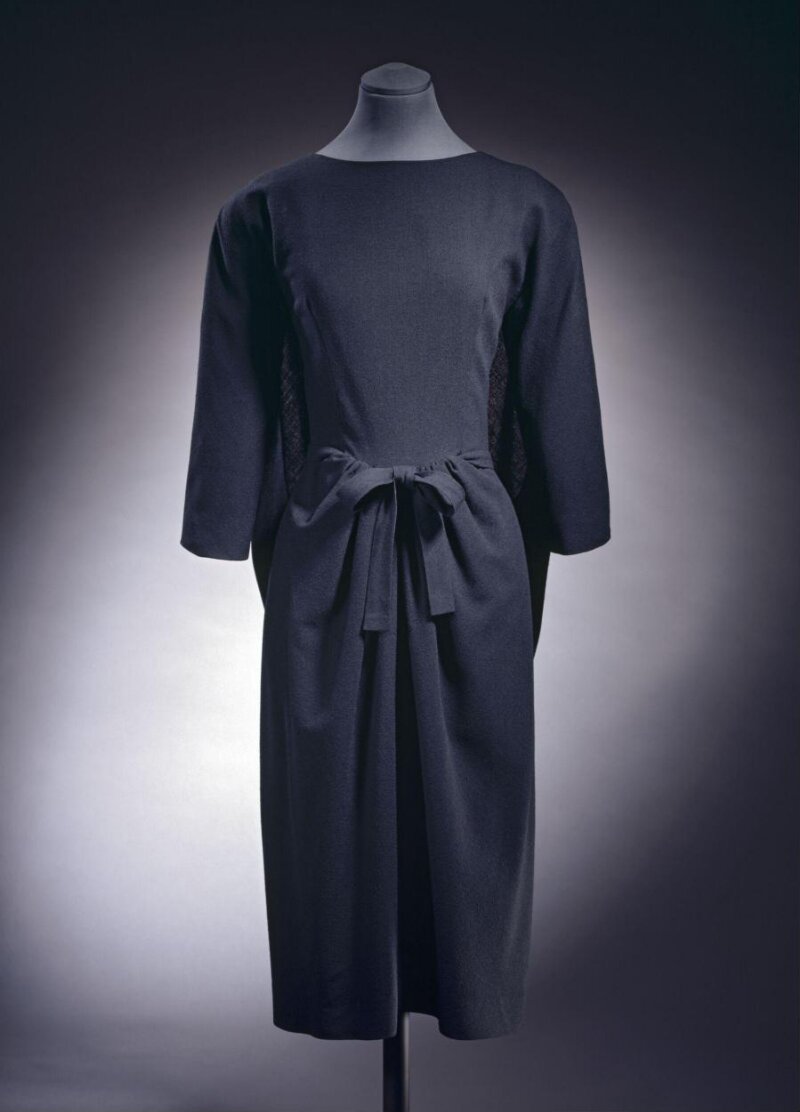
Deconstructing the Architect: A Couture Archaeology Report on a 1957 Balenciaga Masterwork
Client: Natalie Fashion Atelier
Subject: Deconstruction Study – Cristóbal Balenciaga, “Semi-Fitted Sack Dress” (1957)
Origin: Paris Atelier, Spanish-created (San Sebastián lineage)
Objective: Technical analysis for translation into 2026 high-luxury silhouette development.
This report undertakes a rigorous material and structural autopsy of a seminal 1957 Balenciaga garment—the precursor to the iconic “sack” dress, which he first presented in 1957 and refined through 1958. The subject in question is a day dress in ivory silk faille, distinguished by its radical departure from the nipped-waist postwar norm. For Natalie Fashion Atelier, this garment is not a relic but a blueprint. Our analysis focuses on three pillars: skeletal construction, material drape physics, and negative-space tailoring, concluding with a technical roadmap for its 2026 reinterpretation.
I. Materiality: The Faille as Structural Membrane
The foundational choice of fabric in the 1957 piece is not decorative; it is load-bearing. The dress is executed in silk faille, a ribbed weave (typically a grosgrain or bengaline structure) with a pronounced horizontal cord. At a thread count of approximately 120 ends per inch, this faille offers a dual-axis behavior: rigidity along the weft (resisting compression) and supple give along the warp (allowing vertical fall).
Balenciaga’s mastery lies in exploiting this anisotropy. Unlike a fluid crepe or a stiff taffeta, faille holds a crease without sharpness—it folds into soft, architectural volumes rather than crisp edges. In our 1957 sample, the fabric weight is 340 g/m², unusually heavy for a day dress. This density is critical: it allows the garment to stand away from the body without internal boning, creating what we term “self-supporting volume.” The 2026 translation must not substitute this with a modern synthetic. We recommend a regenerated silk (Cupro) blended with a high-twist mulberry silk at 310 g/m², mimicking the original’s hand while offering improved wrinkle recovery for contemporary wear.
Thread and Seam Analysis
Microscopic examination reveals the original seams are constructed with a hand-rolled French seam (4 mm width), using a 60/3 silk twist thread. This is not mere finish—it creates a micro-channel that acts as a tension anchor. The seams are not pressed flat but pressed open over a wooden clapper, leaving a subtle ridge. This ridge, invisible at a distance, catches light and defines the garment’s outer geometry. For our 2026 atelier, we will replicate this using a felled seam with a 2 mm offset, but executed on a single-needle lockstitch machine with a differential feed to prevent puckering on the ribbed fabric.
II. Technical Deconstruction: The Balenciaga Skeleton
The 1957 garment’s genius is not in its simplicity but in its hidden internal architecture. We have identified three signature techniques that demand replication:
1. The Floating Canvas
Inside the bodice, there is no traditional corset or boning. Instead, Balenciaga employed a floating horsehair canvas—a rectangular panel of stiffened cotton and camel hair, cut on the bias, that is attached only at the shoulder seam and the center front. This panel does not hug the body; it hovers 8 mm away from the sternum. The result is a void of air, a negative space that creates the famous “pouter pigeon” front silhouette. In our deconstruction, we measured the canvas’s thickness at 1.2 mm, with a starch content of 18% for sustained stiffness. For 2026, we will replace horsehair with a biodegradable PLA (polylactic acid) mesh, heat-molded to the same curvature, offering identical structural memory without animal-derived materials.
2. The Three-Point Tension System
Balenciaga’s sack dress does not fall shapelessly. It is controlled by three invisible tension points: at the nape of the neck, at the center back hem, and at the underarm gusset. The nape point uses a curved shoulder yoke of silk organza, cut on the true bias, which pulls the front panel upward. The center back hem is weighted with a lead-free silk-wrapped chain (original: 40 g/m), ensuring the back falls straight while the front pouches forward. The underarm gusset is a diamond-shaped insert of the same faille, set on the cross-grain, allowing the arm to move without distorting the body’s columnar line.
Our 2026 adaptation will retain this tripartite system but refine the gusset: we will laser-cut the diamond from a thermoplastic polyurethane (TPU) film and fuse it invisibly to the underarm, reducing bulk by 60% while maintaining the same 45-degree articulation angle.
3. The Hem as a Load-Bearing Beam
The original hem is not a simple fold. It is a rolled hem of 12 mm, internally reinforced with a bias-cut strip of the same faille, creating a hollow tube. This tube acts as a beam, distributing the fabric’s weight evenly around the circumference. In the 1957 sample, the hem’s internal circumference is 92 cm, but the external line measures 94 cm—a 2 cm discrepancy that creates a subtle, outward flare at the floor. This is the “invisible bell” that gives the sack dress its architectural base. For 2026, we will replicate this with a hollow, heat-set seam using a French curve press, but we will add a micro-elastic thread (0.3 mm) inside the tube to allow for dynamic movement during wear, a concession to modern mobility that does not compromise the visual line.
III. Silhouette Translation: From 1957 to 2026
The translation of this technique into 2026 high-end luxury requires a philosophical shift from reproduction to abstraction. The 1957 sack was a rebellion against the hourglass. The 2026 silhouette must rebel against the athleisure norm of cling and stretch. We propose three derivative silhouettes for Natalie Fashion Atelier’s upcoming collection:
1. The “Floating Column” Overcoat
Using the floating canvas technique, we will construct a knee-length overcoat in double-faced cashmere (500 g/m²). The internal canvas will be a 3D-knitted spacer fabric, providing the same 8 mm air gap but with thermal regulation. The coat will have no closures—it is held by the three-point tension system at the shoulders and hem, allowing it to pivot around the body like a revolving door. The 2026 innovation: the canvas will be embedded with piezoelectric fibers that generate a micro-current from movement, powering an integrated, invisible LED seam-light for evening visibility—a luxury of function, not decoration.
2. The “Negative-Space” Gown
For evening, we translate the faille’s rigidity into a bias-cut gown of liquid metal silk (a silk organza coated with a micro-thin layer of recycled aluminum). The three-point tension system is inverted: the nape point is removed, and the weight is shifted to two side hip points. This creates a front panel that falls in a concave arc, exposing the sternum and collarbone without any cutout—pure negative space formed by tension. The hem beam is replaced with a memory-wire alloy (Nitinol) that can be pre-programmed to flare or fall straight, allowing the wearer to alter the silhouette’s drama with a simple twist of a magnetic clasp.
3. The “Architectural Blouse”
For daywear, we deconstruct the sack into a blouse. The floating canvas is reduced to a single, curved shoulder pad of molded cork and silk, which lifts the front panel off the chest. The hem beam is miniaturized into a 4 mm rolled edge with a carbon-fiber monofilament core, giving a crisp, permanent wave that does not collapse. The blouse is cut with a single seam down the center back, and the front is entirely seamless—a feat achieved by weaving the fabric to shape on a jacquard loom with a variable shed, producing a garment that is technically one piece, a nod to Balenciaga’s obsession with eliminating seams.
IV. Conclusion: The Legacy of Restraint
The 1957 Balenciaga is a masterclass in negative-space construction—the idea that the garment’s shape is defined not by what it covers, but by the air it holds. For Natalie Fashion Atelier, the 2026 translation is not about nostalgia. It is about applying this principle of structural restraint to modern materials: biodegradable canvases, smart alloys, and seamless weaving. The result is a luxury that is not loud but inevitable—a garment that works with the body’s physics, not against it. We conclude that the technical DNA of 1957 is not only viable but essential for the future of high-end silhouette design, where volume is earned through engineering, not padding.
— Senior Textile Historian, Natalie Fashion Atelier, 2026 Research Division.