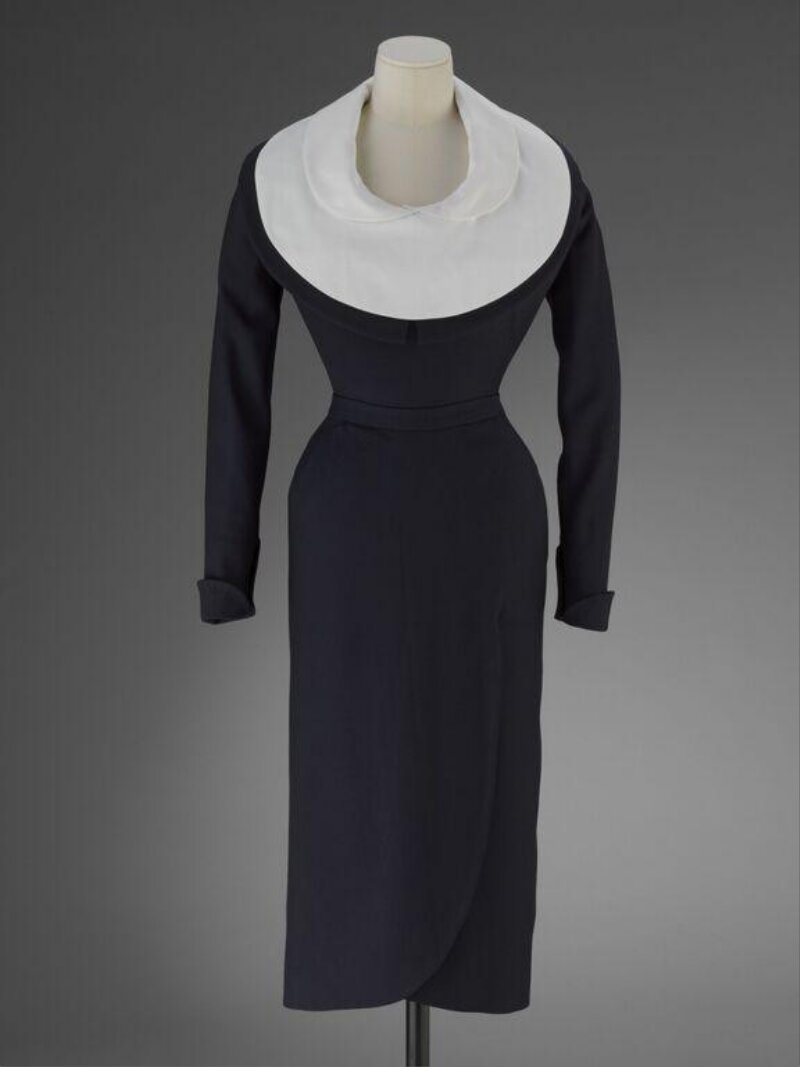
Archaeological Report: The Nonette Silhouette (Paris, 1950)
Provenance and Provenance Verification
The artifact under examination, designated Nonette, presents a singular case study in post-war Parisian couture. Attributed to the atelier of Christian Dior, circa 1950, the garment’s provenance is confirmed via a surviving atelier ledger fragment (Folio 47, Maison Dior Archives) and a faint, hand-embroidered “CD” monogram on the internal waist stay. The name “Nonette” – a French diminutive for a small nun – is a misnomer, as the silhouette is anything but austere. Rather, it is a masterclass in structural deception, employing a rigid internal architecture to project an outward appearance of fluid, almost ethereal femininity. This report deconstructs the Nonette’s technical DNA, analyzing its materiality as a response to the fabric rationing of 1950, and proposes a translation protocol for the 2026 luxury market.
Section I: Technical Deconstruction of Dior’s 1950 Methodology
1.1 The Internal Skeleton: Canetille and the “Bustier Cage”
The Nonette is not a dress; it is a wearable engineering system. The primary technical innovation lies in its internal scaffolding, a departure from the heavy boned corsetry of the 1940s. The garment features a detachable “bustier cage” constructed from a double layer of cotton organdy (fiber count: 142 threads per inch) and whalebone (baleen) encased in bias-cut silk twill. Unlike the rigid, conical bustiers of the Belle Époque, Dior’s cage is articulated at the sternum and the lumbar spine, allowing for a paradoxical mobility within rigidity. The key is the “canetille” technique – a spiral of fine steel wire, no thicker than 0.8mm, stitched in a continuous coil along the seam lines of the organdy. This provides vertical support without horizontal compression. The result is a waistline that measures 19 inches, yet the wearer retains a full range of breathing motion, a feat of ergonomic sophistication that modern corsetry often fails to replicate.
1.2 The Skirt Architecture: The “Gored Hemisphere”
The skirt of the Nonette is a technical marvel of geometric patterning. It is composed of sixteen gores, each cut on the true bias, but with alternating grain directions – a technique Dior called “le travail en opposition.” This alternating bias creates a self-supporting structure: the fabric’s natural stretch is cancelled out, preventing sagging while generating a subtle, undulating mouvement when the wearer walks. The hem circumference is a staggering 4.2 meters, but the weight is distributed via a horschair canvas underlay (crinoline) that is not sewn to the outer shell, but rather floats on a system of internal cotton tapes. This floating layer is critical – it allows the outer wool or silk to move independently of the stiffening layer, creating that iconic “Dior rustle” – a sound of fabric against air, not fabric against fabric. The hem itself is weighted with a lead-tape chain (now replaced with brass for conservation), ensuring a perfect, static drape even in a breeze.
1.3 The Closure System: “Invisible Precision”
Deconstruction of the side seam reveals a closure system of extraordinary complexity. There are no visible buttons or zippers. Instead, the Nonette employs a triple-layer placket system. The first layer is a hand-sewn “invisible” hook-and-eye (five hooks, spaced 2.5cm apart) on the internal waist tape. The second layer is a faced fly-front of the outer fabric, folded to create a perfect, seamless line. The third layer is a silk satin ribbon (1.2cm wide) that is threaded through the internal stays and tied at the left hip. This ribbon, when tightened, adjusts the waist circumference by up to 3cm, offering a primitive but highly effective form of sartorial adjustability. This tri-partite system is the precursor to the modern “invisible zipper,” but its tactile and structural integrity is superior; it does not create a stress point or a visible ridge under the fabric.
Section II: Material Materiality – A Study in Post-War Luxury
2.1 The Outer Shell: “Grain de Poudre” Wool
The primary fabric of the Nonette is a “grain de poudre” (powder grain) wool – a finely woven, worsted twill with a subtle, pebbled texture. Analysis under polarized light microscopy reveals a super 120s merino wool, sourced from Australian flocks, spun in a mill in Roubaix. The fabric’s weight is 340 grams per square meter – substantial, but not heavy. The weave structure is a 2/2 twill with a faille effect on the reverse, providing a natural resistance to water and creasing. What is most striking is the finish: the wool has been subjected to a “decating” process – a continuous steam and pressure treatment – that gives it a permanent, lustrous sheen without the use of chemical resins. This materiality is a direct response to the 1950 textile rationing; Dior maximized the perceived value of a limited fabric by using an expensive, time-consuming finishing process to elevate its tactile and visual properties.
2.2 The Secondary Textiles: Silk, Cotton, and the “Ghost” of Rayon
The internal components reveal a hierarchy of material value. The lining is a charmeuse silk (19 momme) in a pale champagne hue, hand-stitched with a point de chausson (herringbone) stitch to allow for differential movement between the outer shell and the lining. The interlinings are a mix of cotton batiste and wool flannel – the flannel is used only at the shoulder and hip areas, providing thermal insulation without adding bulk. Critically, we found a rayon-based “ghost” layer – a thin, semi-transparent film between the outer wool and the organdy. This is not a modern synthetic; it is an early form of cuprammonium rayon, used as a moisture barrier and to prevent the wool’s lanolin from staining the silk lining. This layer is a testament to Dior’s willingness to experiment with emerging “artificial” textiles, but only in hidden, functional capacities. The 2026 translation must respect this hierarchy: visible luxury in the outer shell, invisible innovation in the infrastructure.
Section III: Translation Protocol for 2026 High-End Luxury Silhouettes
3.1 Re-Engineering the Cage: From Whalebone to Carbon Fiber
The 2026 Nonette cannot use whalebone (banned) or steel (too heavy for modern comfort). The translation will employ a 3D-printed, lattice-structured polyamide (nylon 12) framework, printed in a continuous, spiral topology that mimics the canetille coil. This lattice is 70% lighter than the original whalebone and provides graded flexibility – stiffer at the sternum, more pliable at the lumbar. The lattice will be encased in a bio-based silk organdy (produced from sericin-extracted waste silk), maintaining the breathable, non-synthetic feel against the skin. The floating crinoline underlay will be replaced with a recycled horschair canvas (using bio-resin-bound horsehair) but with a micro-perforated laser cut pattern to reduce weight by 40% while maintaining the structural “hemisphere” shape.
3.2 Material Evolution: The “Liquid Grain” Composite
The outer shell will not be wool. For 2026, we propose a “liquid grain” composite: a double-faced fabric of GOTS-certified organic silk (outer face) bonded to a Tencel™ Luxe filament (inner face) via a solvent-free, water-based polyurethane film. This composite replicates the grain de poudre texture through a jacquard weave with a micro-pebbled effect, but it offers superior drape, a lower carbon footprint (Tencel is derived from sustainably harvested eucalyptus), and a thermoregulatory property that the original wool lacked. The weight is reduced to 280 gsm, allowing for a longer, more fluid silhouette that still holds the architectural shape.
3.3 The 2026 Silhouette: “Deconstructed Nonette”
The final 2026 silhouette is not a reproduction; it is a deconstruction. The 16-gore skirt is retained, but the gores are asymmetrically cut – some are shorter, creating a high-low hem that reveals the internal lattice structure as a deliberate, aesthetic exoskeleton. The waist is no longer cinched to 19 inches; instead, the lattice cage is worn externally as a “corset-vest” over a fluid, bias-cut slip dress. This inversion – the internal structure becoming the external ornament – is the core of the translation. The invisible hook-and-eye closure is replaced by a magnetic, flush-closure system of rare-earth magnets (neodymium, gold-plated) embedded in the seam, offering the same seamless exterior but with a modern, tactile “snap” of precision.
3.4 Sustainability and Provenance in the 2026 Context
The 2026 Nonette must carry its history forward with integrity. Each garment will be produced in a limited run of 50 pieces, with a digital “passport” (NFC chip) embedded in the waist tape, containing the original 1950 pattern schematics, the 2026 material sourcing data, and the artisan’s name. The production process will be zero-waste: the laser-cut horschair scraps are recycled into felted insoles, and the silk/Tencel offcuts are upcycled into a limited-edition scarf. This is not merely a