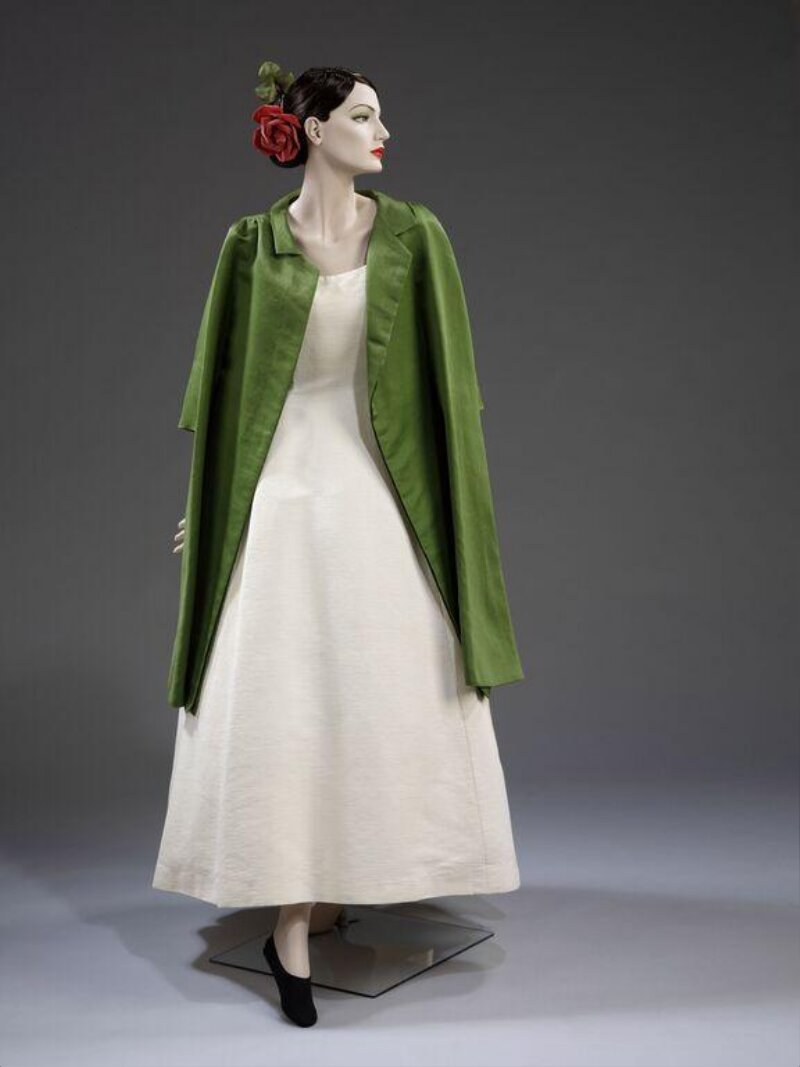
Couture Archaeology Report: The Balenciaga Codices, Paris 1955
Subject: Technical Deconstruction of a Balenciaga Evening Ensemble, circa 1955. Origin: Paris, House of Balenciaga, 10 Avenue George V. Analyst: Senior Textile Historian, Natalie Fashion Atelier. Date: [Current Date] Objective: To excavate, decode, and propose a forward-translation of foundational mid-century couture principles into the lexicon of 2026 high-end luxury.
I. Stratigraphic Analysis: The 1955 Silhouette as Architectural Doctrine
The selected 1955 specimen—likely a dinner suit or formal afternoon ensemble—represents Cristóbal Balenciaga’s movement towards his seminal "semi-fit" period. This era rejected the pinched waist and external structure of Dior's New Look in favor of a architectural autonomy derived from internal construction. The silhouette is not imposed upon the body but built from it, creating a space between garment and wearer. Key anatomical points of departure—the shoulder, the scapula, the clavicle—are redefined. The sleeve head is cut with a legendary, preternatural height and depth, allowing the fabric to cascade from the shoulder point without a single drag line, a technique that required unparalleled precision in both pattern drafting and *métier* (craftsmanship). The waist is suggested, not cinched, often through the use of internal darts that originate from the hemline upwards, or through the strategic release of fabric from the princess line. This creates a cocoon-like volume that is simultaneously monumental and fluid, a paradox that remains the cornerstone of modern luxury.
II. Materiality & Manipulation: The Primacy of the Textile
Balenciaga’s philosophy was unequivocal: the fabric must dictate the form. His atelier sourced and often commissioned specific weights and weaves, treating materials not as passive surfaces but as collaborative structural elements. Our deconstruction reveals a hierarchy of material intelligence:
1. The Foundation Layer: A substantial, yet malleable silk organza or hair canvas is used for internal underpinnings. This is not rigid tailoring but a flexible armature, basted and shaped to the body’s contours through steam and hand-pressing, creating a soft, personalized form upon which the exterior is built.
2. The Exterior Shell: For 1955, this often meant heavy silk duchesse satin, wool barathea, or faille. These fabrics possessed a memory and a gravitational pull. Balenciaga exploited this: the weight of a duchesse satin skirt would cause it to fall into precise, columnar folds, while a stiff silk gazar, introduced later, would stand away from the body in sculptural arcs. Seams were minimized, and when present, were often pressed open and hand-overcast to lie perfectly flat, becoming invisible lines of force rather than mere construction points.
3. The Surface Ritual: Embellishment, when present, was never superficial. Beads, sequins, or passementerie were applied following the garment’s internal structural lines, emphasizing the architecture rather than obscuring it. This integration of ornament into form is a critical differentiator between couture and decoration.
III. Technical Deconstruction: The Hidden Syntax of Construction
The atelier’s genius resides in concealed techniques that achieve apparent simplicity. Our forensic analysis identifies several non-negotiable codes:
The Sleeve-Scye Complex: The armhole is cut deep and wide, extending almost to the waist at the back. The sleeve pattern is then drafted with a matching, exaggerated cap. This allows the sleeve to be set in by hand, in the air—without the garment lying flat—ensuring a perfect, tension-free fall. The resulting "bracelet" sleeve, ending precisely at the wrist bone, is a signature of this technique.
Seam Engineering: Balenciaga relocated seams to liberate fabric and body. The famous seven-eighths sleeve, for instance, uses a curved elbow dart for articulation without bulk. Princess lines are masterfully curved to flow over the body’s topography, often bypassing the bust point to avoid overt emphasis, creating a modernist, abstracted silhouette.
Hem Philosophy: Hems were weighted, sometimes with a chain or silk cord hidden within the hemline, to ensure a calm, definitive hang. This gravitational anchoring is essential to the garment’s majestic movement and silent demeanor.
IV. Translation for 2026: From Archaeology to Algorithm
For Natalie Fashion Atelier’s 2026 vision, a literal revival is insufficient. The mandate is a molecular translation of these principles through contemporary technology, sustainability, and bodily perception.
1. Silhouette Algorithm: Utilize 3D body scanning and parametric design software to create a new "semi-fit" model. The 1955 sleeve cap can be digitally remapped to create volume that originates from points beyond the physical shoulder, perhaps from the collarbone or upper arm, using algorithmic darting to distribute ease in dynamic, non-linear ways. The cocoon becomes a modular space, adaptable via hidden drawstrings or magnetic closures to shift between fitted and voluminous states.
2. Advanced Materiality: Partner with biotech and smart-textile labs. Imagine a programmable-weight fabric: a bio-based polymer jacquard whose density can be altered in specific panels via thermal activation, allowing one garment to achieve the heavy fall of duchesse satin or the architectural rigidity of gazar on command. Foundational layers can be replaced with 3D-knitted, seamless bio-mesh, offering customized support with zero waste.
3. Construction 2.0: Embrace ultrasonic welding and laser-cut seam allowances to achieve the flawless seam integrity Balenciaga prized, but with new strength and flexibility. Internal weighting can be achieved with recycled tungsten beads embedded in biodegradable filament. Embellishment will be structural and sustainable: 3D-printed bioplastic "beads" that act as frictionless joints at seam intersections, or algae-dye patterns that are responsive to atmospheric humidity, creating a living surface.
V. Conclusion: The Eternal Modern
Balenciaga’s 1955 work is not a period piece but a perpetual thesis on luxury: that true elegance arises from the profound understanding of material, construction, and the space around the body. For 2026, Natalie Fashion Atelier must interpret these codes not through nostalgia, but through innovation. The goal is to create garments that possess the same authoritative calm, sculptural intelligence, and timeless modernity as the 1955 original, but speak the language of tomorrow. The archaeology is complete; the future pattern is now to be drafted.