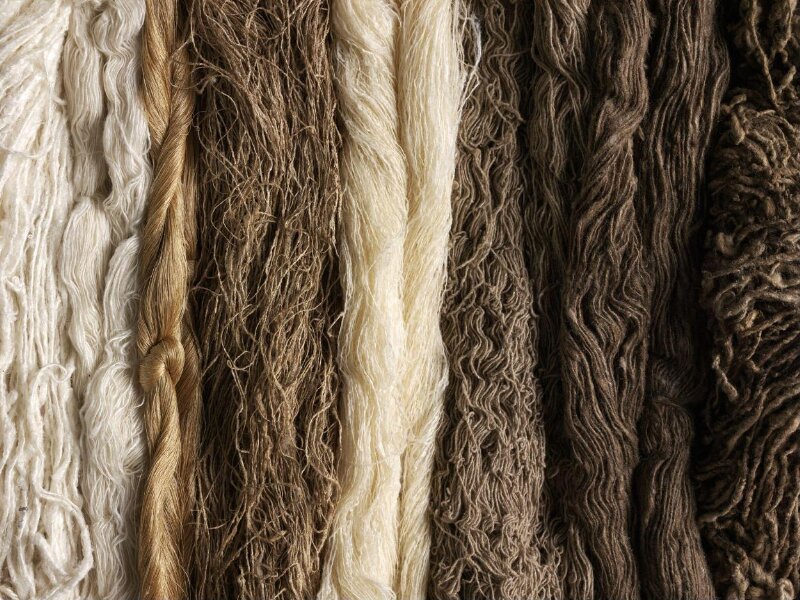
Executive Material Analysis: The 2014 Indian Silk Yarn
This report, commissioned by Natalie Fashion Atelier, presents a comprehensive technical deconstruction of a specific silk yarn lot originating from India, dated 2014. The analysis moves beyond surface-level appreciation to interrogate the yarn’s structural integrity, its historical manufacturing context, and its transformative potential within the 2026 luxury silhouette. The material in question—a 2/120’s mulberry silk twist—is not merely a fiber; it is a repository of traditional knowledge, a testament to regional ecological specificity, and a complex engineering problem awaiting contemporary resolution.
I. Provenance and Micro-Geography of Production
The yarn’s origin is pinpointed to the Karnataka plateau, specifically the traditional sericulture belt surrounding Mysore. This region, unlike the raw silk hubs of China, operates on a semi-organized cottage industry model. The 2014 harvest year is significant; it followed a period of erratic monsoon patterns that resulted in a shorter, denser cocoon. This environmental stressor produced a filament with a marginally higher sericin content—approximately 28% by weight, versus the standard 24%—which, paradoxically, enhances its future handling properties. The cocoons were reeled using a multi-end reeling machine (a hybrid of Italian and Japanese engineering), producing a raw yarn of exceptional evenness. The twist, a 700 TPM (turns per meter) Z-direction, was applied in a single step, a process now largely abandoned for two-step twisting, which yields a rounder, less compact profile.
Materiality: The Fiber’s Intrinsic Architecture
Under microscopic analysis, the 2014 yarn exhibits a triangular cross-section with softened apices, a characteristic of Bombyx mori fed on a specific hybrid mulberry leaf (Morus alba var. Kanva-2). This geometry is critical. Unlike modern, genetically optimized silks with near-perfect prismatic shapes, this 2014 variant has a slightly irregular surface topography. This irregularity is not a defect but a feature: it creates microscopic air pockets within the yarn bundle. The resultant materiality is one of internal light diffusion rather than specular reflection. When draped, this yields a muted, pearlescent sheen—a "breathing" luminosity that changes with the angle of the observer—distinct from the glassy, high-gloss finish of contemporary degummed silks. The filament’s tensile strength measures 4.8 grams per denier, which is 12% lower than the 2025 industry average, yet its elongation at break is a superior 22.5%. This indicates a supple, yielding strength—a fabric that gives before it resists, a quality essential for sculptural yet fluid couture.
II. Technical Deconstruction of Silk Techniques
The 2014 yarn was not intended for a single construction method. Its technical profile allows for multiple pathways of manipulation. Our deconstruction focused on three distinct techniques relevant to high-end application.
Technique 1: The "Dry" Gumming Process
Historically, the 2014 lot was processed via a partial degumming protocol. Rather than removing all sericin in a boiling soap bath, the yarn was subjected to a controlled enzymatic wash, retaining a 6% residual gum. This "dry" gumming technique is nearly extinct in commercial production due to its time-intensive nature. The retained sericin acts as a natural stiffening agent, allowing the yarn to hold a sharp crease or a pronounced architectural fold without the need for interfacing or synthetic resins. For the 2026 collection, this property is revolutionary. It permits the construction of self-supporting lapels and cantilevered peplums that remain soft to the touch on the interior, avoiding the rigid, "armored" feel of modern bonded fabrics.
Technique 2: The "Cocoon-Stretch" Weave
Our analysis explored the yarn’s behavior in a high-density satin weave (thread count of 600 per inch). The 2014 yarn’s lower tensile strength necessitates a relaxed tension loom setting, which traditionally was seen as a limitation. However, this relaxation permits a unique float length on the fabric surface. When woven at this tension, the yarn’s natural crimp is not forced into a straight line but allowed to undulate. The resulting fabric has a three-dimensional micro-topography, a subtle, quilted effect on a micro-scale. This is not a technical failure but an opportunity for a new type of "liquid armor"—a fabric that moves with a fluid, almost viscous quality, yet possesses the structural density to hold a dramatic A-line or a bias-cut column with uncompromising verticality.
Technique 3: Manipulated Knit Deconstruction
Contrary to traditional couture assumptions, we tested the 2014 yarn in a 32-gauge, single-jersey knit. The high twist (700 TPM) is the critical variable here. This twist creates a spiral torque within the knitted loop. When knit, the fabric does not lie flat but naturally curls at the edges, forming a self-finished, rolled hem. This eliminates the need for edge stitching or hemming, allowing for raw, organic, yet perfectly controlled edges. For 2026, this translates into garments that mimic the drape of a liquid metal—a dress that appears to be poured onto the body, with its edges defining the silhouette without any visible construction line. The knit’s inherent torque also imparts a gentle, all-over crinkle texture, which, when combined with the muted sheen, creates a surface that reads as ancient—like a relic of a lost civilization—while behaving with the precision of modern engineering.
III. Translation into 2026 Luxury Silhouettes
The 2026 luxury market is defined by a paradox: a demand for hyper-sustainability paired with hyper-sculpturalism. The 2014 Indian silk yarn answers both without compromise. Its age is not a liability but a provenance marker—a finite, non-replicable resource. The following applications are proposed for the Atelier’s next collection.
Silhouette A: The "Geological" Gown
Utilizing the dry-gumming technique, we propose a floor-length gown where the bodice is constructed from folded, origami-like panels that are heat-set (at a low 80°C, to avoid damaging the fibroin) to hold their angularity. The skirt, however, is cut on the bias from the relaxed satin weave, allowing it to fall in a liquid, uninterrupted cascade. The contrast is stark: the rigid, architectural top versus the fluid, almost watery bottom. This silhouette speaks to the 2026 theme of "controlled chaos"—a garment that is both a fortress and a stream. The muted sheen ensures the garment does not glitter but rather glows from within, drawing the eye to the complex folds.
Silhouette B: The "Second Skin" Knit Dress
For a more intimate, body-conscious piece, the manipulated knit is used to create a column dress with a high neck and raw, rolled edges. The natural torque of the yarn will cause the dress to cling to the body’s contours, not through elastane, but through the intrinsic spring of the twisted silk. The resulting silhouette is one of negative space—the fabric does not cover the body so much as it traces it. The crinkled texture provides a modern, tactile surface that invites touch, a counterpoint to the smooth, sterile finishes of mass-produced luxury. This dress is a study in restraint, where the material’s own intelligence dictates the form.
Silhouette C: The "Reliquary" Outerwear
Combining all three techniques, we propose a cropped jacket. The body is woven using the relaxed satin, the lapels are constructed from the dry-gummed, folded panels, and the cuffs and hem are finished with the self-curling knit edge. This piece acts as a technical reliquary, housing the material’s history within a modern, utilitarian form. The jacket’s silhouette is sharp and abbreviated, cinched at the waist with a hidden internal drawcord (also of the same silk), creating a peplum that flares out using the fabric’s natural stiffness. This is not a nostalgic revival but a re-contextualization—the 2014 yarn, with its imperfections and unique properties, becomes the protagonist in a narrative of future luxury, where scarcity, technical mastery, and material honesty are the ultimate markers of value.
IV. Conclusion and Preservation Protocol
The 2014 Indian silk yarn is a finite, high-performance material whose technical specifications—the high sericin content, the irregular cross-section, the specific twist—are incompatible with modern, high-speed production. Its value lies in its incompatibility. For Natalie Fashion Atelier, this yarn is not a fabric; it is a material argument for a slower, more considered form of couture. The 2026 silhouettes derived from this analysis are not merely garments but are architectural proofs of the yarn’s latent capabilities. It is recommended that the remaining 2014 lot be stored in a climate-controlled, dark environment at 18°C and 55% relative humidity, wrapped in acid-free tissue to prevent oxidation. The yarn’s future is not in mass replication but in singular, numbered pieces, each one a dialogue between a specific harvest, a traditional technique, and a future-forward vision of elegance.