Deconstructing the Sacred Silhouette: Silk and Metal Thread as Architectural Genesis for 2026
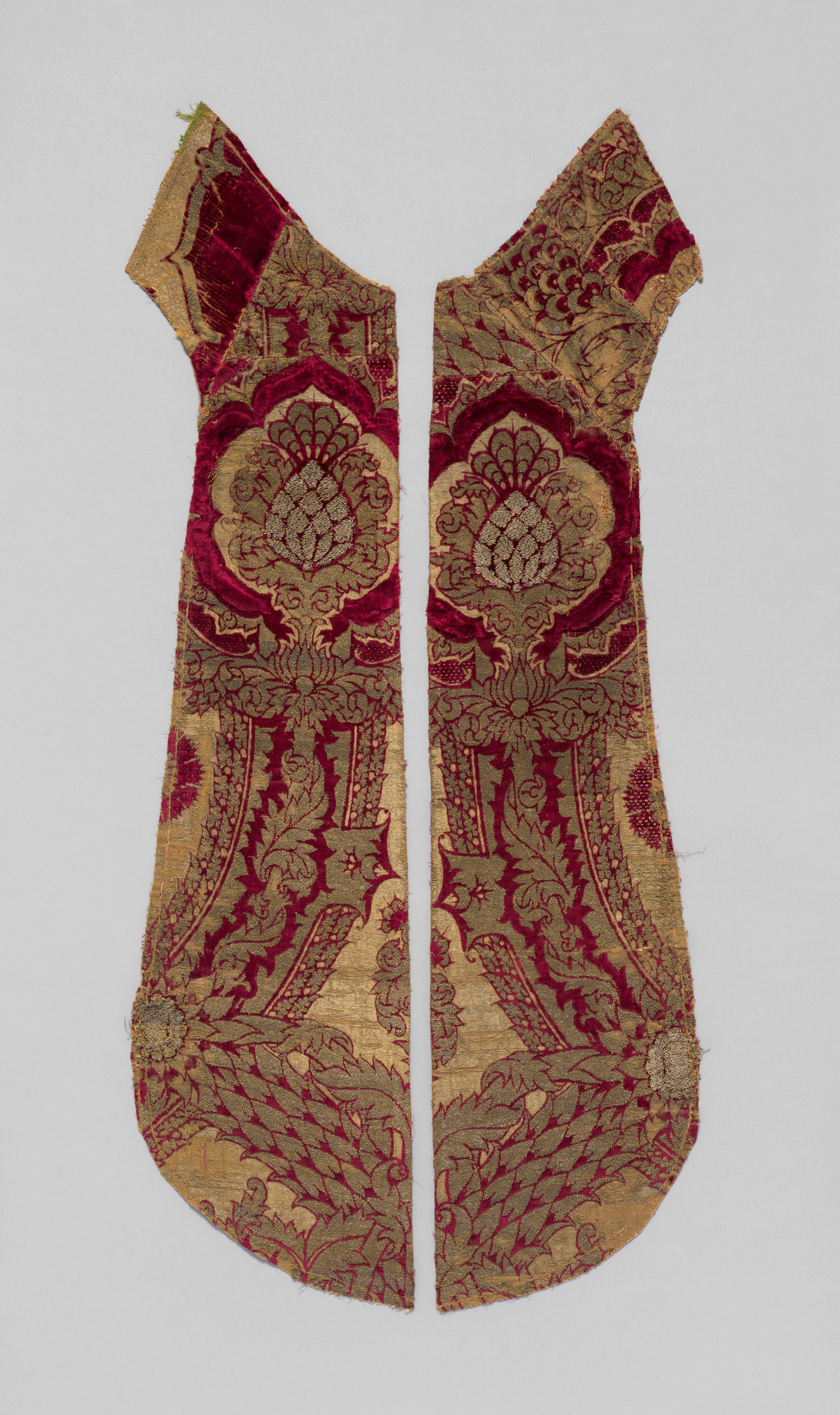
Within the hushed archives of Natalie Fashion Atelier, we isolate a singular artifact: a velvet panel, once part of a liturgical chasuble. Severed from its ceremonial context, it exists now as pure aesthetic archaeology—a fragment of draped history. Its materiality, a plush silk pile interwoven with the rigid luminance of metal thread, presents a compelling paradox. This is not merely a textile; it is a structural manifesto. For the 2026 haute couture season, this chasuble panel serves as our primary research document, informing a new lexicon of silhouette that reconciles devotional weight with contemporary architectural freedom.
Material Dialectics: The Grammar of Silk and Metal
The chasuble’s genius lies in its internal contradiction. The silk velvet provides a ground of absorbent, matte depth, a surface that drinks light and yields to gravity. In contrast, the metal thread—likely a gilded silver or orfroi—acts as a rigid, reflective exoskeleton. This is not mere embellishment; it is a load-bearing system. The metallic filaments, woven in a supplementary weft, create a secondary structure that resists the natural drape of the silk. The result is a fabric that possesses a dual nature: it can flow like liquid shadow or stand as a stiffened architectural plane, depending on how it is cut and manipulated.
For the 2026 atelier, this dialectic is foundational. We move beyond the binary of soft versus hard. Instead, we propose a silhouette that internalizes this tension. The garment does not simply drape the body; it negotiates with it. The silk offers intimacy, a secondary skin; the metal thread offers distance, a ceremonial armor. This negotiation is the new couture gesture.
From Vestment to Vestige: Reinterpreting the Chasuble’s Form
The original chasuble’s form—a voluminous, bell-like envelope—was designed for liturgical movement, not anatomical display. Its front and back panels, once joined at the shoulders, created a powerful, monolithic mass. Our deconstruction isolates this mass and re-engineers it. We extract the “chasuble line”: a silhouette that begins at the shoulder, expands into a generous, unbroken column, and terminates in a weighted, ground-skimming hem. This is not a revival of medieval dress, but a re-contextualization of its spatial logic.
In 2026, this translates into a series of radical propositions. Consider a columnar evening gown where the front is cut from the original velvet, preserving the metal-thread’s vertical striations to elongate the torso. The back, however, is re-cut from a secondary silk, devoid of metal, allowing for a fluid, train-like sweep. The garment thus has two distinct kinetic profiles: a rigid, ceremonial front and a fluid, sensual rear. The wearer experiences the garment as a shifting architectural environment, not a static shell.
Architectural Draping: The Weight of Prestige
The metal thread’s primary contribution to the 2026 silhouette is prestigious weight. In an era of ephemeral, digital fashion, there is a profound luxury in mass. The chasuble panel teaches us that weight is not a limitation but a design parameter. We employ a technique we term “gravitational tailoring.” This involves allowing the metallic density to dictate the garment’s fall, creating deliberate, sculptural folds that would be impossible with lighter fabrics.
Specifically, we are developing a new shoulder construction inspired by the chasuble’s yoke. Instead of a padded, structured shoulder, we use the velvet’s inherent stiffness to create a “self-supporting” cantilever. The metal thread acts as an internal bone structure, allowing the fabric to project outward from the body without visible seams or interfacing. The result is a shoulder line that is both formidable and ethereal—a sharp, geometric plane that softens into the velvet’s fluid body below. This is the 2026 power silhouette, redefined not by aggressive tailoring, but by the quiet authority of material intelligence.
The Palette of Patina: Color as Temporal Depth
Aesthetic archaeology demands we read the artifact’s surface as a record of time. The original chasuble, likely a deep aubergine or royal crimson, has aged. The silk has faded to a muted, smoky plum; the metal thread has tarnished to a bronze-gold. This patina is not decay; it is narrative accrual. For our 2026 collection, we do not replicate the original colors. Instead, we design with the concept of patina.
Our color palette is built on “aged luminosity.” We propose a signature shade: “Relic Aubergine,” a deep, bruised purple with a grey undertone, achieved through a double-dyeing process that mimics the fading of centuries. This is paired with “Tarnished Or,” a metallic finish that is deliberately uneven, with darker oxidation in the crevices of the weave. This is not a nostalgic look. It is a forward-looking aesthetic that values depth over brightness, and history over novelty. The 2026 client does not wear a color; she wears a timeline.
Cutting Against the Grain: Silhouette Strategies
The technical challenge of this material is its resistance to conventional cutting. The metal thread does not yield to the bias. Our pattern-making approach, therefore, is one of “negative space construction.” We do not cut the fabric to fit the body; we cut the body’s space to fit the fabric’s integrity.
This yields three primary silhouettes for the season:
1. The Monolith: A full-length, A-line coat with no side seams. The front and back are cut as single, unbroken panels from the chasuble’s width. The garment is entered from the side, through a hidden placket. The silhouette is severe, almost architectural, but the velvet’s softness allows for a subtle, living movement. The metal thread creates a vertical, ribbed texture that visually slims and elongates.
2. The Reliquary Gown: A sheath dress that encases the body, but with a dramatic, detachable overskirt. The sheath is cut from a pliable silk velvet, while the overskirt is a rigid panel of the metal-thread fabric, shaped into a bell-like form. This overskirt is not sewn to the dress but is suspended from the hips via an internal corset. The wearer can choose to present the full, ceremonial volume, or remove it to reveal the lean, modern sheath beneath. This is couture as a performative act.
3. The Asymmetric Vestment: A single-shoulder top that borrows the chasuble’s diagonal drape. One side of the garment is cut on the straight grain, using the metal thread for structure; the other side is cut on the bias, allowing the silk to spiral around the torso. This creates a silhouette that is simultaneously rigid and fluid, a literal embodiment of the material’s dual nature. The asymmetry is not decorative; it is a functional response to the fabric’s varying properties.
Conclusion: The Future is an Archive
The velvet chasuble panel, isolated and decontextualized, becomes a blueprint. It instructs us that true luxury is not the absence of history, but its deliberate, intelligent incorporation. The 2026 silhouette, informed by this sacred fragment, is not a costume. It is a sophisticated meditation on weight, light, and time. It is a garment that carries its own provenance, not as a label, but as a physical memory embedded in every thread. At Natalie Fashion Atelier, we do not merely design clothes; we engineer relics for the future. This chasuble is our genesis, and the 2026 collection is our testament.