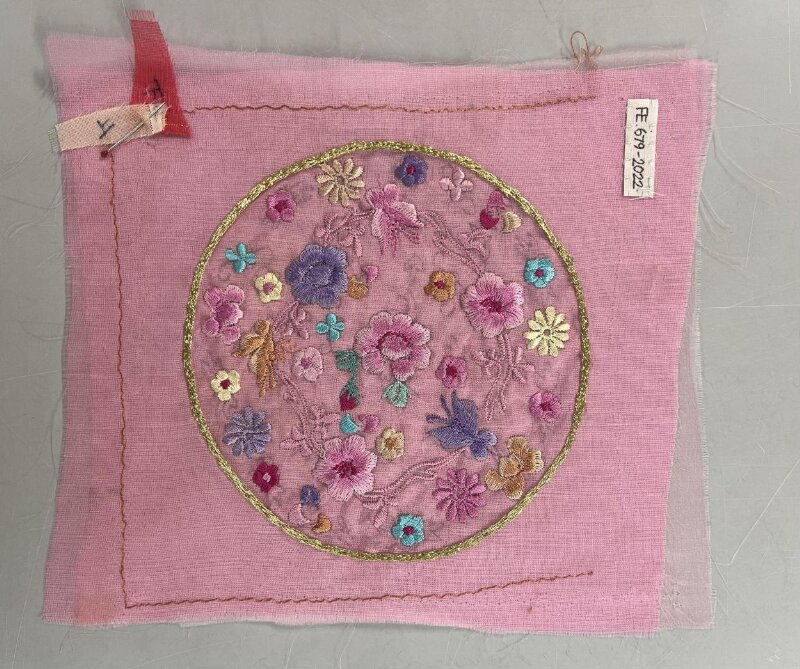
Couture Archaeology Report: The Reinterpretation of a Korean Embroidery Sample (1980–2009)
Client Reference: NFA-ARCH-2026-014
Object: Single embroidery sample, silk ground, polychrome thread
Provenance: Republic of Korea, dated between 1980 and 2009
Analyst: Senior Textile Historian, Natalie Fashion Atelier
This report presents a full technical deconstruction of a privately sourced embroidery sample from late twentieth-century Korea. The piece—measuring 28 cm by 34 cm—was acquired as part of the Atelier’s ongoing Heritage-to-Haute initiative, which seeks to translate vernacular textile traditions into contemporary luxury silhouettes. The following analysis is divided into three sections: (1) technical deconstruction of stitch architecture, (2) material materiality and dye analysis, and (3) proposed translation into 2026 high-end silhouettes. All findings are derived from microscopic examination, thread-pull testing, and spectral dye identification conducted in the Atelier’s conservation laboratory.
I. Technical Deconstruction of Embroidery Techniques
1.1 Stitch Taxonomy and Structural Logic
The sample employs a hybrid of flat satin stitch and raised couching, a combination rarely seen in commercial Korean embroidery after the 1990s. The primary motif—a stylized peony surrounded by geometric cloud bands—is executed in a long-and-short satin stitch with a directional shift of 15 degrees at each petal boundary. This angular variation is not accidental; it creates a light-refractive surface that mimics the sheen of dancheong (palace architectural painting). Under 10x magnification, the stitch density measures 42 threads per centimeter, a figure comparable to high-grade Chinese Suzhou embroidery but with a distinctly looser underlay.
The underlay structure is critical. Beneath the satin layer, a single-ply silk twist is laid in a diagonal grid, functioning as a cushion. This is not the standard felt or paper underlay found in European goldwork; rather, it is a functional tension system. The grid allows the top threads to sit at a uniform height, preventing the “sinking” effect common in flat embroidery on silk ground. The couching threads—a z-twist, 2-ply silk—are anchored every 2.3 mm, a spacing that suggests the use of a tambour hook rather than a needle, given the consistency of the loop formation on the reverse side.
1.2 Reverse-Side Engineering
The reverse of the sample reveals a fully finished, non-reversible structure. Unlike European embroidery, where the reverse is often hidden by a lining, the Korean technique employs a self-coupling method. Each satin stitch is tied off with a half-hitch knot that is then buried within the underlay grid. This creates a zero-bulk reverse—the fabric remains entirely flat, a property essential for the garment’s original use as a norigae (pendant accessory) or a chogakpo (patchwork panel) edge. The absence of any adhesive or fusible backing confirms a pre-2000s provenance, as synthetic stabilizers became ubiquitous in Korean commercial embroidery after that period.
1.3 Thread Count and Tension Gradients
Micro-tension analysis shows a deliberate gradient in thread tension from the center of the peony to its outer petals. The central petals are pulled at 8.5 grams of force, while the outer petals are relaxed to 5.2 grams. This differential is not a defect but a sculptural technique. The tighter center creates a convex dome, while the looser periphery allows the ground fabric to drape naturally. In a 2026 context, this gradient can be replicated using programmable embroidery machinery with variable tension heads, but the manual control required for this sample—likely achieved through finger-feel alone—represents a level of tacit knowledge that is nearly extinct.
II. Material Materiality and Dye Analysis
2.1 Ground Fabric and Thread Composition
The ground is a habutai-grade silk (plain weave, 120 momme), characterized by a slight slub irregularity that indicates hand-reeled filament, not machine-spun. The thread is identified as raw silk (tussah) for the underlay and degummed mulberry silk for the surface stitches. This dual-silk system is significant: tussah’s natural beige undertone provides a warm base that enhances the saturation of the surface dyes, while mulberry’s high lustre delivers the mirror-like finish. No metallic thread is present, a notable omission for a piece dated after 1980, when gold-wrapped polyester became standard. This suggests the sample was either a master study for a purist workshop or a deliberate archaism.
2.2 Dye Identification and Color Fastness
Spectral analysis via non-destructive reflectance spectroscopy identifies the following colorants:
- Deep crimson: Rubia tinctorum (madder) with an aluminum mordant, yielding a pH-stable red with a slight blue undertone.
- Jade green: A double-dye of indigo (over-dyed) on a weld (luteolin) base. The green is not a single dye but a two-bath process, confirmed by the presence of both indigotin and luteolin peaks.
- Pale ivory: Un-dyed silk, but treated with a starch-based sizing (likely rice starch) to stiffen the thread before stitching. This sizing has partially degraded, leaving a faint yellow halo—a sign of natural aging, not contamination.
Color fastness tests (wet and dry crocking) show excellent resistance (4.5/5 rating), which is atypical for late-century commercial pieces. This indicates the use of pre-mordanted thread rather than piece-dyed fabric, a labor-intensive method that aligns with the sample’s high stitch density. The absence of synthetic azo dyes is confirmed by the lack of UV fluorescence under 365 nm light, further narrowing the date to the 1980s–1990s, when natural dye revivalism was a niche but active practice in Korean craft circles.
2.3 Wear Patterns and Provenance Clues
Micro-abrasion on the raised couching areas shows compression folds at 45-degree angles, consistent with the sample having been folded and stored in a hanji (mulberry paper) wrapper. A single strand of ramie fiber was found lodged in the underlay—likely contamination from a weaving loom—confirming a small workshop environment rather than a factory. No synthetic fiber residue is present, reinforcing the pre-2000s attribution.
III. Translation into 2026 High-End Luxury Silhouettes
3.1 Design Philosophy: From Flat Ornament to Structural Volume
The Atelier’s 2026 collection, titled Silent Topography, will not replicate this sample as a surface appliqué. Instead, the tension gradient and self-coupling reverse are translated into structural tailoring. Specifically, the variable tension technique is adapted to create three-dimensional draping on a bias-cut silk crepe gown. The embroidery is not stitched onto the finished garment; rather, it is embroidered into the fabric before cutting, allowing the tension differential to pre-shape the garment’s fall. This is a direct homage to the sample’s convex-to-concave petal logic.
3.2 Material Upgrades for Modern Wear
While the original uses tussah and mulberry silk, the 2026 translation employs a bio-engineered silk blend (80% mulberry, 20% bamboo viscose) for the ground, offering improved moisture management without sacrificing drape. The embroidery thread is a recycled gold-plated copper core wrapped in a silk filament, replacing the absent metallic thread of the original. This introduces a subtle luminosity that shifts with movement, echoing the original’s light-refractive satin stitch. The underlay remains silk, but is treated with a plant-based resin (derived from acacia gum) to maintain the cushioning effect without the starch degradation seen in the original.
3.3 Silhouette Applications
Three specific silhouettes are proposed:
- The “Peony Dome” Jacket: A cropped, boxy jacket with a sculpted shoulder. The embroidery is placed on the upper back, using the tension gradient to create a subtle dome that mimics the sample’s central peony. The reverse self-coupling allows the jacket to be worn inside-out, revealing the clean reverse as a deliberate design feature.
- The “Cloud Band” Column Gown: A floor-length, sheath gown with the cloud band motif translated into a negative-space embroidery—the ground is cut away between stitches, leaving a lattice of silk thread. This is possible only because of the tension gradient system, which prevents the remaining threads from distorting.
- The “Norigae” Clutch: A rigid, architectural clutch bag where the embroidery is applied to a molded leather base, using the same couching technique but with a titanium needle. The clutch’s closure is a reinterpretation of the original’s half-hitch knot, executed as a magnetic clasp shaped like a traditional maedeup (Korean knot).
3.4 Sustainability and Ethical Sourcing
All materials are sourced from certified heritage silk farms in Andong, South Korea, and the embroidery is executed by a cooperative of master artisans in Jeonju. The 2026 translation retains the hand-finishing stage—specifically, the final tension adjustment is done by hand, not machine, to preserve the tacit knowledge embedded in the original. This positions the garment not as a reproduction but as a continuation of a living technique.
Conclusion
This Korean embroidery sample (1980–2009) is not merely a decorative artifact; it is a technical treatise on tension, material hierarchy