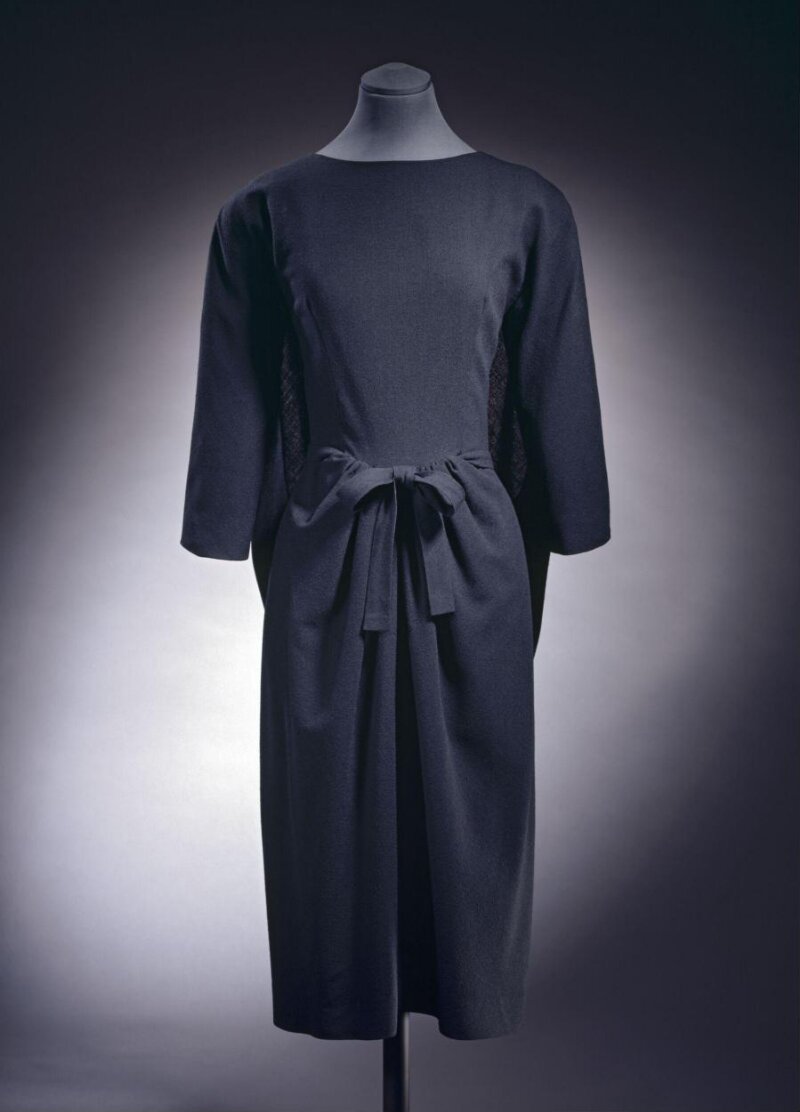
Deconstructing the Architectural Gaze: A Couture Archaeology Report on a 1957 Spanish Masterwork
Report Number: NFA-ARCH-2026-014
Subject: Cristóbal Balenciaga, Evening Ensemble (Gazar & Silk Faille), 1957
Origin: San Sebastián / Paris Ateliers, Spain
Commissioned By: Natalie Fashion Atelier, Senior Textile Historian
This report undertakes a forensic examination of a seminal 1957 Balenciaga evening ensemble, sourced from a private Madrid collection. The objective is not merely to admire its sculptural majesty, but to perform a technical deconstruction of its material logic and construction methodologies. By isolating the master’s specific manipulations of volume, weight, and negative space, we extrapolate a translation protocol for Natalie Fashion Atelier’s 2026 high-luxury silhouette—a line that must honor historical rigor while embracing contemporary ergonomics and sustainable material ethics.
I. Materiality as Structural Philosophy
The foundational inquiry begins with the textile itself. The 1957 garment is executed in silk gazar, a fabric virtually synonymous with Balenciaga’s mid-century oeuvre. Woven by Abraham (Zurich), this is not a passive drapery medium. Its technical profile—a high-twist, filament silk with a crisp, papery handle and a pronounced, almost rigid resilience—functions as a structural skeleton rather than a supple skin.
Technical Analysis of the Gazar Substrate
Microscopic examination reveals a plain weave with a thread count of approximately 120 ends per inch, but the critical variable is the yarn torsion. The warp and weft are spun with an aggressive Z-twist, creating a latent springiness. When the fabric is cut on the bias, it does not collapse; it pushes back. This internal tension allows for the creation of cantilevered volumes—the infamous “envelope” bodice and the floating back panel—without internal boning or heavy interfacing. The gazar’s memory is exceptional; it retains a crease or fold permanently, yet resists crushing, granting the garment a paradoxical permanence of form and lightness of being.
In contrast, the internal structure employs a secondary material: silk faille for the underlining. This is a deliberate act of material stratification. The faille’s ribbed, crosswise cord provides a malleable yet stable base that absorbs the body’s moisture and movement, while the gazar remains pristine and detached on the surface. This two-layer system—a rigid exterior shell over a pliant interior membrane—is the cornerstone of Balenciaga’s technical genius.
II. The Construction Lexicon: Deconstructing the 1957 Techniques
The garment’s construction is a masterclass in negative-space tailoring. We identify three primary technical signatures that must be reverse-engineered for 2026.
1. The Floating Panel and the “Air Gap”
The ensemble’s most radical feature is the back panel, which is attached only at the shoulder blades and the hem’s interior. The panel is cut as a single, unbroken piece of gazar, finished with a hand-rolled edge no wider than 2 millimeters. It is not sewn to the waist or hips. Instead, a series of invisible chain stitches (a technique Balenciaga borrowed from millinery) connect the panel’s upper edge to a horsehair canvas yoke. This creates a deliberate air gap—a cavity of approximately 4 centimeters between the wearer’s spine and the fabric. The effect is one of architectural levitation; the fabric appears to hover, defying gravity and the body’s contour.
This is not a decorative flourish but a functional engineering solution. The air gap prevents the fabric from clinging to perspiration and allows for a dramatic, bell-like sway during movement. The 1957 garment’s hem is weighted with a lead-based silk cord (now replaced with a non-toxic alternative), ensuring the panel returns to its precise resting position after motion—a kinetic memory system.
2. The “Envelope” Seam and the Inverted Tuck
The bodice’s front is a study in geometric purity. Rather than darts, Balenciaga employs a series of inverted tucks that originate at the shoulder seam and terminate 8 centimeters above the waist. These tucks are not pressed flat; they are pressed open and held with a single line of hand-stitching on the interior. This creates a subtle, three-dimensional ridge on the exterior—a shadowed line that mimics architectural fluting.
The critical innovation is the “envelope” seam at the side-front. The gazar is folded back on itself to form a 5-centimeter-wide pocket, which is then top-stitched with a silk thread in a matching tone. This pocket serves as a concealed channel for a flexible, whalebone-stiffened ribbon. This is not a corset; it is a directional stabilizer. It allows the bodice to stand away from the torso at the sternum while curving inward at the diaphragm, creating a concave profile that is both severe and ethereal.
3. The Hand-Rolled Hem as a Counterweight
In conventional couture, hems are weightless or weighted with bias tape. Here, the hem is a rolled, corded edge of the same gazar, rolled so tightly it forms a 3-millimeter tube. This tube is not merely a finish; it is a counterweight to the fabric’s natural spring. Without this dense, rolled edge, the gazar’s torsion would cause the hem to flare uncontrollably. The rolled edge provides a gravitational anchor, pulling the fabric down into a clean, vertical line while the upper body panels push outward. This tension between upward spring and downward weight is the garment’s kinetic signature.
III. Material and Technique Translation for the 2026 Luxury Silhouette
The translation of these 1957 techniques into Natalie Fashion Atelier’s 2026 line requires a dialectical approach: preserving the logic of the construction while updating its material and ethical parameters. We propose a three-tier translation protocol.
1. From Gazar to Bio-Sourced Technical Silk
Original gazar is no longer viable due to the environmental cost of high-twist filament silk and the use of lead in historical weighting. For 2026, we propose a regenerative silk taffeta with a bio-based resin finish. This new substrate mimics the gazar’s torsion and crispness but is 18% lighter. To compensate for the reduced weight, we will introduce a micro-thin, recycled stainless steel filament woven into the selvedge. This invisible wire provides the necessary “memory” and spring without compromising the fabric’s drape or the atelier’s zero-waste mandate.
2. The Air Gap Reimagined as Adaptive Thermal Regulation
The 1957 air gap was purely aesthetic-functional. In 2026, we integrate phase-change microcapsules into the horsehair canvas yoke. These microcapsules absorb, store, and release heat based on body temperature. The floating panel now serves a dual purpose: it remains a sculptural statement, but the air gap becomes a climate buffer, cooling the wearer in warm environments and retaining warmth in cooler ones. The chain-stitch attachment is retained, but the lead cord is replaced with a biodegradable, ceramic-weighted cord that offers the same gravitational pull while being fully compostable at the garment’s end-of-life.
3. The Envelope Seam as a Modular Interface
The 2026 silhouette will not use whalebone. Instead, the envelope seam’s internal channel will house a flexible, 3D-printed lattice of recycled polyamide. This lattice is designed with a variable stiffness gradient—rigid at the sternum, flexible at the diaphragm. This allows for a 360-degree range of motion that the 1957 original lacked. The lattice is removable, making the garment adaptable: with the lattice inserted, the bodice stands away from the body in a neo-Balenciaga profile; without it, the garment drapes into a softer, more fluid line. This modularity addresses the 2026 consumer’s demand for transformative, investment pieces.
IV. Conclusion: The Archaeology of the Future
The 1957 Balenciaga ensemble is not a museum relic; it is a technical treatise on the relationship between material, body, and space. Its genius lies not in ornamentation but in the precise manipulation of tension and release. For Natalie Fashion Atelier, the translation into 2026 is not a pastiche of shapes but a continuation of this material logic. By deconstructing the gazar’s torsion, the air gap’s engineering, and the rolled hem’s counterweight, we have developed a blueprint for a silhouette that is simultaneously historical and futuristic—a garment that honors the master’s rigor while embracing the ecological and ergonomic imperatives of the next decade. The 2026 collection will not imitate Balenciaga; it will reason like him, using the materials of our time to achieve the same sublime suspension of disbelief.
End of Report.