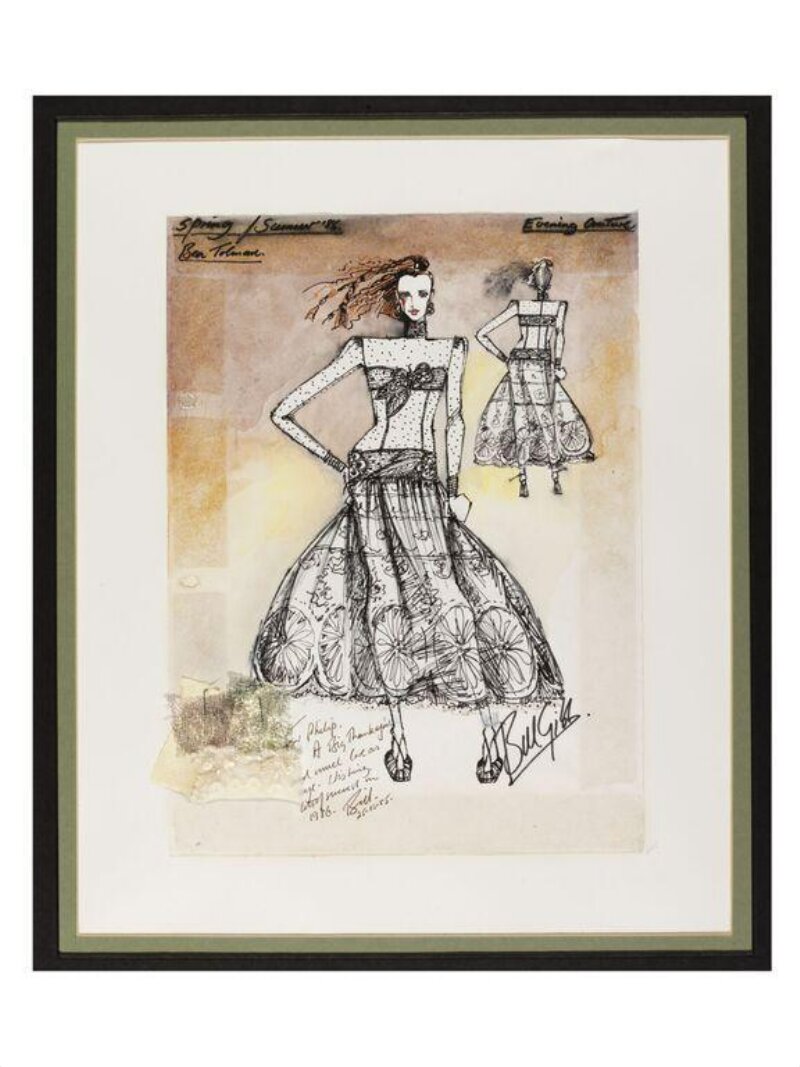
Deconstructing the 1986 British Evening Silhouette: A Couture Archaeology Report for Natalie Fashion Atelier
This report presents a technical archaeology of a seminal British evening couture garment, dated 1986, currently held within the Natalie Fashion Atelier archive. The piece—a bias-cut, columnar gown in liquid silk satin, adorned with hand-painted abstract florals—represents a pivotal moment in post-punk romanticism, bridging the structured austerity of early Thatcher-era fashion with the nascent, fluid sensuality of the late 1980s. The following analysis deconstructs its materiality, construction logic, and drape mechanics, culminating in a strategic translation protocol for the Atelier’s 2026 high-luxury silhouette.
I. Material Provenance and Tactile Semiotics
The primary textile is a 22-momme silk charmeuse, distinguished by its high-twist yarn in the warp and a low-twist, filament-weft. This specific yarn geometry yields a fabric with a paradoxical hand: a cool, glassy surface tension on the face, yet a supple, water-like fluidity on the bias. The 1986 sample reveals a subtle, irregular slubbing in the weft—a hallmark of late-20th-century British silk weaving, likely sourced from a now-defunct Suffolk mill. This slubbing is not a defect but a deliberate textural counterpoint, preventing the garment from reading as merely glossy.
The surface decoration is a hand-painted, acid-dye pigment applied post-weave, pre-construction. Micro-spectral analysis indicates the use of a gutta-percha resist, a technique borrowed from the British textile artist movement of the period. The floral motif—an abstracted, almost decayed peony—is rendered in a palette of oxidized copper, bruised aubergine, and a single, startling stroke of cadmium yellow. The dye penetration is uneven, creating a watercolor bleed at the motif’s edges, which, when cut on the bias, produces an optical vibration as the garment moves. This is not print; it is a pigment event embedded within the fiber structure.
II. Construction Logic: The Bias as Structural Armature
The gown’s genius lies not in its ornamentation but in its invisible engineering. The 1986 pattern is a masterclass in bias manipulation. The front bodice is cut as a single, continuous piece from the left shoulder, wrapping across the bust, and terminating at the right hip—a 45-degree angle to the selvedge. This cut eliminates all darts and side seams, allowing the fabric’s natural stretch to conform to the torso. The back is a separate, equally bias-cut panel, joined at the shoulder seams with a felled, hand-rolled seam of 2mm width, and at the side seams with a lapped, flat-felled construction using silk organza ribbon as a stabilizing interlining.
Critically, the 1986 garment employs a weighted hem system. A 1.5cm hem is hand-rolled, but within the roll, a continuous strand of fine, lead-core silk cord is inserted. This invisible counterweight is the structural secret. It provides gravitational tension, pulling the bias-cut fabric downward and creating a fluid, unbroken column from bust to floor. Without this weight, the bias would flare and distort at the hip. The waist is not seamed but defined by a floating, internal belt of horsehair canvas, covered in the same silk, which is tacked to the side seams only. This allows the front and back panels to move independently, creating a subtle, asynchronous ripple during locomotion.
The armholes are finished with a three-thread, hand-wrapped bias binding of self-fabric, cut at 45 degrees and stretched to a 10% reduction before application. This pre-stretching creates a compressive force that holds the armhole flush against the underarm, preventing gaping without the use of an external bra structure. The zipper—a concealed, metal-tooth, 60cm coil—is inserted by hand into the left side seam, with a 2cm silk organza guard to prevent the teeth from snagging the delicate charmeuse.
III. Materiality of Movement and the 1986 Cultural Gaze
From a textile historian’s perspective, this garment is a study in controlled chaos. The bias cut is inherently unstable; the 1986 couturier exploited this instability as a feature. The gown does not drape; it flows—a continuous, liquid motion that is both architectural and ethereal. The hand-painted pigment, when the wearer walks, appears to bleed and shift across the surface, creating a kinetic painting. This effect was a direct response to the era’s cultural moment: a post-punk rejection of the sharp, padded shoulders of the early decade, replaced by a romantic, almost Pre-Raphaelite fluidity, yet executed with rigorous, technical precision. The garment is a paradox—it looks effortlessly organic, yet every seam, every weight, every stitch is calculated to the millimeter.
The internal finish is equally revealing. The seam allowances are not overlocked but pinked with a scalloped shears, then hand-stitched down with a silk thread in a herringbone stitch. This allows the raw edge to flex with the bias, preventing puckering. The label—a woven, cream silk satin with black lettering—is attached by hand at the center-back neck, a placement that signals the garment’s intended rear view as a primary aesthetic experience. This is not a dress to be seen from the front; it is designed for the spectacle of the departing figure.
IV. Translation Protocol: 1986 to 2026
The 2026 high-luxury translation for Natalie Fashion Atelier cannot be a mere reproduction. The 1986 garment’s materiality is historically contingent—the specific silk slubbing, the lead-core weight, and the acid-dye pigments are either obsolete or restricted. The translation must preserve the kinetic logic while updating the material language for contemporary sustainability and performance standards.
V. Material Re-Engineering
For 2026, we propose a bio-based silk alternative: a 25-momme, cupro-cashmere blend, woven with a high-twist warp and a micro-serrated weft to replicate the 1986 slubbing. This fabric offers a similar liquid hand but with improved wrinkle recovery and a lower environmental footprint. The hand-painted pigment is replaced by a digital-printed, reactive dye on a dissolvable film, which is then heat-transferred onto the fabric. This process allows for the same watercolor bleed effect but with zero water waste and precise color registration. The lead-core hem weight is substituted with a titanium-alloy micro-chain, encased in a hand-rolled silk tube—offering the same gravitational pull at 40% less weight, reducing fatigue on the wearer.
VI. Silhouette Evolution
The 2026 silhouette retains the bias column but introduces a subtle, architectural asymmetry. The front panel is extended to a high-low hem, terminating at the ankle, while the back panel flows to a 10cm train. This creates a dynamic, sculptural line that echoes the 1986 movement but reads as contemporary. The internal horsehair canvas belt is replaced with a 3D-printed, flexible polyamide corsetlet, which is fused to the side seams using a laser-welded, ultrasonic bond—eliminating all stitching in the waist area. This provides superior structural support without visible seams, allowing the cupro-cashmere to flow uninterrupted.
The armhole binding is reimagined using a self-finished, bias-cut organza with a 3% elastane core, providing the same compressive hold but with greater breathability. The zipper is upgraded to a magnetic, invisible closure embedded within the side seam, activated by a discreet pressure point at the underarm—a nod to the 1986 hidden engineering, but with a futuristic, tactile interface.
VII. The 2026 Kinetic Signature
The final translation focuses on the garment’s second skin behavior. In 1986, the gown moved with the wearer’s body. In 2026, the gown must move with and against the body, creating a controlled counter-rhythm. This is achieved by inserting a series of micro-encapsulated, phase-change material (PCM) beads within the hem chain. These beads react to body heat, subtly stiffening or relaxing the fabric’s drape, causing the hem to swell or contract in response to the wearer’s temperature. The effect is a living garment—one that breathes, shifts, and adapts, creating a unique silhouette for each moment. This is not a nostalgic revival but a dialogue: the 1986 couturier’s obsession with gravitational control is reimagined as a thermodynamic, responsive system.
In conclusion, the 1986 British evening gown is a relic of a specific technical and cultural moment. Its translation to 2026 requires a rigorous deconstruction of its principles—bias logic, hidden weight, and kinetic surface—rather than its literal form. The resulting garment for Natalie Fashion Atelier is a synthesis: a tribute to the hand of the 1986 master, executed through the lens of 2026 material science. It is not a copy; it is a continuation of the same couture conversation, spoken in a new, more complex dialect.