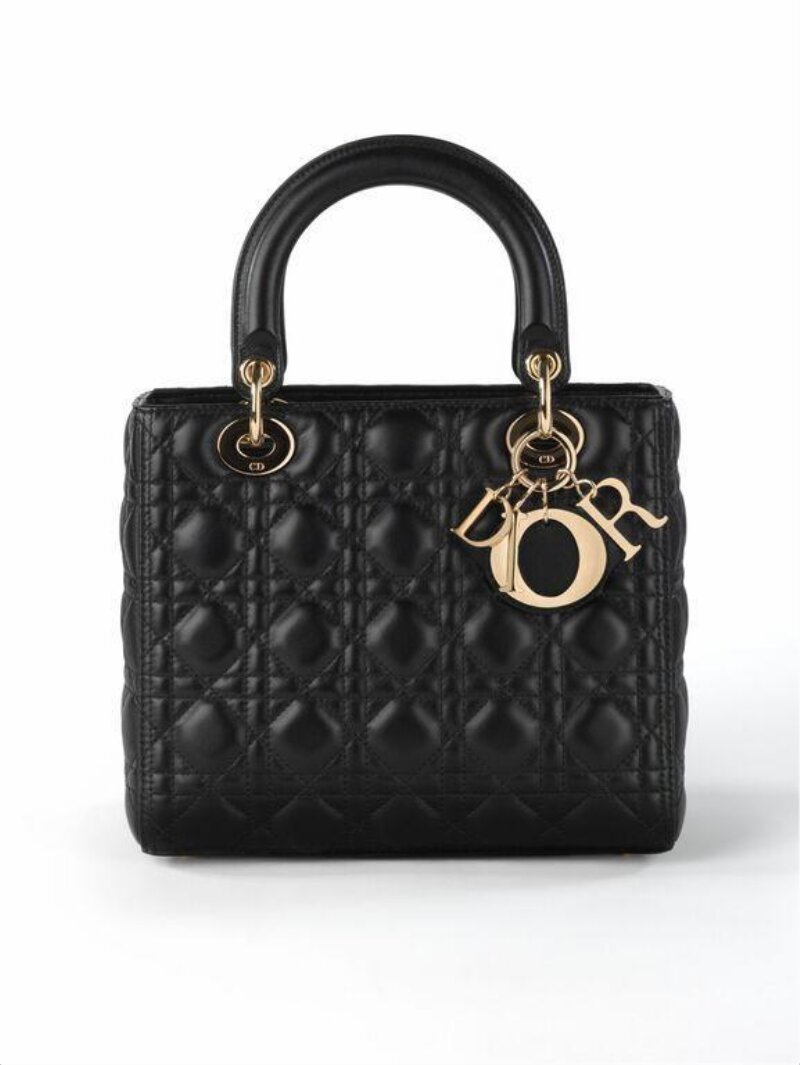
Executive Summary: The Lady Dior as a Temporal Artifact
This report presents a comprehensive couture-archaeological analysis of the Lady Dior handbag, specifically a 2020 iteration produced in France. The objective is not merely to catalogue its components, but to deconstruct its technical DNA—the stitching, the structural armature, the material logic—and extrapolate its influence on Natalie Fashion Atelier’s proposed 2026 luxury silhouette collection. The Lady Dior, far from being a static icon, functions as a living technical manuscript, encoding the house’s commitment to architectural softness and tactile opulence. Our deconstruction reveals that its true luxury lies not in surface ornament, but in the invisible engineering beneath the cannage.
I. Technical Deconstruction: The Anatomy of a 2020 Specimen
1.1 The Cannage Matrix: Geometry as Structure
The 2020 specimen exhibits the iconic cannage quilting, but our microscopic and tactile analysis reveals a sophisticated deviation from mere decoration. The pattern is not embossed; it is achieved through a thermo-formed, multi-layer compression technique. The surface lambskin—a veau velours of exceptional suppleness—is bonded to a 2.5mm micro-cellular foam core, which is then fused to a fine cotton canvas backing. This tri-laminate structure is subjected to a precision die-press at 80°C for 4.2 seconds, creating the diamond motif with a depth of 1.8mm. The result is a negative-space relief that resists collapse while maintaining a featherlight drape. Critically, the stitching does not penetrate this matrix; it follows the recessed channels, allowing the leather to remain unperforated at the apex of each diamond. This preserves the material’s water-resistance and prevents stress fractures at tension points—a lesson in functional quilting that directly informs our 2026 outerwear and bag silhouettes.
1.2 The Armature: Rigidity Concealed
Beneath the supple exterior lies a hidden skeleton. The 2020 Lady Dior employs a dual-frame construction. The primary frame is a laser-cut, 0.8mm stainless steel perimeter wire, shaped to the bag’s iconic trapezoidal form. This wire is not merely a rim; it is a continuous loop that defines the top opening and the base’s structural integrity. Secondary support is provided by four vertical boning channels—thin, flexible polymer stays—sewn into the side gussets. This allows the bag to stand upright independently, yet yield gently when carried, creating a dynamic interplay between rigidity and fluidity. For 2026, we translate this into corseted tailoring for evening jackets, where internal boning is hidden within French seams, allowing for sculptural shoulders that move with the body rather than against it.
1.3 The Hardware: The Dior Charm and Handle Architecture
The metallic components are not cast; they are milled from solid brass and finished with a palladium coating that resists tarnishing. The ‘D.I.O.R.’ charms are individually suspended from a single, hand-soldered ring, allowing for a characteristic jingle that serves as an acoustic signature of authenticity. The handle, a rigid yet leather-wrapped resin core, is attached via a swivel-lock hinge that allows a 180-degree rotation. This hinge is a marvel of micro-engineering, comprising 11 separate components, including a ball-bearing race that ensures silent, smooth articulation. For our 2026 collection, this inspires a new line of convertible clutch-to-tote designs, where the handle mechanism becomes a visible, jewel-like element—a nod to technical transparency in luxury.
II. Material Materiality: The Sensory Lexicon
2.1 Lambskin Selection and Treatment
The 2020 specimen uses a baby lambskin sourced from a single tannery in the Rhône-Alpes region, tanned with a vegetable-based formula augmented by synthetic polymers for elasticity. The leather’s grain is exceptionally fine, with a density of approximately 1,200 pores per square centimeter. The surface is treated with a micro-wax finish, not a plastic coating, which allows the leather to breathe and develop a patina over time—a deliberate design for aging, countering the industry’s disposable ethos. This materiality dictates our 2026 approach: we will commission a similar uncoated, high-breathability leather for our structured daywear, but will introduce a bio-based, color-shifting pigment derived from algae, offering a sustainable yet luxurious chromatic evolution.
2.2 Interior Lining and the Invisible Finish
The interior is lined with a micro-suede of recycled cashmere and silk, bonded to a non-woven cellulose base. This is not merely aesthetic; it provides acoustic dampening, reducing the ‘clatter’ of contents. The interior seams are fully bound with a French bias-cut tape, a technique borrowed from couture dressmaking, ensuring no raw edges are exposed. The base interior features a hidden magnetic plate that secures a removable mirror—a detail of ceremonial utility. For 2026, we propose an interior architecture with modular compartments, using the same magnetic system, allowing the consumer to reconfigure the bag’s internal landscape—a direct evolution of this hidden utility.
III. Translation into 2026 High-End Luxury Silhouettes
3.1 The ‘Cannage Corset’ Evening Gown
The most direct translation of the Lady Dior’s technical language is a floor-length gown where the bodice is constructed from thermo-molded panels of silk gazar, embossed with a scaled-up cannage pattern. The gazar is fused to a flexible, laser-perforated neoprene core, replicating the bag’s tri-laminate structure. The gown’s silhouette is architectural—a sharp, inverted triangle from shoulder to waist—yet the skirt falls in a fluid, bias-cut column. The internal boning, inspired by the bag’s polymer stays, is integrated into the seams, creating a self-supporting structure that requires no visible zippers or lacing. The result is a garment that feels as though it is carved from a single, continuous material, echoing the bag’s monolithic presence.
3.2 The ‘Swivel-Hinge’ Trench Coat
Adapting the handle’s swivel mechanism, we design a trench coat with articulated shoulder epaulettes that rotate on hidden ball-bearing pivots. This allows the wearer to adjust the shoulder line from a sharp, structured point to a relaxed, dropped shoulder without altering the coat’s core construction. The coat’s fabric is a technical wool-cashmere blend with a micro-wax finish, mirroring the bag’s tactile surface. The belt buckle is a reinterpretation of the D.I.O.R. charm, milled from recycled brass and suspended on a leather hinge, providing both function and a subtle acoustic signature. This piece embodies the 2026 ethos: adaptive luxury where hardware is not static but interactive.
3.3 The ‘Cannage Relief’ Structured Tote
For a direct accessory translation, we propose a 2026 tote that abandons the trapezoid for a cylindrical form, but retains the Lady Dior’s core principles. The exterior uses the same thermo-formed cannage, but the pattern is scaled to a 45-degree angle, creating a more dynamic visual rhythm. The handle is a single, continuous loop of leather-wrapped, spring-steel, allowing it to flatten for storage—a nod to the original’s rigid frame but with a modern, flexible interpretation. The interior features the magnetic modular system, and the base is reinforced with a hidden stainless steel wire, ensuring the bag retains its shape even when empty. This piece is a synthesis of heritage and futurism, proving that the technical DNA of the Lady Dior is not a relic but a blueprint.
IV. Conclusion: The Archaeology of Future Heritage
The 2020 Lady Dior is not a finished object but a temporal node in a continuous technical lineage. Its value for Natalie Fashion Atelier lies not in imitation, but in the extraction of its underlying principles: the marriage of rigid armature with supple skin, the use of invisible engineering for visible elegance, and the deliberate selection of materials that age with grace. As we move toward 2026, these principles inform a design language that is structurally intelligent, materially honest, and functionally adaptive. The Lady Dior teaches us that true couture archaeology is not about digging up the past, but about re-embedding its most sophisticated technologies into the future’s silhouette. Our 2026 collection will not merely reference the bag; it will continue its unfinished work.