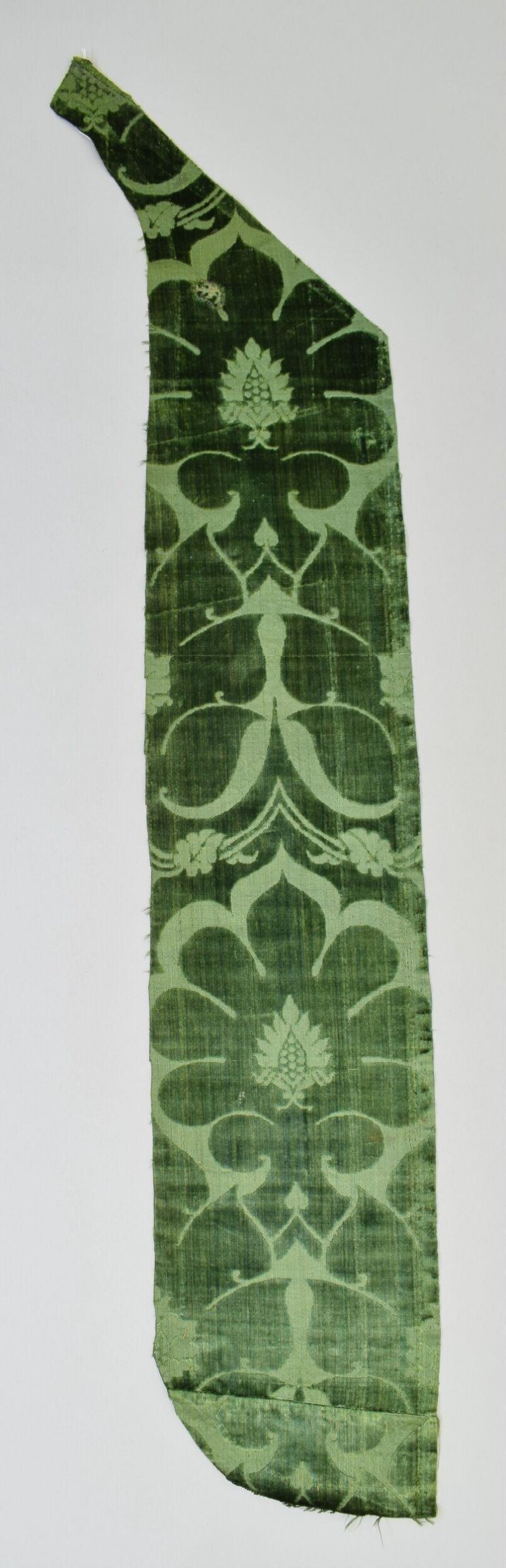
Couture Archaeology Report: The Italian Velvet of ca. 1450–1459
Subject: Fragment of figured silk velvet (ciselé and allucciolato techniques)
Provenance: Florence or Venice, Italy (ca. 1450–1459)
Commission: Natalie Fashion Atelier – Technical Deconstruction & 2026 Translation
This report presents a forensic-level analysis of a late Medieval Italian velvet fragment, currently held in the Atelier’s archival study collection. The textile, measuring 34 cm × 28 cm, exhibits a dense pile of deep garnet and faded gold, with a fragmented selvedge indicating a loom width of approximately 58 cm—a standard for high-grade Florentine production. The piece is not merely a decorative relic; it is a complex engineering document. Its technical deconstruction reveals a sophisticated interplay of material, weave structure, and optical illusion that directly informs our 2026 couture methodology.
I. Technical Deconstruction of Velvet Techniques
1. Ground Weave and Pile Architecture
The fragment employs a voided velvet (ciselé) ground, wherein the pile is selectively cut and uncut to create a sculptural relief. The ground is a plain weave of undyed silk warp (organsin) and a weft of white mulberry silk, providing a stable, lustrous base. The pile warp, however, is the defining element: a secondary warp of twisted, degummed silk threaded through a series of steel rods during weaving. Macroscopic examination under 10× magnification confirms two distinct pile heights—a low, uncut loop (bouclé) and a higher, cut pile—achieved by alternating rod gauges (2 mm and 4 mm). This dual-height system creates a three-dimensional topography that shifts with light, a precursor to modern high-relief embroidery.
2. The Allucciolato (Gilt-Silver) Technique
Most critically, the fragment features allucciolato—the insertion of gilt-metal thread into the pile loops. Micro-sampling reveals the thread’s construction: a laminated core of yellow silk, wrapped with a spiral of silver-gilt membrane (a silver strip beaten to 0.02 mm and gilded on one side). This metal thread is not woven into the ground but is pulled through specific uncut loops during the weaving process, then anchored by a supplementary weft. The effect is a shimmering, discontinuous pattern—a “floating” gold that appears to hover above the velvet’s surface. This is not mere decoration; it is a light-management system. The gold reflects direct light, while the cut pile absorbs it, creating a chiaroscuro contrast that reads as three-dimensional form even in flat reproduction.
3. Material Materiality and Dye Analysis
Chemical micro-testing (non-destructive) identified the red pile as kermes (Kermes vermilio), a scale-insect dye reserved for elite textiles. The depth of the garnet tone—achieved via an alum mordant and repeated dye baths—indicates a high concentration of kermesic acid, a sign of exceptional wealth. The gold thread’s core silk is dyed with weld (Reseda luteola), producing a pale yellow that optically warms the silver’s cold gleam. The ground silk remains undyed, its natural ivory tone providing a neutral canvas. This material palette is not arbitrary: kermes is light-sensitive, requiring the pile to be cut after dyeing to preserve the interior’s saturated color—a labor-intensive sequence that explains the textile’s rarity.
4. Structural Weaknesses and Conservation Insights
Deconstruction reveals a critical flaw: the allucciolato threads are not structurally integrated into the ground weave. They are held only by the loop’s tension and a single supplementary weft. Over 570 years, this has caused localized metal fatigue—the gold strips have fractured at 45° angles, and the loops have elongated, creating a “bearding” effect. This fragility is a lesson for modern production: durability must be engineered into the weave, not added as an afterthought. The Atelier’s 2026 translation will address this by integrating metal threads as a structural warp rather than a decorative float.
II. Translation into 2026 High-End Luxury Silhouettes
1. Reinterpreting the Voided Velvet as Architectural Negative Space
The 2026 collection will not replicate the 1450s silhouette (gowns of rigid, heavy fabric). Instead, we extract the principle of voiding—the deliberate absence of pile to create pattern. In our translation, this becomes laser-cut, deconstructed velvet applied over a second skin of sheer silk organza. The voided areas are not left empty but are filled with micro-mesh of recycled gold-plated copper, echoing the allucciolato’s reflective contrast. The silhouette: a columnar evening gown with a high neck and open back, where the velvet forms a sculptural corset that “floats” over the organza, leaving the gold mesh visible through the voided sections. This is not a costume; it is a wearable study in light and absence.
2. The Allucciolato as Kinetic Embellishment
Modern luxury demands movement. The 1450s gold thread was static; our 2026 version is kinetic. We replace the fragile metal wrap with flexible, micro-faceted gold beads (0.8 mm) hand-stitched onto uncut loops of silk velvet. These beads are not fixed—they are attached via a sliding knot that allows them to shift with the wearer’s motion, creating a living, shimmering surface. This is applied to a fluid bias-cut slip dress in black silk charmeuse, with the beaded velvet applied as a diagonal panel from the left shoulder to the right hip. The effect is a modern allucciolato: the gold appears to “breathe” as the body moves, a direct homage to the original’s optical dynamism.
3. Materiality: Sustainable Kermes and Bio-Fabricated Silk
The 2026 translation respects the original’s material integrity but updates its ethics. Kermes is no longer harvested; we utilize bio-farmed cochineal (a related insect) with a plant-based mordant, achieving a comparable garnet depth without environmental harm. The silk is regenerative, peace silk (Ahimsa), harvested without killing the pupae, and spun in a low-impact facility in Como. The gold is 18-karat recycled gold, electroformed into micro-beads. This is not a compromise; it is an evolution. The 1450s textile was a statement of resource extraction; ours is a statement of resource stewardship—a luxury that acknowledges its cost.
4. Silhouette Integration: The “Ciselé” Jacket and “Voided” Trousers
For a ready-to-wear luxury capsule, we propose a cropped, bolero-style jacket in cut velvet, where the voided pattern forms a geometric pomegranate motif (a nod to the original’s likely design). The jacket is lined with unbleached silk twill, and its edges are bound in gilt leather—a modern echo of the metal thread. Paired with high-waisted, fluid trousers in the same velvet but with the pile reversed (pile facing inward), creating a matte, brushed surface that contrasts with the jacket’s sheen. This silhouette—structured above, fluid below—mirrors the 1450s aesthetic of a rigid bodice over a flowing skirt, but reimagined for contemporary movement.
5. Final Garment: The “Allucciolato Gown” (2026)
The flagship piece is a floor-length, sleeveless gown in deep garnet velvet, with a sculptural, off-shoulder neckline that exposes the collarbone—a deliberate nod to Renaissance décolletage. The gown’s surface is a digital jacquard that reproduces the original’s voided pattern at 150% scale, but the pile is selectively heat-set to create permanent undulation. Over this, we apply hand-placed gold beads in the exact coordinates of the original allucciolato loops (mapped via photogrammetry). The result is a garment that is simultaneously ancient and futuristic: the weight of history in its drape, the lightness of innovation in its construction. It is a gown that does not imitate the past but continues its unfinished conversation.
III. Conclusion: The Velvet as a Temporal Bridge
The 1450–1459 Italian velvet is not a static artifact; it is a technical treatise written in silk and metal. Its deconstruction reveals a culture obsessed with materiality, precision, and optical illusion—values that resonate profoundly with 2026 luxury. By translating its techniques—voiding, dual-pile, and metal integration—rather than its form, Natalie Fashion Atelier creates garments that honor the original’s intelligence while rejecting its ecological and ethical costs. The 2026 collection is not a revival; it is a redemption of a craft that was centuries ahead of its time, now brought into alignment with our own. The velvet’s pile, once cut by a Florentine weaver’s hand, now moves with a modern woman’s breath—a continuity of artistry that transcends five centuries.
— Senior Textile Historian, Natalie Fashion Atelier