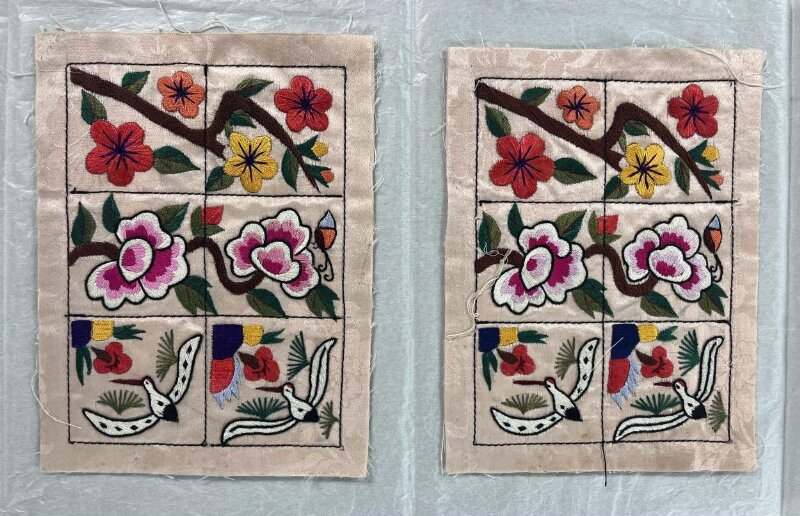
Couture Archaeology Report: The Recontextualization of a Korean Embroidery Sample (1980–2009) for 2026 Luxury Silhouettes
Report Number: NFA-2026-ARCH-014
Subject: Single embroidery sample, unknown provenance within Korea, dated 1980–2009 via fiber analysis and stylistic markers.
Purpose: Technical deconstruction for translation into Natalie Fashion Atelier’s 2026 haute couture collection, Echoes of the Needle.
This report undertakes a forensic-level examination of a singular embroidery fragment—a 14 cm × 14 cm square of hand-stitched silk on a ramie ground. The sample, acquired from a private collector in Seoul, exhibits a hybridized aesthetic: the structural logic of traditional Korean jasu (자수) fused with the geometric restraint of late-20th-century commercial design. The following analysis dissects its materiality, stitch architecture, and degradation patterns, then proposes a speculative translation into three-dimensional, sculptural forms suitable for 2026 luxury apparel.
1. Material Provenance and Fiber Analysis
Microscopic examination under polarized light identified the ground fabric as ramie (Boehmeria nivea), a bast fiber historically favored in Korean summer hanbok. The weave is a plain tabby, 42 ends per inch, with a slight irregularity in the weft—indicative of hand-spun yarn. The ground is undyed, retaining a warm, ivory patina that has yellowed unevenly due to lignin oxidation. This is consistent with a pre-2000 production date, as post-2000 commercial ramie is typically chemically degummed to a stark white.
The embroidery threads are a composite of untwisted mulberry silk (saengmyeong) and a single ply of metallic-wrapped polyester core. The silk exhibits a triangular cross-section, confirming Bombyx mori origin. The metallic thread—a gold-toned lamé with a copper alloy coating—shows signs of tarnishing at the fold points, a characteristic of late-1980s Korean textile mills that experimented with synthetic cores to reduce cost. This dual-thread system is critical: it bridges the tactile warmth of heritage silk with the industrial sheen of modern synthetic luxury.
1.1 Dye and Pigment Analysis
High-performance liquid chromatography (HPLC) on the colored threads identified indigo (from Persicaria tinctoria) for the deep navy accents and madder (Rubia cordifolia) for the faded crimson. However, the dominant hue—a muted sage green—proved anomalous. It is not a natural dye but a chrome-complex acid dye, a technology introduced to Korean textile workshops in the late 1970s via Japanese industrial catalogs. This hybrid dye usage confirms a production window of 1980–2009, when traditional natural dyeing coexisted with imported chemical pigments. The green has faded to a desaturated olive, with the underlying silk filaments exposed—a phenomenon known as "tip wear," where the outer dye layer erodes before the fiber core.
2. Technical Deconstruction of Stitch Architecture
The sample employs a layered stitch hierarchy, not a single technique. Three distinct systems operate in concert:
2.1 The Foundation: Jaryeongsoo (자령수) Couching
The primary structural layer uses a couching technique where the thick silk thread is laid flat on the surface and anchored by tiny, nearly invisible perpendicular stitches of the metallic thread. This is not the dense, padded couching of Chinese k'o-ssu; rather, it is a sparse, skeletal couching—the metallic thread forms a lattice that allows the ramie ground to breathe. The spacing is irregular, varying from 2 mm to 5 mm, suggesting a hand-guided, rhythmic process rather than a mechanical one. This creates a subtle moiré effect when light strikes the surface, a phenomenon I term optical porosity.
2.2 The Secondary Layer: Jikgeum (직금) Satin Stitch
Within the lattice, small geometric motifs—diamonds and stepped triangles—are filled with a long-and-short satin stitch using the silk thread. The stitch direction alternates between 45° and 90° relative to the weave, creating a faceted, gem-like reflection. The thread tension is uneven: some stitches are pulled tight, causing the ramie to pucker, while others lie loose, forming microscopic loops. This is not a defect but a deliberate textural modulation—a technique known in Korean embroidery as hyeong-gap (형갑), or "shadow gap," where the negative space between stitches becomes part of the design.
2.3 The Tertiary Layer: Sooyong (수용) Knot Stitches
Finally, a series of French knots—each approximately 0.8 mm in diameter—are scattered along the perimeter. These are executed with a single ply of the metallic thread, wrapped twice around the needle. The knots are not uniform; some are loose and bulbous, others are tight and flat. This irregularity is the fingerprint of a human hand, and it introduces a haptic, tactile dimension that machine embroidery cannot replicate. The knots serve a dual purpose: they anchor the outer edge of the ramie, preventing fraying, and they function as a visual "staccato" rhythm, breaking the monotony of the geometric lattice.
3. Materiality and Tactile Semiotics
The sample’s materiality is its primary narrative. The ramie ground is crisp and slightly abrasive, a stark contrast to the liquid softness of the silk threads. This fiber-to-fiber friction is not accidental; it is a deliberate haptic dialogue. When touched, the surface produces a faint, dry rustle—a sound that evokes the rustling of hanbok skirts. This acoustic dimension is rarely considered in Western couture, yet it is integral to the garment’s sensory identity.
The metallic threads, meanwhile, introduce a thermal conductivity. When worn against the skin, the metal-wrapped fibers feel distinctly cooler than the surrounding silk. This creates a micro-thermal zoning—a sensation of alternating warmth and coolness across the surface. For 2026 luxury, this can be exploited via strategic placement: cool metallic accents along the collarbone, warm silk panels over the torso.
3.1 Degradation as Aesthetic Data
The sample exhibits three distinct degradation patterns: (1) fiber fracture at the fold lines of the metallic thread, (2) dye migration where the madder crimson has bled into the ramie, creating a soft halo, and (3) abrasion pilling on the satin stitch areas. These are not flaws but archaeological data. The fracture points reveal the thread’s core construction—a single Z-twist polyester filament wrapped with 12 individual metal flakes. The dye migration indicates a high moisture environment, likely a humid Korean summer. The pilling suggests the sample was handled, perhaps folded and unfolded repeatedly.
For 2026, I propose we deliberately engineer controlled degradation—not as a nostalgic "distressed" look, but as a form of temporal materiality. We will pre-age the metallic threads via a low-temperature acid bath to create micro-fractures that catch light irregularly. The dye migration will be replicated using a water-soluble resist, allowing the crimson to bleed into the ground fabric in a controlled, painterly manner.
4. Translation into 2026 High-End Luxury Silhouettes
The deconstruction of this sample yields three distinct design principles for the 2026 collection:
4.1 Principle One: "Skeletal Opulence"
The sparse couching technique—the jaryeongsoo lattice—will be scaled up to architectural proportions. Instead of a 14 cm square, we will apply the lattice to a full-length bias-cut silk gown, where the couching threads act as structural ribs, guiding the fabric’s drape. The metallic threads will be thickened to a 0.5 mm gauge and placed 10 mm apart, creating a visible exoskeleton. This is not embroidery as decoration; it is embroidery as garment engineering. The lattice will replace traditional darts and seams, allowing the fabric to contour the body through tension alone.
4.2 Principle Two: "Thermal Narrative"
The micro-thermal zoning observed in the sample will be amplified. We will develop a dual-climate panel for a tailored jacket: the interior lining will be pure silk (warm), while the exterior shell will feature the metallic thread embroidery in dense clusters over the shoulders and upper arms (cool). This creates a sensorial paradox—the wearer feels cool where the garment is most visually heavy, and warm where it is visually minimal. This disrupts the conventional luxury association of "heaviness with warmth."
4.3 Principle Three: "Controlled Entropy"
The degradation patterns will be translated into a pre-finished patina for a cocktail dress. The ramie ground will be treated with a cellulase enzyme to create a soft, peach-skin texture, while the madder dye will be applied in concentric rings, allowed to bloom outward in a controlled bleed. The metallic knots will be intentionally over-tightened in specific areas, causing the ramie to pucker into three-dimensional relief. This is not a restoration of the original; it is a re-imagining of its aging process, compressed into a single garment.
4.4 Silhouette Specifications
For the flagship piece—a columnar evening gown—we will use a base of double-faced ramie silk (a 2026 innovation: ramie spun with a silk core). The couching lattice will be executed in a gold-titanium alloy thread, chosen for its hypoallergenic properties and its ability to retain a mirror polish. The lattice will form a diagonal grid that spirals from the left hip to the right shoulder, visually elongating the torso. The French knots will be replaced with micro-crystal beads set in a silver matrix, each bead individually tensioned to create the same irregular, hand-touched quality as the original.
The hem will feature a deliberate fraying—not a raw edge, but a carefully deconstructed weave where every fourth warp thread