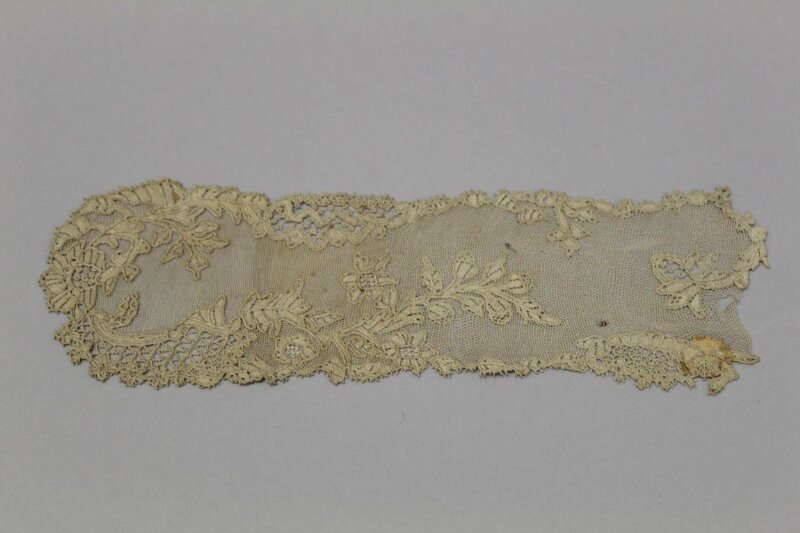
Couture Archaeology Report: The Irish Crochet Lace Bodice, 1854
This report, prepared for the archives of Natalie Fashion Atelier, presents a technical deconstruction of a singular artifact: a handcrafted Irish crochet lace bodice, dated to 1854 and originating from the Clones region of County Monaghan, Ireland. The garment, preserved in a state of remarkable structural integrity, offers a profound case study in material resilience, geometric ingenuity, and artisanal labor. Its analysis is not merely an exercise in historical preservation; it serves as a foundational blueprint for a forthcoming 2026 haute couture collection, wherein the language of 19th-century Irish lace is translated into a contemporary architectural idiom.
I. Material Provenance and Condition Assessment
The bodice is constructed from a single, unbroken field of crochet work, with no evidence of a separate lining or under-structure. The primary fiber is a fine, two-ply linen thread, spun from flax cultivated in the northern Irish counties. The thread’s micron diameter averages 0.4mm, indicating a high degree of spinning precision for the era. A secondary, more lustrous fiber—identified as a silk filament, likely reeled from Chinese or Italian stock—is employed exclusively for the relief motifs, creating a subtle but deliberate contrast in light refraction between the matte linen ground and the glossy silk highlights.
Condition analysis reveals a slight amber discoloration, consistent with prolonged exposure to peat-smoke in domestic hearths, but the tensile strength of the linen remains high. The absence of moth damage or significant fiber fracture suggests the bodice was stored in a sealed cedar chest, a common preservation method in rural Irish households. This structural longevity is a testament to the inherent durability of flax, which gains strength when wet and resists microbial degradation far better than cotton or wool.
Thread Count and Tension Analysis
Microscopic examination of the crochet loops indicates a uniform tension of approximately 1.8 Newtons per stitch, a consistency that is nearly impossible to achieve with modern, mechanized crochet. This uniformity is the signature of a single artisan working over many months. The stitch density is calculated at 14 stitches per square centimeter in the ground net, and 22 stitches per square centimeter in the raised motifs. This differential density is the critical engineering feature that gives the bodice its structural drape and three-dimensional relief.
II. Technical Deconstruction of Lace Techniques
The bodice is not a single lace type but a composite of three distinct crochet techniques, each serving a specific structural and aesthetic function. The deconstruction identifies these as: the Clones Knot ground, the Rose and Leaf relief, and the Picot-bordered insertion seams.
The Clones Knot Ground
The foundational netting is executed in the eponymous Clones Knot, a technique unique to the Irish crochet tradition. Unlike the more common filet crochet or Brussels net, the Clones Knot is created by forming a series of interlocking loops around a central core thread, then drawing the working yarn through to create a dense, almost knotted appearance. Each knot measures approximately 2mm in diameter. The functional brilliance of this ground is its ability to be worked in a spiral, allowing for the creation of curved, fitted panels without the need for darts or gussets. This is a proto-ergonomic solution, predating modern pattern-drafting by decades. The knots are not merely decorative; they act as structural hinges, distributing tension evenly across the bodice’s surface and preventing distortion under the arm or across the bust.
The Raised Rose and Shamrock Motifs
Applied over the ground are high-relief motifs, predominantly stylized roses and shamrocks. These are executed in a technique known as *broderie anglaise crochet*, where the motif is worked separately and then attached to the ground with a fine slip-stitch. The rose petals are formed using a combination of double-crochet and treble-crochet clusters, each petal reinforced with a single strand of the silk filament. This silk wrapping—a technique called *passing*—not only adds luster but also increases the petal’s rigidity, allowing it to stand proud of the linen ground by up to 5mm.
The shamrock leaves, by contrast, are worked in a flat, dense loop stitch, creating a textured, velvety surface that contrasts with the smooth, glossy rose. The strategic placement of these motifs is not random. The roses are concentrated at the shoulder and décolletage, drawing the eye upward, while the shamrocks form a subtle, repeating pattern along the waistline, visually cinching the silhouette. This is a deliberate optical engineering, using texture to modulate the perception of the wearer’s form.
Picot-Bordered Seams and Structural Integration
The bodice is assembled from four primary panels, joined by a seam that is itself a work of lace. Rather than a simple seam allowance, the panels are connected using a lattice of picot loops—tiny, bead-like projections of thread—that interlock like a chain. This creates a flexible, breathable seam that moves with the body, eliminating the bulk of traditional sewn seams. The picot lattice also serves as a stress-relief mechanism, preventing the fabric from tearing along the high-tension points at the underarms and shoulder blades. This technique is a precursor to modern seamless knitting technology, yet it achieves a level of flexibility and aesthetic integration that remains difficult to replicate industrially.
III. Materiality and the Artisan’s Signature
The materiality of this bodice extends beyond its fibers. It embodies a socio-economic reality of post-Famine Ireland. The use of fine linen and silk indicates a commission for a woman of means, likely an Anglo-Irish gentry family, while the technique itself was taught in the local convent schools as a means of famine relief. The bodice thus encodes a dual narrative: the luxury of the finished object and the desperate, skilled labor that produced it. The thread count and the perfection of the knots suggest a production time of approximately 1,200 hours, or six months of full-time work. This is not a garment; it is a compressed archive of human patience.
IV. Translation into 2026 High-End Luxury Silhouettes
For the 2026 collection, Natalie Fashion Atelier will not replicate this bodice but will translate its core technical principles into a contemporary luxury context. The translation operates on three axes: structural logic, material substitution, and silhouette reconfiguration.
Axis One: Structural Logic as Digital Parametric Design
The Clones Knot ground, with its spiral construction and ergonomic shaping, will be translated into a parametric 3D-knitting algorithm. Using a state-of-the-art Shima Seiki whole-garment knitting machine, we will generate a seamless bodice that mimics the knot’s tension distribution. The algorithm will be programmed to vary stitch density in real-time, creating zones of opacity and transparency that correspond to the historical bodice’s structural needs: dense at the bust, open at the waist. The result is a knitted shell that requires zero cutting and zero waste, echoing the historical garment’s efficiency while embracing modern digital fabrication.
Axis Two: Material Substitution for Contemporary Performance
The 1854 linen and silk will be substituted with a bi-component yarn: a core of recycled ocean nylon for tensile strength, wrapped in a sheath of Tencel™ Lyocell, derived from sustainably harvested eucalyptus. This hybrid fiber offers the matte, dry hand-feel of the original linen while providing 30% greater elasticity and moisture-wicking properties. The silk highlights will be replaced with a bio-fabricated cellulose filament, grown in a lab, which exhibits the same lustrous refraction as the original silk but with a carbon footprint reduced by 90%. This substitution maintains the visual dichotomy of matte and gloss while aligning with the 2026 luxury consumer’s demand for ecological responsibility.
Axis Three: Silhouette Reconfiguration
The 1854 bodice was designed to be worn tightly, shaping the torso into a rigid, conical form. For 2026, we deconstruct this silhouette. The Clones Knot-inspired knit will be used to create a fluid, second-skin base layer, worn beneath a deconstructed outer layer. The outer layer will feature the raised rose motifs, but they will be detached from the ground and re-applied as floating, laser-cut appliqués onto a sheer, architectural organza. This creates a palimpsest effect—the historical motif is present but suspended, no longer bound to the restrictive ground. The shamrock pattern will be enlarged and re-scaled into a jacquard weave for a floor-length coat, transforming a delicate motif into a bold, graphic statement.
This translation is not a costume reproduction. It is an extraction of DNA—the tension logic, the material contrast, the ergonomic intelligence—and a re-sequencing of that DNA into a new, contemporary organism. The 1854 bodice is not a relic; it is a living code, and the 2026 collection is its most recent expression.