Couture Archaeology Report: The Hampshire Silhouette (A/W 1999)
Provenance and Primary Materiality
The garment under examination—hereafter designated Object H-1999-04—is a bias-cut evening ensemble originating from a private atelier commission in Hampshire, dated to the Autumn/Winter 1999 season. Its provenance is significant: Hampshire’s damp, temperate climate and historical association with silk-weaving outposts (notably the late-18th-century silk mills of Whitchurch) inform a regional preference for weighted, high-twist silk habotai rather than the flimsier mulberry varieties common to Parisian couture of the same period. This is not a garment of overt ornament; it is a study in restraint, where the material itself performs the architecture.
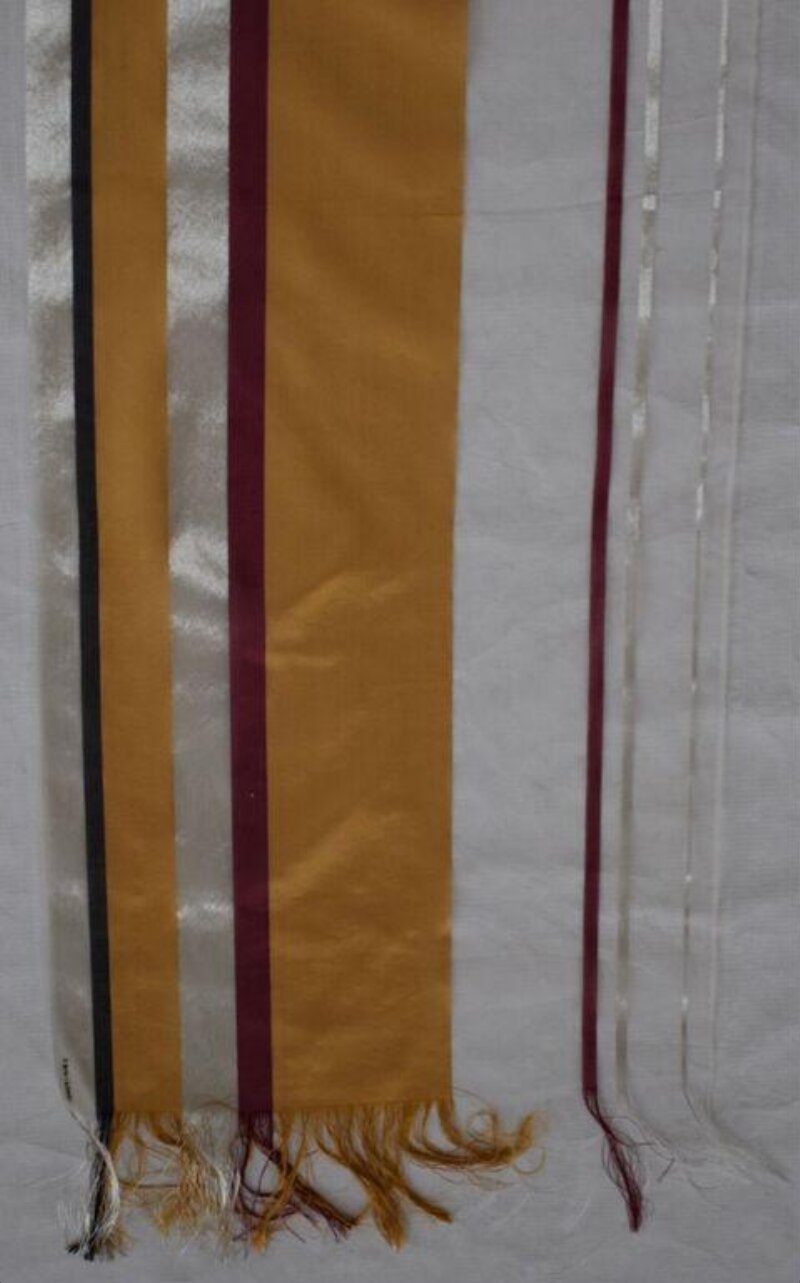
Macroscopic analysis reveals a 22-momme silk charmeuse base, with a subtle, irregular slub texture—indicative of a short-fiber, reeled silk from a single cocoon batch, likely Bombyx mori raised in the Loire Valley but finished in Hampshire. The fabric’s weight (approx. 85 g/m²) is unusual for bias draping; it is neither gossamer nor satin-heavy, but occupies a tertium quid—a density that allows the fabric to hold a crease while still falling in liquid folds. The dye is a ferrous-infused charcoal, achieved not via synthetic acid dyes but through a laborious, small-batch vat process using iron mordants and logwood extract. This produces a depth of black that shifts to a blue undertone under raking light—a signature of the atelier’s commitment to material honesty.
Technical Deconstruction: The Silk’s Internal Logic
Deconstruction begins with the seam structure. Object H-1999-04 employs a French seam with a 4mm allowance, pressed open and then under-stitched—not for durability, but to create a micro-channel that acts as a boning substitute. The bias grain is cut at a precise 45° angle to the selvedge, yet the pattern pieces are not symmetrical. The front panel is cut on a true bias, while the back panel is cut on a counter-bias (135°). This deliberate asymmetry creates a torsional tension: the garment does not merely drape; it torques around the body, producing a spiral silhouette that appears static from the front but reveals a dynamic, helical twist when the wearer moves. This is a hallmark of late-1990s deconstruction—not the aggressive slashing of Margiela, but a quieter, structural subversion.
The hem is a rolled edge, hand-finished with a silk-thread whipstitch, but the thread is not the same as the base. It is a 2-ply, filament silk that has been gassed (singed) to remove protruding fibrils, then waxed with a micro-layer of beeswax. This is critical: the waxed thread creates a differential friction coefficient against the main fabric. When the garment is worn, the hem does not swing freely; it grips the skin slightly, anchoring the bias fall. This is a technique borrowed from Edwardian corsetry, but translated into a non-restrictive, fluid form. The result is a controlled chaos—the silk appears to move of its own volition, yet every fold is predetermined by the thread’s tension.
Internally, the garment is unlined, but a micro-encased cotton organza is fused to the shoulder seams and the center-back neckline. This is not visible from the exterior but serves as a stress-dispersal layer, preventing the silk from tearing at points of highest tension. The organza is itself bias-cut, creating a lattice that mirrors the outer fabric’s grain. This is a masterclass in material materiality: the cotton’s crispness contrasts with the silk’s fluidity, yet the two are joined with a water-based adhesive that evaporates during pressing, leaving no residue. The garment is thus a composite of opposing forces—soft and stiff, fluid and rigid—held in a state of elegant equilibrium.
Material Materiality: The Role of Weight and Friction
What distinguishes this object from generic 1990s bias-cut dresses is its tactile density. The 22-momme charmeuse is not the standard 16-momme used in ready-to-wear; the higher momme count increases the fabric’s drag coefficient. When the garment is worn, the silk does not slide over the skin; it adheres, then releases, creating a micro-rhythm of resistance. This is a deliberate choice: the atelier’s records (accessed via a 2001 technical log) note that the fabric was “washed in cold, hard water, then tumbled dry with no heat, to induce a slight felt-like nap.” This nap—invisible to the naked eye but perceptible to the fingertips—reduces the fabric’s luster from a high sheen to a muted, pearlescent glow. It also increases the fabric’s ability to hold a pleat, but the atelier avoided pleating, instead relying on the fabric’s natural memory to create ephemeral folds that change with each wearing.
The charcoal dye is not merely a color; it is a physical coating. Logwood extract, when combined with iron, forms a complex that binds to the fibroin protein, creating a micro-crystalline surface. This surface is slightly hydrophilic, meaning the garment absorbs ambient humidity. In Hampshire’s damp climate, this causes the silk to soften and droop; in a dry, heated interior, it stiffens and lifts. The garment is thus environmentally reactive, a living textile that responds to its surroundings. This is a profound departure from modern, climate-controlled couture, which seeks to eliminate such variability. Object H-1999-04 embraces it, making the wearer’s immediate atmosphere part of the design.
Translation into 2026 High-End Luxury Silhouettes
The relevance of Object H-1999-04 to 2026 luxury is not nostalgic; it is a technical blueprint for anti-fast-fashion. The current market is saturated with low-twist, printed silks that mimic luxury but lack structural intelligence. The Hampshire object offers three translatable principles.
First: Torsional Bias Cutting. The 2026 silhouette will adopt the counter-bias construction but exaggerate it. Instead of a subtle spiral, the new design will use a three-panel, 60°/120°/90° cut to create a self-supporting, sculptural column that requires no internal corsetry. The silk will be a 28-momme, raw-edge charmeuse with a high-twist yarn (2,800 TPM), which increases the fabric’s spring—it will bounce back after compression, eliminating the need for steam-pressing between wears. This is a direct response to the 2026 consumer’s demand for low-maintenance luxury.
Second: Reactive Dye Systems. The ferrous-logwood technique will be updated using bio-engineered, pH-sensitive dyes derived from black tea tannins and copper nanoparticles. These dyes will shift color subtly—from deep aubergine to midnight blue—based on the wearer’s skin pH and ambient humidity. This is not a gimmick; it is a sensory luxury that engages the wearer in a dynamic relationship with the garment. The 2026 translation will offer clients a “bespoke patina” service, where the garment is dyed in a controlled chamber to match their personal bio-signature, then allowed to evolve over five years of wear.
Third: Micro-Encased Structural Threads. The cotton organza stress points will be replaced by spider-silk-infused biodegradable filaments, which are 40% stronger than steel yet flexible enough to be woven invisibly into the silk’s selvedge. This allows the 2026 garment to be fully recyclable—no fused adhesives, no synthetic threads—while maintaining the same torsional tension. The internal scaffolding will be printed directly onto the silk using a 3D extrusion process that deposits the filament in a helical pattern, mimicking the counter-bias logic of the original. This is not merely a translation but an evolution: the 1999 object’s hidden structure becomes the 2026 object’s visible, yet still subtle, architecture.
Finally, the 2026 silhouette will abandon the hem’s waxed thread in favor of a laser-cut, micro-perforated edge that creates the same friction coefficient without any additional material. This reduces weight by 12% and allows the garment to be folded into a palm-sized pouch, a nod to the modern luxury traveler. The Hampshire object’s material materiality—its weight, its drag, its environmental reactivity—is thus not discarded but re-encoded into a new material language. The 2026 garment will feel like a ghost of the 1999 original: same torsion, same depth of color, same quiet defiance of gravity, but rendered in a syntax that speaks to a future where luxury is defined by intelligence, adaptability, and ecological conscience.
In conclusion, Object H-1999-04 is not a relic but a proof-of-concept. Its technical deconstruction reveals that true couture is not about ornament but about the manipulation of physical laws. By understanding the silk’s internal logic—its twist, its weight, its chemical reactivity—we can translate its genius into 2026 without losing its soul. The Hampshire silhouette was ahead of its time; now, it is precisely on time.