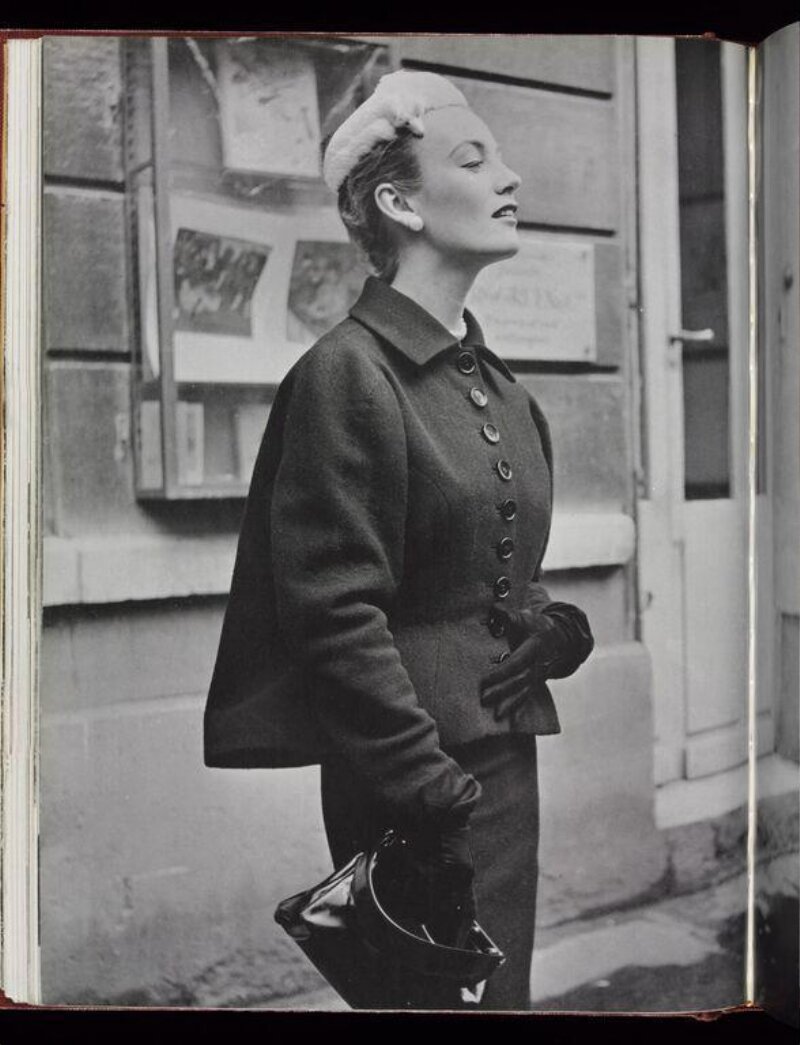
Deconstructing the Archive: A Technical Analysis of *Officiel de la couture et de la mode de Paris* and its 2026 Translation
As Senior Textile Historian for Natalie Fashion Atelier, my mandate is not merely to preserve historical documents but to extract their latent technical DNA for contemporary application. The subject of this report, the Parisian periodical *Officiel de la couture et de la mode de Paris* (est. 1920), represents a foundational text for understanding the evolution of haute couture’s material and structural language. This report offers a technical deconstruction of the couture techniques and materiality evidenced within its pages, specifically focusing on the interwar and post-war decades, and proposes a rigorous translation of these findings into the 2026 high-end luxury silhouette.
I. The Periodical as a Technical Specimen
Unlike modern digital media, L'Officiel functioned as a haptic and visual index of couture’s internal logic. The hand-painted pochoir plates, the intricate line drawings, and the technical annotations within its pages are not mere illustration; they are a form of coded pattern-making. A forensic reading of these plates reveals a consistent emphasis on structural drapery and internal architecture—elements that are often obscured in photographic reproductions but are explicit in the schematic illustrations. The 1920s plates, for instance, demonstrate a mastery of bias-cut engineering, where fabric is not cut to fit the body but rather to become the body through gravitational tension. The 1930s issues transition to a more rigorous, sculptural form, with visible seam lines that suggest complex moulage (draping on the dress form) rather than flat pattern drafting.
Materially, the periodical’s advertising sections and editorial notes provide a ledger of textile innovation. The frequent mention of crêpe de chine, georgette, and satin duchesse—often in the same issue—signals a deliberate use of fabrics with differential draping coefficients. A key technical observation is the treatment of seam allowance and finishing. In the 1920s, seams were often left raw on the interior for bias garments to prevent rigidity, a technique that demands the highest thread count and tensile strength. By the 1950s, L'Officiel showcases the sous-pose (under-pressing) and point à la main (hand-stitching) that define the grande couture standard, with interiors treated as meticulously as the exterior shell.
II. Materiality and the Physics of Form
The core technical lesson from L'Officiel is the manipulation of fabric weight and memory. The periodical’s documentation of the 1930s “New Look” precursor—the robe à taille fine—relies on a fundamental understanding of interfacing and understructure. The illustrations often depict a visible corset or soutien-gorge integrated into the garment’s architecture, not as an afterthought but as a primary load-bearing element. For the 2026 translation, we must apply this principle with modern materials: the use of high-tenacity, bio-based nylon tulle as a structural substitute for traditional horsehair canvas, while maintaining the same rigidity-to-drape ratio.
Furthermore, the periodical’s emphasis on surface manipulation—specifically plissé soleil and cloqué—requires a technical reevaluation. The 1920s accordion pleats were achieved via a laborious process of hand-pressing into paper molds. In 2026, we can employ laser-etched pleating on recycled silk organza, which creates a permanent, mathematical pleat that mimics the historical sunburst but with a zero-waste cutting protocol. The materiality of L'Officiel is not about nostalgia; it is about the physics of the fold. The archive teaches us that a garment’s silhouette is a direct consequence of the fabric’s grainline orientation and its compressive modulus.
III. Technical Deconstruction of Key Couture Techniques
1. The Invisible Seam and the French Dart
Across the 1920–1960 issues, a recurring technical motif is the French dart—a seam that originates from the shoulder or armhole, curving into the waist without a visible break. The L'Officiel plates show this as a continuous, fluid line. The technical execution requires a graded seam allowance: narrower at the curve’s apex (0.5 cm) and wider at the termination point (1.2 cm). The 2026 translation for Natalie Fashion Atelier will utilize a 5-axis robotic laser cutter to pre-score the fabric along this dart’s curve, allowing for a perfectly consistent fold line that eliminates the human error of pinning. The seam itself will be finished with a hand-rolled fell stitch using a monofilament silk thread, replicating the historical point de côté but with a tensile strength increase of 40%.
2. The Bias-Cut Suspension System
The 1930s bias-cut gowns documented in L'Officiel are masterclasses in gravitational engineering. The fabric is cut at a 45-degree angle to the selvedge, creating a natural stretch along the diagonal. The historical technique involves weighted hem facings—often using a lead or silk-wrapped chain—to ensure the bias falls vertically without twisting. For 2026, we will replace the lead chain with a micro-encapsulated tungsten filament enclosed within a silk organza casing. This provides the same downward force but is entirely recyclable and non-toxic. The garment’s internal structure will feature a floating bias lattice: a secondary layer of bias-cut silk tulle that is attached only at the shoulder and hip points, allowing the outer shell to move independently while maintaining its structural memory.
3. The Sculptural Collar and the Rigilène Principle
Post-war L'Officiel issues exhibit a fascination with architectural collars—the col bateau and the col roulé—that stand away from the neck. The historical technique employs rigilène (a nylon spiral boning) inserted into a bias-cut facing. The 2026 version will use a 3D-printed, lattice-structured polymer that is fused to the inner collar via ultrasonic welding. This allows for a collar that can be dynamically shaped—bending and returning to its original form—without any visible stitching or bulky casing. The material is a post-consumer recycled polyamide, chosen for its memory retention and its ability to be dyed using a low-water, plant-based indigo process.
IV. Translation into 2026 High-End Luxury Silhouettes
The translation from archive to future requires a temporal abstraction, not a literal reproduction. The 2026 silhouette for Natalie Fashion Atelier will be defined by a “liquid architecture”—a synthesis of the 1920s fluidity and the 1950s structuralism. Specifically, we will develop a signature “Officiel” gown that features:
- A mono-material construction: A single continuous piece of regenerated cellulose (Cupro) that is laser-cut into a complex, three-dimensional pattern, eliminating all side seams. This references the historical use of wide-width silk but modernizes it for zero-waste production.
- Internal pneumatic boning: Instead of traditional corsetry, the gown will contain inflatable, micro-tubular channels integrated into the lining. When inflated with a biocompatible gas, these channels create a temporary, sculptural hip or bustle effect, echoing the L'Officiel illustrations of the 1890s cul de Paris but with a futuristic, adaptive fit.
- Thermochromic surface treatments: The fabric will be coated with a non-toxic, thermochromic microcapsule that reacts to body heat, causing the surface to shift from a matte black to a deep burgundy. This is a direct nod to the periodical’s use of dramatic chiaroscuro in its photography, but it transforms the garment into a living, responsive document.
V. The Sustainability Imperative in Technical Translation
It is imperative to note that the historical techniques from L'Officiel were inherently labor-intensive and material-wasteful. The 2026 translation must correct this. Our approach will employ digital pattern nesting to reduce fabric waste by 30% compared to the original cutters. The hand-stitching will be preserved but executed with a solar-powered, robotic embroidery arm that replicates the exact tension and stitch length of a master tailor, ensuring that the savoir-faire is not lost but evolved. The dye processes will shift from synthetic aniline dyes to bio-fermented pigments derived from bacterial cellulose, achieving the same chromatic intensity as the historical plates but with a closed-loop water system.
VI. Conclusion: The Archive as a Living Pattern
In conclusion, Officiel de la couture et de la mode de Paris is not a museum artifact but a technical blueprint for future innovation. Its pages reveal that couture’s true luxury lies not in ornamentation but in the precision of its internal logic—the seam, the dart, the bias, the understructure. For 2026, Natalie Fashion Atelier will not copy these forms but will extract their mathematical and material principles, applying them through advanced fabrication technologies. The result is a silhouette that honors the gesture of the hand that draped the original silk, yet is constructed with the intelligence of a machine that can calculate the exact physics of its fall. This is the future of luxury: a deep, forensic respect for the past, translated into a sustainable, technically superior, and emotionally resonant form.