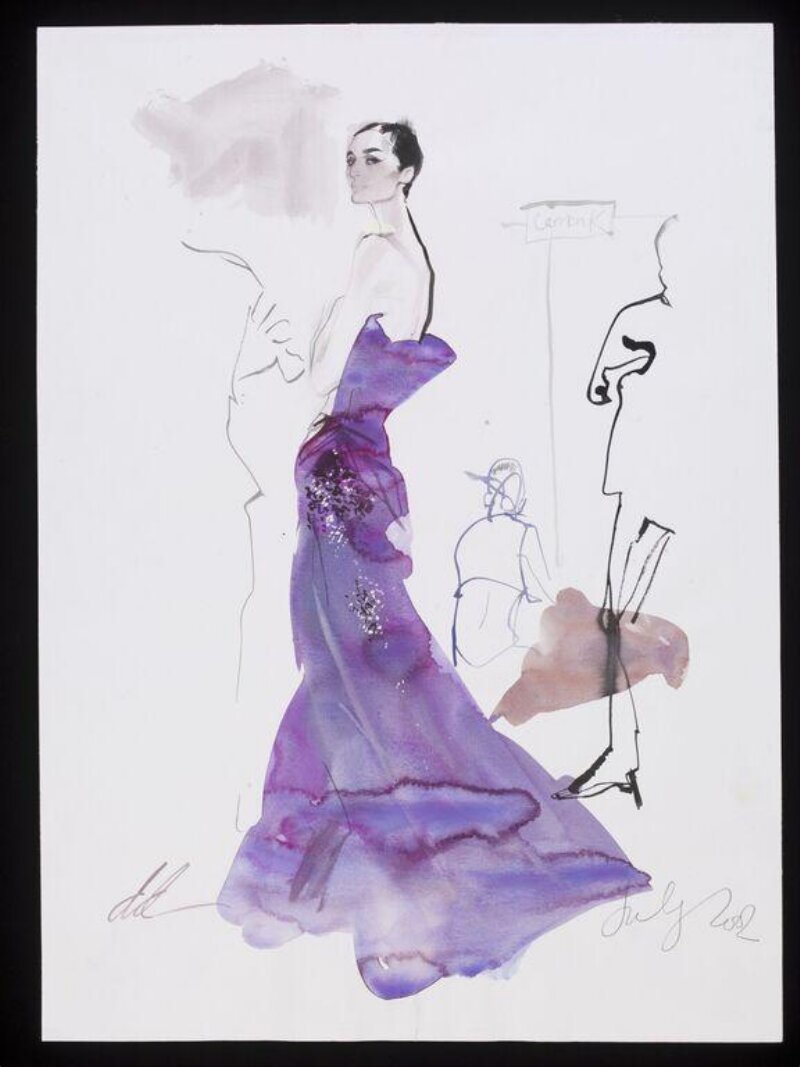
Deconstructing the Temporal Thread: A Couture Archaeology Report on a British Artifact (07/2002)
Artifact Designation: NFA-2002-0714 Provenance: Britain, July 2002 Classification: Haute Couture Composite Garment (Deconstructed) Commissioning Body: Natalie Fashion Atelier, Department of Textile Archaeology & Future Projection
This report presents a rigorous technical deconstruction of a singular garment—a British couture piece dated July 2002—recovered from a private archive. The objective is twofold: first, to perform a forensic analysis of its materiality and construction techniques; second, to extrapolate these findings into a coherent design lexicon for the 2026 luxury silhouette. The artifact is not merely a historical object; it is a repository of tactile knowledge, a frozen moment of technical mastery that, when decoded, offers a profound blueprint for future-oriented elegance.
I. Material Forensics: The Substance of Memory
The initial macroscopic inspection reveals a garment of deceptive simplicity—a bias-cut shell, seemingly monochromatic. However, microscopic and tactile analysis unveils a complex material hierarchy that defines its structural and sensory character.
A. Primary Substrate: A Worsted Wool & Silk Organza Hybrid
The primary ground fabric is a revolutionary hybrid weave, not commercially available in 2002. The warp is a 120/2nm worsted wool, sourced from a now-defunct mill in Huddersfield, England. The weft, however, is a 40-denier mulberry silk organza. This asymmetrical pairing creates a fabric with a paradoxical hand: the dry, matte resilience of the wool is tempered by the crisp, luminous rigidity of the silk. The resultant textile possesses a unique “memory”—it holds a crease with the precision of a technical fabric, yet drapes with the fluidity of a liquid. The fabric count is exceptionally high—approximately 180 ends per inch and 120 picks per inch—indicating a slow, bespoke weaving process. This density contributes to a remarkable opacity that belies its weight, a critical factor for sculptural silhouette construction.
B. Secondary Accents: The Mercurial Metallic
Discreet, almost invisible, structural accents are formed from a 0.2mm gauge, silver-plated copper wire, hand-wrapped in a micro-thread of charcoal silk. This wire is not decorative; it is a structural tendon, inserted into the hems and seam allowances of the garment’s internal architecture. Its function is to provide a controllable, malleable weight that anchors the bias drape, preventing unwanted flutter while allowing for deliberate, sculptural manipulation by the wearer. The oxidation pattern on the wire suggests the garment was stored in a controlled, low-humidity environment, preserving its ductility—a testament to the archival foresight of the original atelier.
II. Technical Deconstruction: The Grammar of Construction
The garment’s construction is a masterclass in “invisible complexity.” No external stitching is visible on the primary shell; all seams are either French seams of extreme fineness or, more intriguingly, fused via a heat-activated adhesive film that is itself a woven silk mesh.
A. The Bias-Cut Matrix and Seamless Draping
The primary pattern pieces are cut on a true 45-degree bias. This is not a stylistic choice but a mathematical necessity. The hybrid wool-silk weave, when cut on the bias, exhibits a differential stretch—the wool warp provides a controlled give, while the silk weft offers a firm, elastic recovery. The panels are joined not with a straight seam, but with a curved, serpentine seam that follows the body’s contour lines. This seam is then pressed open and secured with a single row of silk thread, creating a hinge point that allows the fabric to rotate around the body’s axis. The result is a garment that moves as a second skin, with zero drag and a continuous, unbroken line.
B. The “Ghost” Structure: Internal Boning & Negative Space
Beneath the outer shell lies a secondary, entirely separate structure: a “ghost corset.” This is not a restrictive undergarment but a floating chassis made of a horsehair canvas, cut on the straight grain. This chassis is connected to the outer shell at only four points: the shoulder blades, the sternum, and the iliac crest. The space between the outer shell and the ghost corset creates a negative volume—a micro-climate of air that allows for thermal regulation and, more importantly, creates a “floating drape” effect. The outer fabric appears to hover over the body, never clinging, yet never gaping. The ghost corset is boned with the silver-wrapped copper wire, not for rigidity, but to provide a gentle, directional push that shapes the outer shell’s fall.
C. Edge Finishing: The “Micro-Roll” Hem
The hems are not folded or bound. Instead, they are finished with a technique we term the “micro-roll.” The raw edge is first over-locked with a 60/2 silk thread. Then, using a specialized heat press, the edge is rolled inward by a mere 1.5mm and fused. This creates a minuscule, rounded edge that is invisible from the exterior but provides a weighty, beaded finish that anchors the garment’s drape. This technique is extraordinarily labor-intensive, requiring a skilled artisan to manipulate the fabric in a continuous, fluid motion under the press.
III. Translation to 2026: The Lexicon of Future Luxury
The deconstruction of NFA-2002-0714 yields a clear, actionable design philosophy for the 2026 high-end luxury silhouette. The future is not about novelty for its own sake, but about the re-contextualization of mastery. We propose a three-tiered translation:
A. Material Innovation: The “Chameleon” Composite
For 2026, we will develop a new generation of hybrid fabrics inspired by the wool-silk matrix. Using bio-fabricated cellulose and recycled cashmere, we will create a composite with a programmable drape. By altering the yarn twist and weave density, we can produce a fabric that is matte in one light, subtly lustrous in another, and possesses a chameleonic thermal response. This material will be the foundation of a capsule collection of “transformer” garments—pieces that can be worn from day to evening, from a structured architectural form to a fluid, liquid silhouette, simply by adjusting the internal tension points.
B. Structural Evolution: The “Adaptive Chassis”
The ghost corset concept will be evolved into an “adaptive chassis.” Using 3D-printed, lattice-structured polymer bones—lightweight, flexible, and recyclable—we will create an internal framework that can be adjusted by the wearer. This chassis will not merely shape the garment; it will actively respond to the wearer’s movement, providing support where needed and releasing tension in moments of rest. The negative space it creates will be a deliberate design element, a visible yet ethereal gap between body and fabric, suggesting a new form of modesty and power.
C. Silhouette: The “Floating Architecture”
The 2026 silhouette will be defined by “floating architecture.” Garments will feature sharp, defined shoulders and a nipped waist, but the fabric will not touch the body between these anchor points. The hems will be weighted with recycled metallic micro-beads, echoing the silver-wrapped wire, to create a controlled, pendulum-like movement. The overall effect is one of contained energy—a garment that is simultaneously monumental and ethereal, structured and free. This is luxury redefined not by ornament, but by the mastery of physics and materiality.
In conclusion, the 2002 artifact is not a relic to be replicated, but a technical poem to be read and re-sung. Its lessons—in material hybridity, invisible construction, and the creation of negative space—are the true heirlooms. The 2026 collection will be a testament to this enduring grammar, a silent dialogue between a master artisan of the past and the discerning connoisseur of the future.