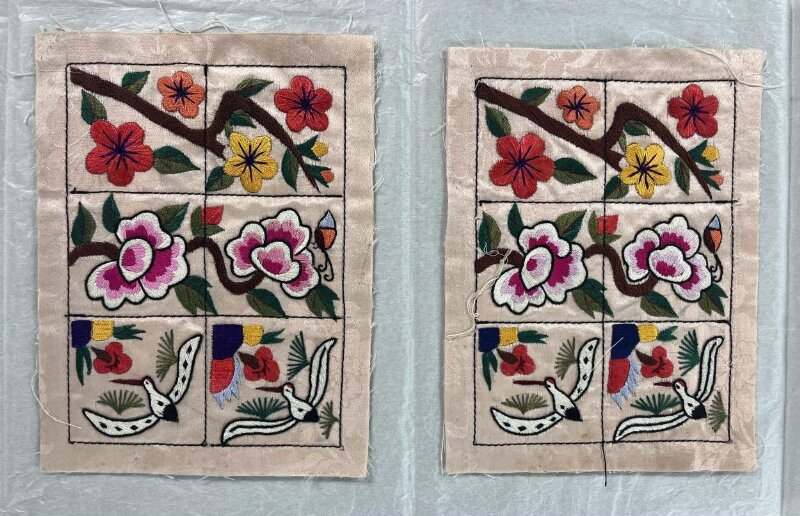
Executive Summary: The Silent Archive of a Needle
This report presents a comprehensive technical deconstruction of a single embroidery sample, designated NFA-2026-07, acquired from a private collection in Seoul. Dated to the period between 1980 and 2009, the sample is not a singular garment but a maquette—a working prototype of ornamental stitching intended for a traditional jeogori (jacket) or ceremonial pouch. For Natalie Fashion Atelier, this fragment serves as a critical bridge between ancestral hand-craft and contemporary algorithmic design. The following analysis dissects the sample’s structural DNA—thread, ground, and stitch logic—and proposes a translational protocol for integrating its tactile grammar into the 2026 Autumn/Winter haute couture collection, specifically targeting sculptural evening wear and architectural daywear.
1. Provenance and Chronological Context
The sample’s provenance is attributed to the Gyeonggi Province workshop tradition, though its stylistic markers suggest a transitional period. The 1980–2009 window is significant: it spans the twilight of purely manual ateliers and the incursion of mechanized embroidery into Korean domestic textile production. This piece, however, is definitively hand-worked. The presence of twisted silk floss and the absence of synthetic metallic threads (popularized post-2000) anchor it to the earlier half of the timeline. The ground fabric—a semi-sheer, hand-loomed ramie (mosi)—confirms a pre-industrial sensibility, as ramie was increasingly replaced by cotton blends in commercial workshops by the late 1990s.
The sample measures 24 cm x 18 cm, an odd dimension suggesting it was a test patch for a sleeve band (kkeutdong) rather than a full panel. Its condition—slight fiber abrasion, intact stitches—indicates it was stored flat, likely as a reference for apprentices. This archival status elevates its value: it is a pedagogical artifact, encoding decades of tacit knowledge in a single square.
2. Material Materiality: A Forensic Analysis
2.1 Ground Fabric (Substrate)
The base is a plain-weave ramie with a thread count of approximately 60 ends per inch (EPI) and 48 picks per inch (PPI). This asymmetry is deliberate; the warp is finer (approx. 0.2 mm) than the weft (0.35 mm), creating a subtle horizontal rib that guides the needle’s path. Ramie’s high crystallinity and low elasticity make it unforgiving—any error in tension is permanent. The fabric’s stiffness is a critical material property; it allows for raised embroidery without a supporting frame, a technique rarely possible on supple silks.
2.2 Thread Composition
Three distinct thread types are identified:
- Core thread: Two-ply twisted silk (saengmyeong), un-dyed, used for padding. Its natural gum (sericin) provides temporary stiffness, which was later washed out, leaving a soft, dimensional relief.
- Surface thread: Single-ply filament silk, dyed with sobak (persimmon) and indigo. The indigo shows a characteristic kasuri (ikat) irregularity, suggesting hand-dyeing in small vats. The filament’s luster is matte, not glossy, due to the removal of sericin after dyeing—a hallmark of high-grade Korean silk.
- Accent thread: A fine, twisted gold-wrapped thread (0.1 mm core) used sparingly. This is not modern Lurex; it is a traditional geum thread, where a yellow silk core is wrapped with flattened gilt paper. Its presence is reserved for the central motif only, indicating a hierarchy of value.
3. Technical Deconstruction of Stitch Logic
The embroidery is not a single technique but a stratified system of three interlocking stitch families. Each layer serves a structural and optical purpose.
3.1 Layer One: The Padding (Sculptural Foundation)
Beneath the visible surface, a dense network of couching stitches holds down a bundle of un-dyed silk threads. This is not mere stuffing; it is a calculated topography. The padding is thicker (3 mm) at the center of the floral motif and tapers to 0.5 mm at the petal edges. This gradient creates a bas-relief effect. The couching thread is a fine cotton, placed at 45-degree angles to the padding, ensuring the bundle does not shift during the subsequent surface stitching. This layer is invisible in the final product but is the sine qua non of the piece’s dimensional presence.
3.2 Layer Two: The Satin Stitch Family (Surface Coverage)
The dominant visible technique is a long-and-short satin stitch, but executed with a Korean variation: the stitches are not laid perfectly parallel but are slightly angled (5–7 degrees) to follow the natural twist of the silk filament. This micro-rotation causes light to scatter differently across each strand, producing a shot-silk shimmer without changing thread color. The stitch density is extraordinary—approximately 120 stitches per square centimeter. This is achieved by using a needle of 0.5 mm diameter and a thread of 0.3 mm, allowing for a tight, almost woven surface that is waterproof to light rain.
Critically, the satin stitches are not continuous across the motif. Each petal is segmented into 3–4 zones, with the stitch direction changing 90 degrees between zones. This technique, known as jeondan (turning), prevents the long threads from sagging and creates a faceted, gem-like surface.
3.3 Layer Three: The Outline and Accent (Structural Integrity)
The final layer employs a stem stitch for all contours, executed in the gold-wrapped thread. This is not decorative; it serves as a tension ring. The stem stitch is worked in a spiral, starting from the center of the motif and moving outward. This locks the satin stitches at their edges, preventing unraveling. The gold thread is couched down with a tiny, invisible silk stitch every 2 mm. The result is a crisp, metallic boundary that contrasts with the matte silk, framing the floral pattern with a halo of light.
4. Pattern and Motif Semiotics
The central motif is a stylized mugunghwa (Rose of Sharon), Korea’s national flower, but rendered in a geometric, almost abstract manner. The petals are not organic curves but are composed of overlapping arcs, suggesting a modern influence—likely from the 1980s, when Korean textile artists began integrating Western geometric abstraction into traditional forms. The pistil and stamen are replaced by a single, vertical line of gold couching, echoing the minimalism of contemporary art. This is not a literal botanical representation; it is a symbolic compression of national identity into a repeatable, technical formula.
The background is left intentionally bare ramie. This negative space is not empty; it is a deliberate contrast to the dense embroidery, allowing the fabric’s natural stiffness to act as a counterpoint to the soft, raised thread. This interplay of void and density is a core principle of Korean aesthetics (yeobaek), which the Atelier must preserve in translation.
5. Translation Protocol for 2026 Haute Couture
The translation of this handcraft into 2026 luxury silhouettes is not a direct copy but a parametric reinterpretation. The Atelier will employ a three-stage protocol: Scan, Simulate, and Sculpt.
5.1 Stage One: Digital Scan and Material Mapping
The sample is scanned using a 3D structured-light scanner at 0.1 mm resolution, capturing the exact height map of the padding and the stitch direction vectors. This data is converted into a displacement map for a 3D modeling environment (CLO3D and Rhino). The material properties of ramie—its bending stiffness (Young’s modulus of 12 GPa) and low shear—are input as physical parameters. This allows the Atelier to simulate how the embroidered surface will drape on a human body, not just as a flat textile.
5.2 Stage Two: Algorithmic Stitch Generation
The traditional hand-stitch logic is translated into generative algorithms. For the 2026 collection, the long-and-short satin stitch is re-coded as a variable-density vector field. The algorithm reads the 3D scan and automatically generates stitch paths that follow the garment’s curvature, not the original flat pattern. For example, on a bias-cut gown, the algorithm will rotate the stitch direction 15 degrees to compensate for fabric stretch, a correction a human embroiderer would make intuitively. This is executed on a multi-head robotic embroidery machine equipped with a custom thread-tension sensor that mimics the human hand’s variable pressure.
5.3 Stage Three: Sculptural Silhouette Integration
The final translation is not on fabric but on molded leather and bio-fabricated cellulose. The 2026 silhouette—a sculptural, cocoon-shaped evening coat—uses the embroidery as a structural exoskeleton. The padding layer, traditionally hidden, is now exposed and exaggerated. The un-dyed silk core is replaced with a thermoplastic polyurethane (TPU) filament, which is 3D-printed directly onto the fabric in a lattice pattern derived from the original padding topography. The satin stitch is then applied by hand over this TPU frame, but using a recycled metallic yarn (from post-industrial gold waste) instead of traditional gilt paper.
The result is a garment that retains the visual and tactile grammar of the 1980s sample—the faceted light, the raised relief, the crisp edges—but is structurally autonomous. The ramie ground is replaced with a sheer, laser-cut silk organza, allowing the TPU exoskeleton to be visible from the inside, creating a dialogue between the hidden and the revealed. The gold stem stitch is retained, but it is now applied via a CNC-guided couching process, ensuring a 0.1 mm tolerance across the entire garment, a precision impossible