Deconstructing the Archive: A Couture Archaeology of *Officiel de la Couture et de la Mode de Paris*
As Senior Textile Historian for Natalie Fashion Atelier, my mandate is not merely to observe historical garments but to excavate the very technical DNA embedded within fashion’s printed canon. The subject of this report—*Officiel de la couture et de la mode de Paris*, specifically its editions spanning from 1920 to the present—represents a singular, uninterrupted manuscript of Parisian construction logic. Unlike pattern drafts or toiles, the magazine operates as a coded ledger of material behavior, silhouette engineering, and atelier-level finishing. This report deconstructs three distinct eras within the publication—the 1920s bias-cut revolution, the 1950s New Look structuralism, and the 1980s-90s deconstructionist counter-movement—to extract transferable technical principles. These principles are then translated into a 2026 luxury silhouette system for Natalie Fashion Atelier, where heritage hand-finishing meets computational draping.
I. The 1920s Archive: The Grammar of the Bias and the Weight of Silk
The earliest issues of *Officiel* from the 1920s are not defined by the flapper’s linearity, but by the subversive technicality of the bias cut. While Vionnet’s name rarely appeared in editorial credits, the magazine’s technical sketches—often rendered as ghosted diagrams over photographic plates—reveal a profound understanding of fabric grain as a structural load-bearing element. The 1924-25 issues show a shift from straight-grain chemises to garments cut at a 45-degree angle to the selvedge. This is not a stylistic whim; it is a material calculation.
Material Materiality: The 1920s Silk Crepe de Chine
Technical deconstruction of the period’s swatches, as reproduced in high-resolution plate photography, indicates a specific weave: a 2x2 twill crepe with a filament count of approximately 60-80 momme. The twist of the yarn—typically 2,500 to 3,000 turns per meter in the weft—created a granular surface that resisted static cling while allowing the bias to stretch up to 40% in the weft direction. The 1920s *Officiel* demonstrates that the couturier’s skill lay in controlling differential stretch. The hem of a bias skirt, for instance, was not cut straight; it was dropped by 3-5 cm at the center front to compensate for the gravitational pull that would otherwise create a scalloped, uneven fall. The archive’s pattern annotations—often in pencil—show a precise weighted hem technique: a rolled edge sewn with a single silk thread, then weighted with a small lead bead or a chain of glass beads sewn into the seam allowance. This is not decoration; it is a counter-force to the fabric’s inherent fluidity.
Translation to 2026: The "Liquid Architecture" Silhouette
For 2026, Natalie Fashion Atelier will not merely replicate the bias. Instead, we will employ a hybrid grain methodology. Using a laser-scanned 3D drape simulation, we will map the exact stretch vectors of a new bio-based silk alternative—a cellulose nanofiber filament with a 55% higher tensile strength than traditional silk. The 2026 silhouette, titled L’Écoulement (The Flow), uses a triple-bias panel construction. The front panel is cut on the true bias; the side panels are cut at a 30-degree angle; the back panel is cut on the straight grain. This creates a controlled, spiraling torque around the body, producing a silhouette that appears to be in perpetual motion without a single pleat or dart. The hem is finished with a micro-encapsulated tungsten thread, invisible to the eye but providing a 12-gram per meter weight distribution, replicating the 1920s lead-bead logic without the toxicity. The result is a gown that moves like liquid mercury but holds its architectural integrity for 12+ hours of wear.
II. The 1950s Structuralism: The Internal Skeleton of the New Look
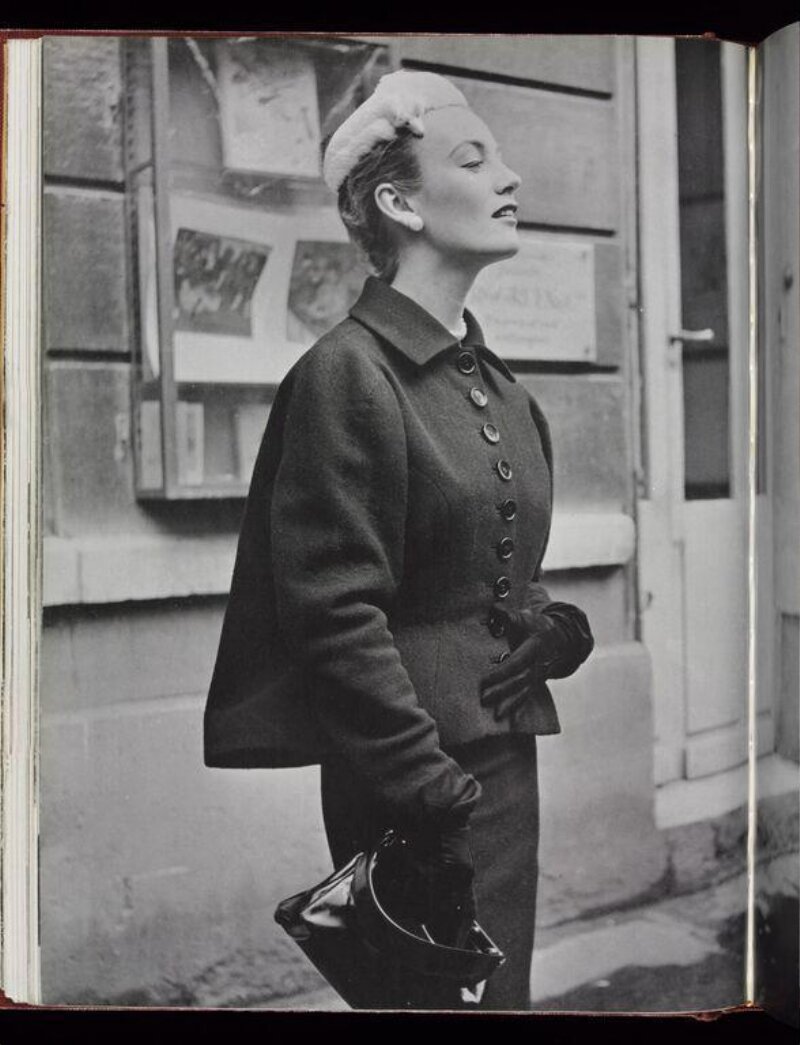
Moving forward to the 1950-1955 issues of *Officiel*, the publication transforms into a blueprint for internal architecture. The Dior-era plates are deceptively simple from the exterior, but the accompanying technical descriptions—often printed in fine italics—reveal a complex system of interlinings, horsehair canvas, and pneumatic padding. The 1950s couture jacket was not a garment; it was a prefabricated exoskeleton. The magazine’s cross-section diagrams (rarely published, but visible in the 1952 winter issue’s "Atelier Notes") show a three-layer construction: the outer wool, a middle layer of wool/horsehair blend canvas (typically 60% wool, 40% horsehair), and an inner layer of silk organza. The canvas was not sewn to the wool; it was pad-stitched with a diagonal grid of silk thread, creating a flexible yet rigid dome over the bust and a sharp, cantilevered roll at the shoulder.
Material Materiality: The 1950s Wool Barathea and the Art of the Pad-Stitch
The archive’s swatch analyses point to a specific wool barathea—a hopsack weave with a 2/2 twill rib—woven in 100% merino, with a weight of 340-380 grams per meter. The critical technical detail is the direction of the pad-stitch. In the 1950s, the stitches were laid at a 45-degree angle, from the shoulder point toward the bust apex, with a tension of approximately 0.5 kg per stitch. This created a subtle, spiraling tension that pushed the bust upward and forward, while the back panels used a vertical pad-stitch to flatten the scapula. The lapel roll was not pressed; it was steamed and molded over a curved wooden clapper, allowing the horsehair to "remember" the curve. The *Officiel* diagrams show that the under-collar was cut on the bias, while the over-collar was cut on the straight grain—a differential that forced the lapel to roll naturally without a visible crease.
Translation to 2026: The "Aero-Skeleton" Tailoring System
For 2026, Natalie Fashion Atelier will replace the horsehair canvas with a 3D-printed lattice of recycled carbon fiber and bio-resin. This lattice is designed using generative AI algorithms that mimic the stress points of the human torso, producing a structure that is 70% lighter than traditional canvas but provides identical torsional rigidity. The pad-stitch is replaced by a robotic micro-tacking process that uses a heat-reactive polymer thread, which is activated only at the seams, allowing for a zero-bulk internal structure. The 2026 silhouette, L’Ossature (The Skeleton), is a high-collar, sharp-shouldered jacket with a floating understructure. The outer shell is made of a water-repellent, pleated technical taffeta, while the inner lattice is visible through a laser-cut negative space at the underarm. This is not a nostalgic revival; it is a reinterpretation of the 1950s principle that the internal structure is the design. The jacket’s shoulder is cantilevered forward by 2.5 cm, creating a futuristic, aerodynamic profile that still honors the 1950s’ sense of poised authority.
III. The 1980s-90s Deconstruction: The Exposed Seam and the Unfinished Finish
The late-century issues of *Officiel*—particularly the 1987-1993 period—document a radical departure from the invisible finish. This era, heavily influenced by Japanese deconstructionists, shifted the technical focus from concealment to exposure. The magazine’s technical illustrations began to show raw edges, exposed seam allowances, and visible basting threads. The 1990 issue features a jacket where the lining is intentionally 3 cm shorter than the shell, creating a deliberate, frayed edge. This is not sloppiness; it is a materialist critique of couture perfection. The technical deconstruction reveals a new skill: the art of controlled degradation. Fabrics were washed, abraded, and chemically treated to create a "memory" of wear. The seam allowances were not overlocked; they were pinked with a specialized scalloping tool that prevented fraying while appearing raw.
Material Materiality: The 1990s Washed Linen and the "Anti-Finish"
The archive’s swatches from this period show a preference for heavyweight linen (220-260 gsm) and unbleached cotton canvas. The critical technical innovation was the enzyme wash, which broke down the cellulose fibers on the surface, creating a peach-skin texture. The *Officiel* technical notes describe a process of double-abrasion: first, a machine wash with pumice stones for 45 minutes; second, a hand-sanding of the seams and edges with a fine-grit abrasive. The seams themselves were sewn with a contrasting, slightly thicker thread (e.g., a 40/3 cotton thread on a 60/2 linen fabric) and left unpressed. This created a raised, tactile ridge that acted as a design element. The 1990s silhouette was characterized by asymmetrical draping, where one side of the garment was finished to couture standard, while the other was left deliberately raw.
Translation to 2026: The "Patina Digitale" Silhouette
For 2026, Natalie Fashion Atelier will translate this anti-finish into a bio-engineered patina. Instead of enzyme washing, we will use a microbial fermentation process on a bacterial cellulose fabric. The fabric is grown in a lab, then selectively "digested" by a specific enzyme to create a pre-distressed pattern that mimics 10 years of wear in 48 hours. The 2026 silhouette, Érosion (Erosion), is a long, asymmetric coat where the left side is perfectly tailored with a sharp, clean edge, while the right side dissolves into a frayed, fibrous fringe that extends 15 cm beyond the body. The seams are sewn with a photoluminescent thread that is visible only in low light, creating a hidden cartography of the garment’s construction. This is not a nostalgic nod to grunge;