Deconstructing the Aquatic Muse: The Hellenistic Earring as a Blueprint for 2026 Haute Couture
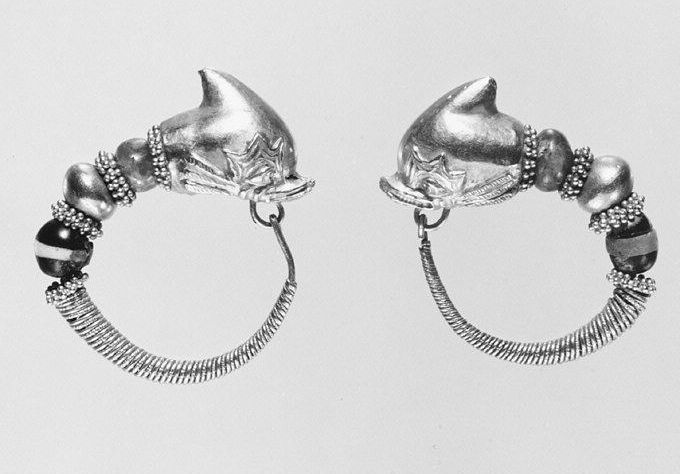
Within the hushed archives of Natalie Fashion Atelier, we conduct our aesthetic archaeology not upon excavated marble, but upon the shimmering detritus of ancient adornment. The subject of this technical inquiry—a pair of Greek gold earrings terminating in dolphin heads, suspended with emeralds, glass, and gold beads—represents far more than a decorative artifact. It is a condensed treatise on kinetic sculpture, material hierarchy, and the semiotics of marine power. For the 2026 luxury silhouette, this piece offers a radical departure from minimalist reduction. It demands a return to architectural fluidity, where the body becomes a vessel for controlled movement and the garment a frame for precious, deliberate weight.
I. Material Dialectics: The Structural Conversation Between Gold, Emerald, and Banded Glass
The earring’s genius lies not in the individual components, but in their tensile relationship. The gold, worked with the lost-wax technique, provides a rigid, warm skeleton—the anatomical certainty of the dolphin’s snout. The emeralds, in their raw, unbacked setting, offer a point of cool, verdant focus, a chromatic anchor that pulls the eye downward. The banded glass, however, is the subversive element. Its striations mimic the natural veining of agate, yet its materiality is synthetic, a democratized luxury that the Greeks employed for its optical vibration. In 2026, this tripartite hierarchy translates directly into our couture layering logic.
Translating Material Weight to Fabric Drape
We propose a silhouette that rejects uniform fabric weight. Instead, the atelier will employ a gradient of substance. The structural gold is interpreted via a rigid, sculpted gazar silk or a technical faille, used to construct the jacket’s shoulder line and collar—the “snout” of the garment. This provides the architectural confidence. The emerald is translated into liquid satin panels of deep jade or malachite, inserted at the waist or along a single hip, creating a focal point of saturated color that interrupts the monochrome flow. The banded glass is the most innovative translation: we utilize organza strips fused with metallic thread, creating a fabric that shifts in opacity and sheen as the wearer moves, mimicking the striated, refractive quality of the ancient glass. The 2026 silhouette is thus not a single textile, but a stratified composite, echoing the earring’s layered construction.
II. The Dolphin’s Arc: Kinetic Silhouette and the Architecture of Motion
The dolphin head is a study in arrested motion—a curve that suggests a leap from the water. This dynamic curvature is the primary generative force for our 2026 lines. We abandon the static, vertical column in favor of a biomorphic asymmetry. The silhouette will feature a pronounced, sweeping hemline that arcs from a high point at the left hip to a sweeping train on the right, echoing the dolphin’s dorsal curve. This is not a random drape; it is a calculated contrapposto for the modern era, where the garment’s energy is perpetually forward-moving.
The Pivot Point: Engineering the Swivel
Critical to the earring’s wearability is its swivel mechanism—the ability of the pendant to rotate and catch light. Our 2026 construction borrows this principle through articulated gussets at the shoulder and elbow. We are engineering a jacket where the sleeve cap is not sewn rigidly, but attached via a hidden series of micro-chain links, allowing the sleeve to pivot slightly with the arm’s motion. This creates a subtle, ever-changing silhouette, where the garment’s outline is never fully static. The visual effect is one of controlled liquidity, a direct homage to the earring’s gentle oscillation against the neck.
III. Chromatic Restraint and Optical Disruption
The earring’s palette is deceptively simple: warm gold, deep green, and the muted, earthen tones of the glass. Yet, the optical result is complex due to the interplay of reflective and absorptive surfaces. For 2026, we propose a strict, almost monastic color discipline, but with a high degree of textural variance. The base of the collection will be a warm, antique gold—not a shiny metallic, but a brushed, slightly oxidized tone achieved through a combination of silk, wool, and a fine metallic Lurex thread. This serves as the canvas.
The Emerald Accent as Structural Logic
The emerald is not used as a print or a pattern. Instead, it appears as hard, three-dimensional elements—cabochon-like buttons, a sculptural brooch closure, or a single, oversized enameled panel at the sternum. This placement is deliberate; it draws the eye to the center of gravity, providing a visual rest stop before the eye travels the arc of the garment. The banded glass informs our jacquard patterns, where we weave contrasting threads to create a subtle, irregular stripe that reads as organic strata from a distance, but reveals its complexity up close. This is a study in optical depth—the 2026 silhouette must reward close inspection, just as the ancient earring does.
IV. The Isolated Artifact: From Museum Case to Modern Armor
Isolated from its funerary or votive context, the earring becomes pure aesthetic data. It is no longer a symbol of Aphrodite or a marker of status; it is a pure form. This isolation is our curatorial license. We strip away the historical narrative and retain only the visual and structural grammar. The 2026 wearer is not a Greek goddess; she is a contemporary woman who understands that true luxury is the ability to carry weight with grace. The silhouette we propose is a form of personal armor, not of defense, but of presence. The gold gives her structure; the emerald gives her focus; the glass gives her the shimmer of unpredictability.
Conclusion: The Grammar of Aquatic Luxury
The dolphin earring, in its microcosmic perfection, offers a complete design lexicon for the 2026 haute couture collection. It teaches us that luxury is not about volume, but about precision of articulation. It demonstrates that a silhouette can be both monumental and fluid, and that materiality is the ultimate communicator of value. By deconstructing its classical elegance—the gold’s confidence, the emerald’s intensity, the glass’s subtle deception—we construct a new form of elegance for the future. The 2026 Natalie Fashion Atelier silhouette is thus a kinetic, stratified, and optically complex garment, a modern artifact destined for its own archaeological discovery. It is the dolphin’s leap, frozen in time, translated into the language of contemporary couture.