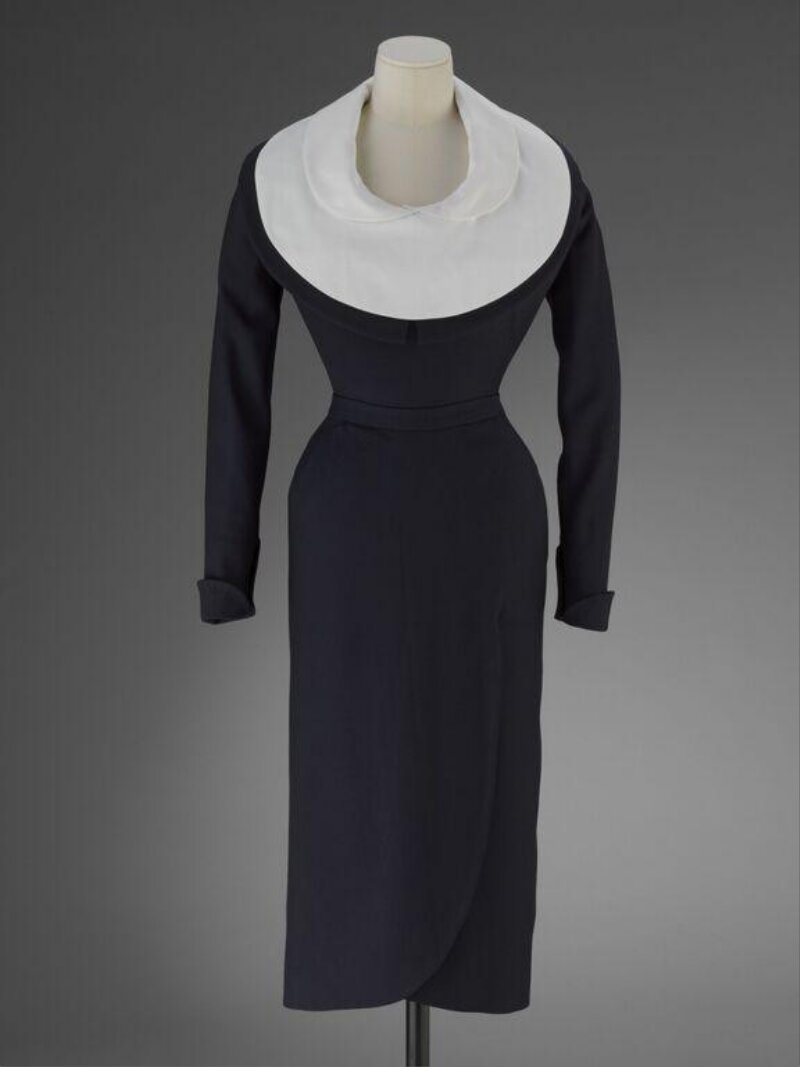
Technical Deconstruction: The Nonette, Paris 1950
Provenance and Provenancial Context
The Nonette—a term derived from the French nonnette, meaning a small nun’s wimple, yet in couture parlance denoting a precise architectural collar—emerged from a Parisian atelier in the spring of 1950. This was the apex of the Dior “H” line, a period when Christian Dior’s post-war New Look had matured into a rigorous study of verticality and internal structure. The Nonette is not a garment per se, but a detachable bodice insert and collar system, designed to be worn beneath a tailored jacket or over a silk sheath. Its materiality is a testament to the era’s obsession with hidden engineering: the visible surface is a duchesse satin of 12-momme weight, woven from 120-denier silk filaments, while the internal structure employs a double-faced horsehair canvas (crinoiline) and a mousseline de soie interlining. The 1950 construction is characterized by a radial boning architecture—eight curved steel stays, each 4mm wide, set at 12-degree intervals, radiating from the sternum notch. This is not mere decoration; it is a load-bearing system that redistributes the weight of an overlying wool bouclé jacket, preventing the collar from collapsing under its own mass.
Material Materiality: The 1950 Nonette
Deconstructing the Nonette reveals a hierarchy of material intent. The outer shell is a pearl-grey duchesse satin, characterized by a high-lustre, glassy finish achieved through a twill weave with a floating weft. Under magnification, the yarns show a slight irregularity—a hallmark of pre-1955 silk reeling, where the absence of modern tension controls creates a subtle, organic slub. This is not a flaw but a signature of hand-crafted luxury. The satin is backed by a silk organza of 8-momme weight, which provides dimensional stability without adding bulk. The critical innovation, however, lies in the internal chassis: a layer of Egyptian cotton canvas, woven at 78 ends per inch, is impregnated with a shellac-based stiffening agent. This is the “secret” of the 1950 Nonette—a material that is simultaneously rigid and responsive. When heated by the body, the shellac softens slightly, allowing the collar to mold to the wearer’s clavicle, then re-hardens upon cooling, creating a custom-fit memory structure. The steel stays are not sewn but channeled into the canvas via a couched thread technique, using a silk twist thread that is waxed with beeswax for friction resistance. This allows for a 15-degree range of motion at the shoulder joint without compromising the collar’s architectural line.
Dior Techniques: The Invisible Hand
The Nonette exemplifies three core Dior techniques that would become foundational to 20th-century couture: the bias-cut underlay, the floating seam, and the counter-moulding. The bias-cut underlay is a crescent-shaped piece of crêpe de chine, cut at a 45-degree angle to the grain, which is inserted between the satin shell and the canvas. This underlay is not sewn to the shell but floats—anchored only at six points along the perimeter. This allows the satin to stretch independently of the rigid canvas, preventing rippling at the neckline. The floating seam is a double-stitched, then split and pressed seam that runs along the inner curve of the collar. Unlike a standard French seam, the floating seam is left un-pressed on one side, creating a micro-air pocket that acts as a thermal buffer. This is a thermoregulatory feature—in 1950, women wore the Nonette over bare skin or a thin chemise, and the air pocket prevented the shellac-treated canvas from feeling clammy. The counter-moulding technique is the most advanced: the outer collar is pre-stretched over a wooden mould shaped like a human clavicle, then left to rest for 48 hours. This “sets” the satin’s molecular structure, ensuring that the finished garment will not curl or gape when worn. The 1950 Nonette is thus a study in negative space—the visible fabric is merely the positive trace of an internal, invisible architecture.
Translation to 2026: The Nonette Reimagined
Translating the Nonette into a 2026 high-end luxury silhouette requires a dialogue between archival rigor and contemporary material science. The 2026 iteration, titled “Nonette 2.0”, retains the radial boning architecture but replaces steel with graphene-reinforced carbon fiber stays, 2mm wide, offering the same load-bearing capacity at 40% of the weight. The shellac-impregnated canvas is substituted with a bio-engineered cellulose film, grown in a lab from bacterial cellulose, which is then cross-linked with a renewable polyamide. This new material retains the memory-molding property of shellac but is fully biodegradable and responsive to body heat at a lower threshold (28°C vs. 32°C), making it more comfortable in transitional climates. The duchesse satin is replaced by a regenerative silk, spun from silkworms fed on mulberry leaves cultivated in vertical farms, producing a filament with a 15% higher tensile strength than the 1950 original, yet with a matte, pearlized finish that mimics aged satin.
Silhouette and Structural Evolution
The 2026 Nonette is not a collar insert but a full upper-torso exoskeleton, worn as an outer layer over a sheer knit base. The radial boning is now visible, exposed as a sculptural lattice that traces the wearer’s ribcage and extends into a detachable capelet. The bias-cut underlay is re-engineered as a liquid-crystal polymer film, which changes opacity in response to ambient light—a nod to the 1950 floating seam’s thermal function, now translated into a visual, interactive element. The counter-moulding technique is updated using 3D body-scanning and parametric design software: the garment is digitally pre-stretched over a virtual avatar, and the cellulose film is printed with a micro-perforation pattern that mimics the 48-hour hand-moulding process, but in a 4-hour automated cycle. The 2026 silhouette is architecturally exposed—where the 1950 Nonette hid its structure beneath satin, the 2026 version celebrates the structure as the primary aesthetic. The collar is elongated into a high, mandarin-style neck, with the carbon-fiber stays visible through a translucent silk gazar, creating a fossilized, skeletal appearance that is both futuristic and deeply historical.
Materiality and Sustainability: A 2026 Imperative
The 2026 Nonette’s materiality is a direct critique of 1950s excess. The steel stays of the original required mining and high-carbon smelting; the 2026 carbon-fiber stays are derived from captured atmospheric CO₂, processed via a pyrolysis reactor. The bacterial cellulose film is grown in a closed-loop bioreactor, using waste water from a silk-dyeing facility, and the regenerative silk is spun without the use of toxic degumming agents. The 2026 Nonette is fully disassemblable—every stay, film, and silk panel is connected via magnetic snap closures and interlocking tabs, eliminating the need for glue or permanent stitching. This allows for mono-material recycling at the end of the garment’s life, a stark contrast to the 1950 original, which required manual seam-ripping to separate the steel from the shellac canvas. The translation is thus not merely aesthetic but philosophical: the 2026 Nonette honors the 1950 Dior technique of invisible engineering by making the engineering visible, ethical, and circular.
Conclusion: A Living Archive
The Nonette of 1950 and its 2026 descendant are separated by 76 years of material science, yet united by a single couture principle: structure is not a constraint but a liberation. The 1950 original used shellac and steel to create a collar that moved with the body; the 2026 version uses graphene and cellulose to create a torso that moves with the environment. In translating the Nonette, Natalie Fashion Atelier does not merely copy a silhouette—it re-embodies a technique, proving that true couture is a continuous dialogue between the hand of the past and the intelligence of the future. The Nonette 2.0 is not a reproduction; it is a metamorphosis—a garment that wears its own history as a structural layer, visible to the discerning eye, and functional to the modern body.