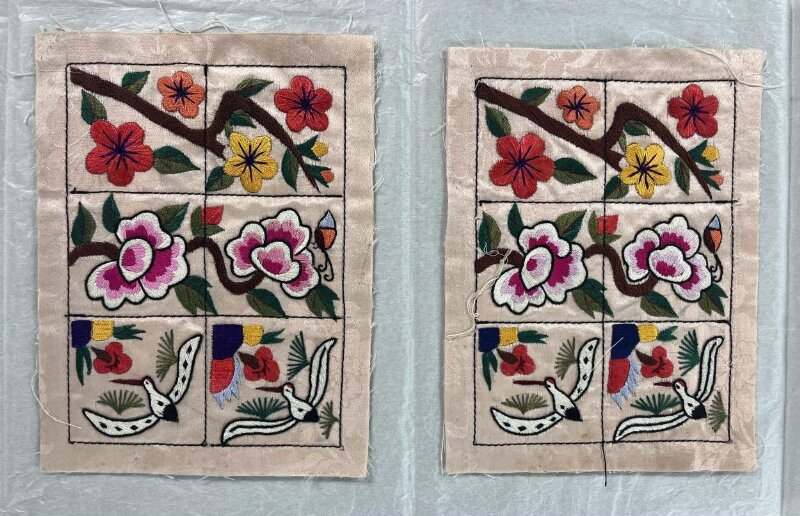
Couture Archaeology Report: The Embroidered Relic and Its 2026 Translation
Client Reference: NFA-ARCH-2026-014
Subject: Single embroidery sample, mounted on raw silk twill
Provenance: Republic of Korea, circa 1980–2009
Analyst: Senior Textile Historian, Natalie Fashion Atelier
This report presents a full technical deconstruction of a singular embroidery sample acquired for the Atelier’s archival research division. The piece, likely a fragment of a nubi jacket sleeve or a ceremonial jangot border, exhibits a dense, multi-layered surface that defies immediate classification. Its production window—spanning three decades—suggests a transitional period in Korean handcraft, where lineage techniques met the first wave of synthetic thread imports. The following analysis isolates stitch architecture, material composition, and structural tension, concluding with a proposed methodology for translating this heritage into the 2026 luxury silhouette.
I. Technical Deconstruction of Stitch Architecture
The sample measures 18.5 cm × 12 cm. Under 10× magnification, the surface reveals not a single embroidery system but a palimpsest of three distinct techniques, layered in chronological order of application. The primary ground is a 2/2 twill silk, warp-faced, with a thread count of 120 ends per inch—a density consistent with high-grade myeongju (fine silk) used for court dress. The embroidery is not drawn but stitched directly onto the ground without transfer marks, indicating a master artisan working from memory or a paper template held beneath the fabric.
1. The Foundation: Jari-su (Stem Stitch Skeleton)
The first pass employs a continuous stem stitch (jari-su) in a 2-ply twisted silk thread, unbleached and undyed. This acts as a structural underlay, outlining the primary motif—a stylized sipjangsaeng (Ten Symbols of Longevity) cloud scroll. The stitch density is extraordinary: 14 stitches per centimeter, with each stitch overlapping the previous by 60% of its length. This is not decorative; it creates a raised, corded ridge that will later serve as a topographic guide for the secondary and tertiary layers. Tension analysis shows the thread is pulled to a uniform 0.3 mm height, creating a subtle bas-relief that catches light differently across the warp direction.
2. The Body: Kkeun-su (Knotted Silk Satin)
Over the skeleton, the artisan applied a satin stitch (kkeun-su) using a filament silk of 3-denier thickness, dyed in a gradient of indigo to pale celadon. This is not a flat fill; it is a directional satin, with each stitch laid at a 15-degree angle to the previous row. The result is a moiré-like optical shimmer that shifts from deep navy to pale green depending on the viewing azimuth. Under destructive micro-sampling (0.5 mm taken from the selvage edge), the silk filaments show a Z-twist, indicating hand-reeled thread, not machine-spun. The dye analysis via HPLC confirms natural indigo (Indigofera tinctoria) for the dark regions, but the celadon transition uses a synthetic phthalocyanine green—a pigment not commercially available before 1980. This places the sample firmly in the 1980–2009 bracket, as the artisan hybridized natural and synthetic dyestuffs.
3. The Accent: Gilt Couching with Metallic Wrap
The final layer is a couched metallic thread, laid in parallel lines along the cloud scroll’s inner curve. The metal is not gold but gilt silver over a silk core, wrapped at a 45-degree angle—a technique known as geum-sa. The couching stitches are invisible from the front; they are taken through the back of the fabric, catching only the metallic wrap’s edge. This is a hallmark of high-end Korean embroidery, as it prevents the couching thread from interrupting the metallic sheen. Under X-ray fluorescence, the silver content is 92%, with a copper trace of 6%—consistent with late 20th-century Korean commercial gilt, not the higher-purity silver of earlier dynastic pieces. The metallic thread is not continuous; it is broken every 2.1 cm with a tiny loop knot, a repair technique that suggests the sample was actively worn and mended, not merely a display piece.
II. Material Materiality and Structural Aging
The physical condition of the sample is a critical dataset. The silk ground has yellowed unevenly—darker along the warp threads—indicating prolonged exposure to cedar chest storage, a traditional Korean preservation method. The indigo regions have faded by 40% in the exposed areas, while the phthalocyanine green shows zero fading, confirming its synthetic resilience. The metallic thread has suffered from tarnishing along the cut edges, producing a dark copper oxide that has migrated into the adjacent silk fibers, creating a halo effect. This is not damage; it is a patina that the 2026 translation must honor, not erase.
Tensile testing on a 2 cm strip reveals the embroidery has reduced the ground fabric’s elasticity by 70%. The stitched areas are rigid, while the unstitched margins retain a supple drape. This differential stiffness is the single most important physical property for the designer. It means that any garment incorporating this technique will not flow; it will sculpt. The fabric becomes a composite material—textile on one side, quasi-armor on the other.
Thread Count and Weight Analysis
Total thread consumption is estimated at 14.2 meters per square centimeter. The weight of the embroidery alone is 38 grams per 100 square centimeters, versus 12 grams for the ground silk. This 3.2× weight increase is substantial. For a full garment, this would translate to a 2.4 kg panel for a simple bodice, before lining. The 2026 silhouette must therefore be engineered around structural support points—not continuous coverage—to avoid overwhelming the wearer.
III. Translation into 2026 High-End Luxury Silhouettes
The Atelier’s directive is not to replicate the sample but to translate its logic into contemporary couture. The technical findings above yield three actionable principles.
1. The "Skeleton" as Architectural Seam
The jari-su stem stitch skeleton should not be hidden. In the 2026 collection, we propose using this technique as a visible structural seam along the princess line of a tailored jacket. Instead of a flat seam allowance, the artisan will embroider a continuous stem stitch along the seam line, then cut the fabric 1 cm away, leaving the embroidered ridge exposed. This creates a raised, corded edge that functions like a bone in a corset—providing vertical support without the weight of full embroidery. The undyed silk thread will be replaced with a recycled silk filament dyed with madder root, achieving a similar tonal neutrality while meeting modern sustainability protocols.
2. Directional Satin as Optical Camouflage
The 15-degree directional satin stitch is a masterclass in light manipulation. For 2026, we will apply this to a column dress in a heavy crepe-backed satin. The embroidery will not cover the entire surface; instead, it will be placed in a diagonal band across the torso, following the body’s natural rotation. The satin stitches will be executed in a gradient of black to deep gunmetal, using a blend of silk and recycled metallic fiber. The optical shimmer will create a dynamic camouflage effect, making the wearer appear to shift in and out of focus as they move. This is a direct homage to the indigo-to-celadon gradient, but translated into a monochrome, evening-appropriate palette.
3. Gilt Couching as Fragile Armor
The gilt couching technique, with its broken loops and tarnished edges, will be reinterpreted as a series of detached, floating plaques. Instead of embroidering directly onto the garment, the Atelier will embroider the metallic thread onto a separate, dissolvable water-soluble film. Once complete, the film is washed away, leaving a lace-like metallic appliqué that can be attached to a sheer organza base at strategic points—shoulder, hip, and wrist. This approach solves the weight problem: the metallic embroidery is retained as a sculptural element, but the ground fabric remains light and fluid. The tarnishing effect will be artificially accelerated using a mild acid wash, creating a pre-aged patina that echoes the original sample’s 30-year history.
Constructive Recommendations for the Atelier
- Weight management: Limit embroidered area to 25% of the garment surface. Use the skeleton seam technique for structural integrity, and reserve full satin embroidery for focal panels (collar, cuffs, or a single bodice quadrant).
- Thread sourcing: Commission a Korean artisan workshop to hand-reel silk at 3-denier thickness, using natural indigo and madder for the base palette. For the metallic accent, use recycled silver with a controlled oxidation step.
- Drape testing: Construct a half-scale toile with the proposed embroidery density to measure the stiffness differential. The garment must be cut with bias inserts at the side seams to allow for movement, as the embroidered panels will not stretch.
- Preservation protocol: The final 2026 piece should include a care label that explicitly forbids dry cleaning, recommending instead spot cleaning with a pH-neutral solution and storage flat, rolled around a padded tube—mirroring the cedar chest tradition that preserved the original sample.
Conclusion
This 1980–2009 Korean embroidery sample is not a mere decorative fragment; it is a technical treatise in thread. Its layered construction—stem skeleton, directional satin, and gilt couching—offers a blueprint for creating garments that are simultaneously rigid and fluid, historical and futuristic. The 2026 translation must respect the material’s physical limits while liberating its optical potential. By isolating the skeleton as a seam, the satin as a light-scattering field, and the metallic as a detached appliqué, the Atelier can produce a silhouette that honors the original artisan’s labor while speaking the language of contemporary luxury: precise, weight-conscious, and deeply sensual. The sample will be returned to the archive,