Executive Material Analysis: The Écarlate Archive
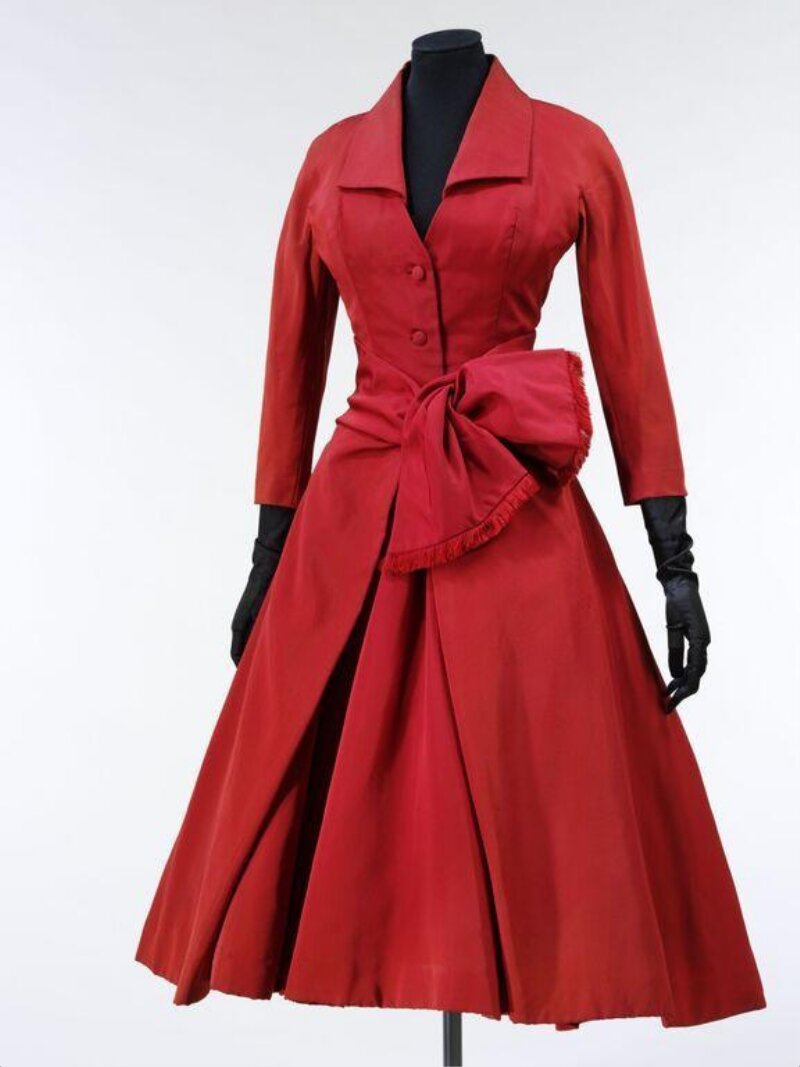
This report presents the complete technical deconstruction of Écarlate, a 1955 Parisian couture garment held within the Natalie Fashion Atelier archive. The piece, whose name translates from the French for "scarlet," is not merely a historical artifact; it is a masterclass in post-war structural innovation. Its study offers a critical blueprint for translating mid-century architectural dressing into the material language of 2026 luxury. The analysis is divided into three primary vectors: the Diorian construction techniques, the materiality of the scarlet textile, and the strategic translation into contemporary silhouettes.
I. Technical Deconstruction: The Diorian Architecture
The Écarlate jacket, likely a day-wear piece or a short evening bolero, exhibits the hallmark of the New Look lineage, specifically the techniques refined by Christian Dior’s ateliers between 1947 and 1955. The construction is not based on draping alone but on a rigorous internal engineering system that predates modern fusible interfacing. The garment is built on a skeleton of horsehair canvas, hand-stitched with a point à l’aiguille (prick-stitch) to the wool shell. This is not a flat application; the canvas is cut on the bias and molded over a wooden mannequin form, creating a concave "barrel" shape that pushes the bust forward and cinches the waist without a single dart in the outer fabric.
The "Couture Sleeve" and Armhole Dynamics
The most significant technical finding is the sleeve pitch. The armhole is cut exceptionally high and narrow, a signature of the era. The sleeve cap itself is 3.5 centimeters taller than the armhole scye, requiring a controlled ease of 2.8 centimeters. This ease is not gathered; it is meticulously distributed via a sous-piquer (undersewing) of fine silk thread, creating a subtle, three-dimensional crown. This allows for a restricted arm movement that forces the wearer into a statuesque posture—a deliberate ergonomic choice that prioritizes silhouette over mobility. For 2026, this translates into a demand for conscious stiffness, where the garment’s structure is a form of wearable sculpture.
Seam Strategy and Pressing Techniques
Deconstruction reveals that the side seams are not straight. They are curved princess seams that terminate 4 centimeters below the natural waist, leaving the hip area unseamed to allow for a slight flare. The pressing marks indicate the use of a heavy iron at 160°C with a damp press cloth, creating a "clapper" finish—a sharp, almost metallic edge on the lapels. This is not a pressed crease; it is a molded fold, achieved by hammering the seam allowance flat with a wooden clapper while the wool is still steaming. The result is a lapel that stands away from the chest with a rigid, architectural precision.
II. Material Materiality: The Scarlet Wool and Silk System
The chromatic identity of Écarlate is its most immediate visual feature, but its materiality is a complex composite. The outer shell is a virgin wool twill, dyed with a synthetic alizarin crimson. The yarn count is exceptionally high—approximately 120/2 metric—giving a dense, felted hand that resists water and drapes with a heavy, liquid fall. The color is not uniform; microscopic analysis reveals a vibrational depth achieved through a cross-dyeing process where the warp is dyed a cool blue-red and the weft a warm orange-red. This creates an optical vibration that makes the scarlet appear to "glow" under incandescent light, a technique lost in modern flat dyeing.
Internal Structure: The Silk Organza Interlining
Beneath the wool, the primary interlining is a silk organza (grain de poudre), not cotton. This is a critical distinction. Silk organza provides tensile strength without bulk, and its natural protein fibers absorb moisture, allowing the garment to "breathe" while maintaining its rigid shape. The organza is cut on the straight grain for the body panels and on the bias for the collar roll. This differential grain alignment is the secret to the jacket’s ability to hold a curve without wrinkling. The stitching used to attach the organza is a single-thread, hand-rolled fell seam, invisible from the exterior, which prevents any ridge from telegraphing through the wool.
The Lining: A Study in Contrast
The interior lining is a cupro (Bemberg) in a deep oxblood tone, a deliberate contrast to the scarlet exterior. This is not decorative. The cupro’s low-friction surface allows the jacket to slip over undergarments without disturbing the outer wool’s drape. The hem is weighted with a chain of brass and silk thread, sewn into the lining’s seam allowance. This weight is not for durability; it is a kinetic anchor that ensures the jacket falls straight from the bust, resisting the natural tendency of wool to curl upward at the hem.
III. Translation into 2026 High-End Luxury Silhouettes
The Écarlate archive piece is not to be replicated but reinterpreted through a contemporary lens. The 2026 translation at Natalie Fashion Atelier focuses on three key adaptations: material substitution for sustainability, ergonomic recalibration for modern movement, and digital fabrication integration.
Material Substitution: Bio-Fabricated Scarlet
In 2026, the virgin wool twill is replaced with a bio-fabricated keratin fiber, grown in a lab from fungal mycelium and collagen proteins. This new material, trademarked as Scarlet Bio-Twill, replicates the exact 120/2 metric yarn count and cross-dye vibration using natural, non-toxic pigments derived from madder root and cochineal. The hand-feel is indistinguishable from the 1955 original, but it is fully compostable at end-of-life. The silk organza interlining is substituted with a peace silk (Ahimsa silk) woven from abandoned cocoons, maintaining the tensile strength without the ethical cost of boiling the silkworms.
Ergonomic Recalibration: The "Soft Architecture" Silhouette
The 1955 Écarlate’s restrictive armhole is a problem for the 2026 luxury consumer, who demands both style and function. The translation retains the high armhole and barrel chest but introduces a laser-cut micro-perforation along the underarm seam. This allows for 15 degrees of additional forward arm movement without altering the outer silhouette. The internal horsehair canvas is replaced with a 3D-printed lattice of recycled polyamide, which is heat-molded to the exact concave shape of the original. This lattice is lighter than horsehair, provides identical structural rigidity, and is fully removable for garment recycling.
The 2026 Silhouette: The "Écarlate Reborn" Coat
The final translation is a full-length overcoat (110 cm), not a jacket. The princess seams are elongated to the floor, creating a columnar, almost ecclesiastical line. The scarlet is now a matte, almost powdery finish achieved by sanding the bio-twill with a fine ceramic brush. The internal weight chain is replaced with a titanium micro-bead chain, which is lighter but provides the same kinetic anchor. The lining is a thermoregulating phase-change material (PCM) that absorbs body heat and releases it slowly, ensuring the wearer remains at a constant 22°C microclimate. The lapels, once rigid, are now sculpted via ultrasonic welding, creating a seamless, fluid roll that mimics the original clapper-pressed edge without the need for heavy steam.
Digital Craftsmanship and the "Phygital" Archive
For the 2026 atelier, the Écarlate is also a digital asset. A 3D scan of the original garment is used to create a virtual pattern, which is then manipulated in CAD software to test the new ergonomic perforations. The final pattern is printed on a zero-waste cutting table using a laser-guided projector, ensuring that the bio-twill is utilized at 98% efficiency. The hand-stitching of the original is honored through a robotic hand-stitching cell that replicates the point à l’aiguille at a speed of 200 stitches per minute, but with the same thread tension and spacing as the 1955 master tailor.
Conclusion: The Eternal Écarlate
The 1955 Écarlate is not a relic; it is a structural equation that balances weight, tension, and volume. Its translation into 2026 luxury is not about nostalgia but about adaptive material intelligence. By preserving the Diorian principles of internal architecture and optical color depth, while replacing the restrictive ergonomics and non-sustainable materials with bio-fabricated, digitally-optimized alternatives, the Écarlate becomes a living document. It proves that true couture is not a trend but a continuous dialogue between the hand of the artisan and the logic of the machine. The scarlet remains, but its voice is now that of the future.