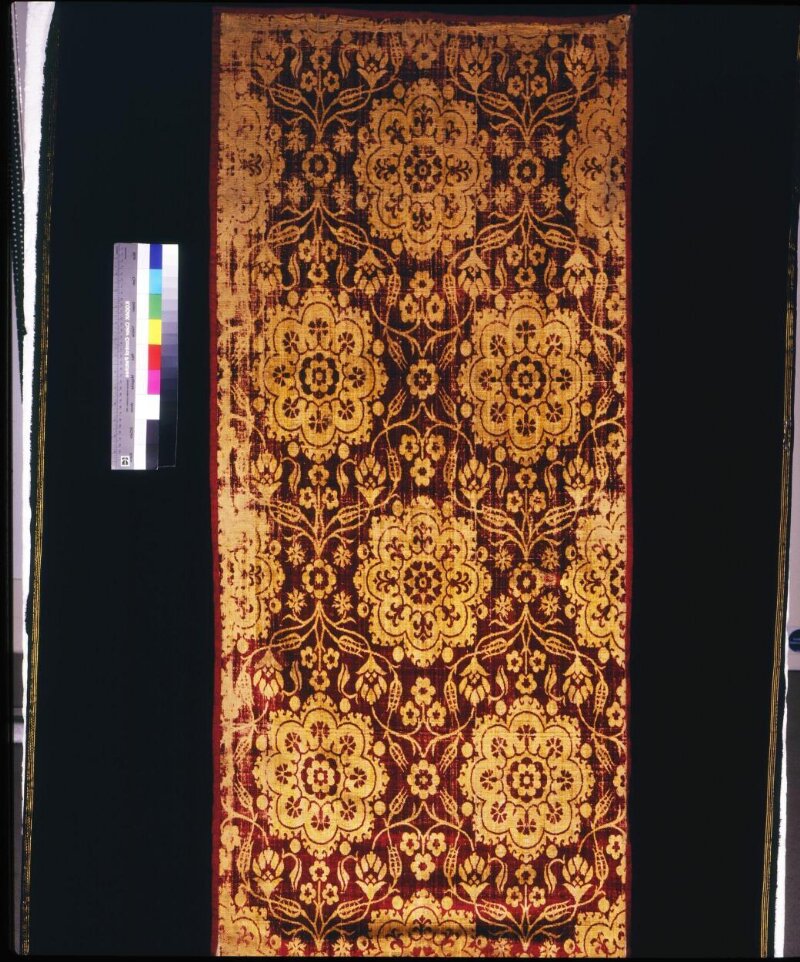
Couture Archaeology Report: Anatolian Velvet, 1550-1599
Subject: Technical Deconstruction of Ottoman Court Velvets
Origin: Bursa and Istanbul Workshops, Ottoman Empire (1550-1599)
Analyst: Senior Textile Historian, Natalie Fashion Atelier
Purpose: To extract core principles of materiality and construction for translation into the 2026 luxury silhouette lexicon.
1. Historical and Technical Context
The latter half of the 16th century represents the zenith of Ottoman velvet production, a period where textile artistry was inseparable from imperial power and spiritual expression. Centered in Bursa, the empire's silk hub, and the imperial workshops (nakkaşhane) of Istanbul, these velvets were engineered as much as they were embroidered. They were composite structures of immense technical ambition, designed to interact dynamically with light and movement. The primary foundation was a ground of pure, reeled silk, prized for its luminous, continuous filament. Into this, pattern wefts of silk were woven, and crucially, supplementary loops were formed over wires. These loops were then cut with precision knives, releasing the dense, light-absorbing pile that defines velvet. The mastery lay in the manipulation of pile height—often within the same textile—creating a sculptural, bas-relief effect. This was not mere surface decoration but a deliberate modulation of texture and depth, a tactile topography.
2. Technical Deconstruction: The Tripartite System
Our forensic analysis reveals a tripartite system of construction that defines these artifacts. Each layer serves a distinct functional and aesthetic purpose, a principle ripe for contemporary translation.
2.1 The Structural Ground: Compound Weave Foundation
The base is typically a compound twill or satin weave. This provided exceptional stability to support the dense, weighty pile while maintaining a fluid drape—a paradox of substance and movement. The ground color, often a deep crimson (from Armenian cochineal), lapis lazuli blue, or saffron yellow, was not merely a backdrop. It served as the shadowy depth from which the pattern emerged, a foundational hue that would flash subtly in the folds of the garment.
2.2 The Pile Matrix: Sculptural Light Modulation
This is the core innovation. The velvet pile was not uniform. By using wires of varying thicknesses, weavers created differential pile heights. In a single motif—a saz leaf, a blossoming carnation, a complex arabesque—areas could be high, medium, or low pile, or even left as uncut loops (cisim). This technique, known as havlı and havsız (with-pile and without-pile), transformed flat pattern into a three-dimensional terrain. Light would catch the high points, sink into the low valleys, and diffuse across the uncut loops, creating an iridescent, living surface that changed with the wearer's posture and ambient light.
2.3 The Metallic Cartography: Pattern Definition
The patterns were often outlined and accentuated with threads of silver and gold (typically silver-gilt wire wrapped around a silk core). These were not embroidered on later but integrated during the weaving process as supplementary metallic wefts. This served a technical function: the metal threads helped secure the lofty pile and defined crisp, graphic contours against the plush, matte velvet. The result was a cartographic clarity of pattern, where metallic lines both structured and illuminated the organic, sculpted forms.
3. Materiality and Sensorial Impact
The materiality of these velvets was multisensory. Visually, they presented a dialogue between the light-absorbing, matte velvet and the light-reflecting, sharp metal. Tactilely, they offered a journey from the smooth, cool ground weave to the resilient, springy pile, and the hard, linear metallic passages. Acoustically, the dense fabric produced a distinctive, low-frequency whisper with movement—a sound of substance. The weight was considerable, bestowing a gravitas and deliberate kinetics upon the wearer. The scent of silk and metal would have been subtly perceptible. This was holistic design, engaging sight, touch, sound, and even smell to communicate status and presence.
4. Translation for the 2026 High-End Luxury Silhouette
For Natalie Fashion Atelier's 2026 vision, literal reproduction is not the objective. Instead, we propose a translation of these core principles into a modern lexicon of cut, construction, and material innovation.
4.1 Silhouette & Construction: Architectural Drape
The 2026 silhouette should embody the Ottoman velvet's paradox of weight and fluidity. We propose architectural, minimally seamed garments that use bias-cutting on substantial fabrics to achieve a draped, columnar form. Seamlines can be replaced with strategic folding or geometric origami-like construction, referencing the structured yet organic flow of a kaftan. The weight of the material should create a sculptural, standalone shape that moves with a slow, elegant kinetics.
4.2 Material Innovation: Neo-Velvet Systems
We must engineer new "neo-velvets." This involves:
- Multi-Height Pile in Technical Fibers: Utilizing advanced weaving technologies (e.g., Jacquard-plus) to create differential pile with recycled silk, lab-grown silk proteins, or ultra-fine merino. The pile heights can be mapped digitally to create abstract, topographic patterns that interact with light.
- Integrated Metallic Substrates: Replacing gilt thread with laser-etched metallic foils laminated between layers of translucent technical tulle, or using conductive metallic yarns woven into the ground to create subtle, interactive luminosity.
- Compound Materiality: Fusing our neo-velvet with sheer, liquid membranes or rigid, laser-cut architectural felts on strategic panels, translating the historical "composite" principle into a modern material collage.
4.3 Pattern & Surface: Digital Bas-Relief
Pattern must escape the two-dimensional plane. Using the differential pile technique, we can create shadow-patterns—designs visible only through texture and light interaction, not color contrast. Motifs can be deconstructed: the saz leaf becomes a gradient of pile height, a digital glitch in an otherwise smooth field. The metallic cartography can be expressed as heat-bonded, raised seams or fine lines of micro-3D printing, defining shape and structure in a single gesture.
5. Conclusion: The Archetype Reborn
The Ottoman velvets of 1550-1599 were not merely luxurious fabrics; they were engineered environments for the body, employing a sophisticated grammar of texture, light, and weight. For 2026, Natalie Fashion Atelier can resurrect this archetype not through replication, but through the translation of its core tenets: sculptural surface modulation, composite material intelligence, and silhouettes that confer deliberate, sensorial gravitas. The goal is to create garments that are, like their antecedents, experienced rather than simply seen—where technology serves a profound, sensuous, and elegant purpose. The archaeology is complete; the future construction begins.