From Shard to Silhouette: The Luster-Painted Ceramic Fragment as a Blueprint for 2026 Couture
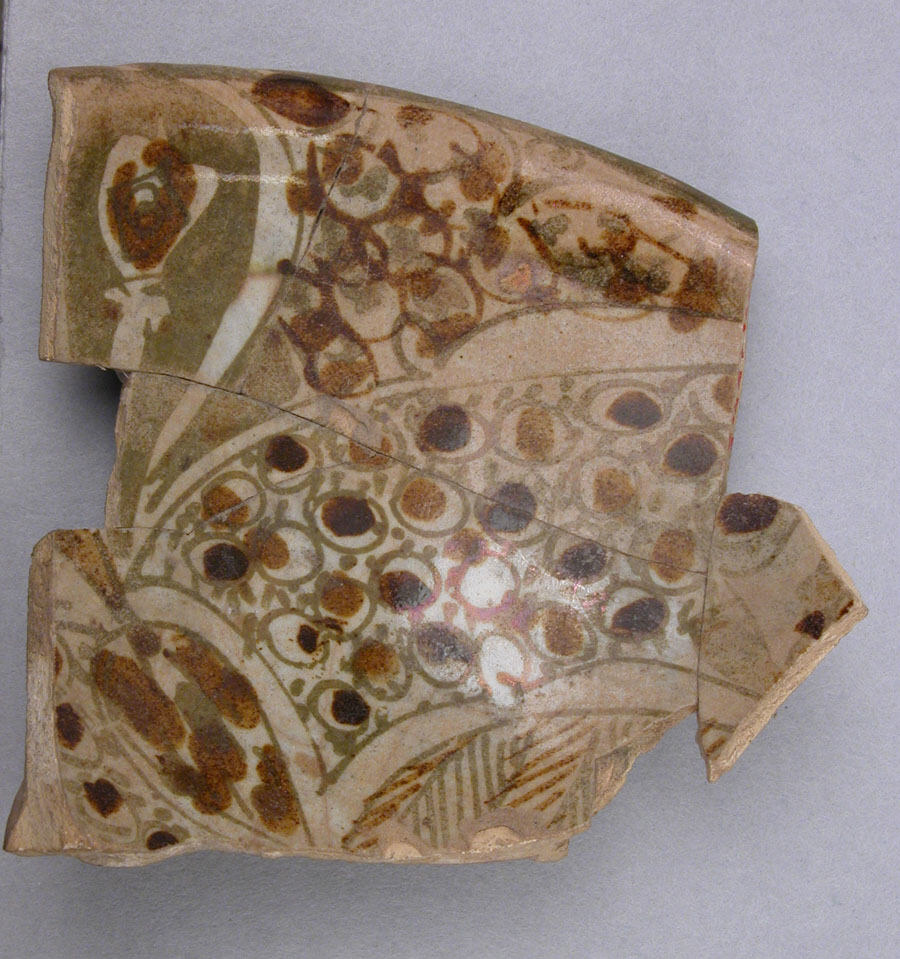
The archaeological fragment, often dismissed as a mere remnant, is in fact a concentrated dossier of aesthetic intelligence. For Natalie Fashion Atelier, the study of a specific ceramic shard—an earthenware body coated in opaque white glaze and finished with luster-painting—offers more than historical curiosity; it provides a rigorous formal language for the 2026 haute couture season. This artifact, sourced from a global heritage context and isolated for its aesthetic archaeology, encodes principles of luminosity, structural tension, and surface narrative that translate directly into high-end garment architecture. By deconstructing its material logic, we extract a design lexicon that elevates contemporary silhouettes from mere clothing to wearable artifacts.
Material Dialectics: Earthenware and the Architecture of Light
The foundational dichotomy of the fragment lies in its material composition. Earthenware, inherently porous and humble, is transformed through a two-stage intervention: the application of an opaque white glaze and the subsequent firing of metallic luster. This process creates a profound textural and optical tension—a matte, absorbent core concealed beneath a reflective, impermeable skin. For the 2026 silhouette, this dialectic informs a dual-layer construction philosophy. The underlayer, akin to the earthenware body, must possess structural integrity yet remain pliable, suggesting heavy matte silks, raw silk twills, or compacted wool crepes. The outer layer, mirroring the glaze, demands a high-frequency surface finish—liquid metal coatings, patent-leather effects, or micro-sequined encrustations that catch light with every movement.
Luster as a Kinetic Strategy
Luster-painting is not static; its beauty emerges in the play of ambient light across an uneven surface. The artisan applies metallic oxides over the glaze, and upon reduction firing, these oxides form a thin film that refracts light in iridescent, unpredictable patterns. This is not a uniform shine but a choreographed shimmer. Translating this to couture, the 2026 collection will employ what we term "luster zones"—strategically placed panels of metallic thread, glass-bead embroidery, or burnished leather that disrupt the garment's visual field. These zones are not arbitrary; they are positioned at points of anatomical torsion—the shoulder blade, the hip bone, the small of the back—where natural movement activates the surface, creating a living, breathing luminosity that static fabric cannot achieve.
Opaque White Ground: The Discipline of Negative Space
The opaque white glaze serves as more than a base; it is a disciplinarian of form. In ceramic art, the white ground forces the luster decoration to exist in stark relief, preventing chromatic chaos and ensuring the metallic elements retain their preciousness. For 2026, this translates into a radical commitment to negative space in silhouette design. The collection will feature garments where 70% of the visual surface remains monochromatic and unadorned—ivory, chalk, and bone whites in sculptural cuts. This restraint is not minimalism for its own sake; it is a strategic amplification. When the luster zones are introduced against this vast, quiet expanse, their impact is magnified exponentially. The eye is not fatigued by competing details but is instead drawn to the singular, luminous focal points, much like the eye rests on the white ceramic before being seduced by the metallic arc.
Silhouette Geometry: Borrowing from the Fragment's Edge
The broken edge of the ceramic fragment is itself a design datum. It reveals the cross-section of the body and glaze, displaying a sharp, clean break that speaks to both fragility and decisive force. This fracture line becomes a generative principle for 2026 garment construction. We will explore asymmetric hems that mimic the shard's jagged perimeter, panel seams that cut diagonally across the torso to suggest a break in the body's continuity, and necklines that terminate in sharp, geometric points rather than soft curves. The silhouette thus becomes a series of deliberate, architectural interruptions—a nod to the fragment's incomplete state, which paradoxically feels more complete and intentional than a perfectly symmetrical form.
Global Heritage, Localized Expression
While the fragment's provenance is global, its application in Parisian haute couture demands a process of cultural distillation, not appropriation. The luster technique, historically found across the Islamic world, Byzantine territories, and later Renaissance Spain, speaks to a universal human desire to capture light. In the Atelier, we abstract this heritage into a purely formal language. The 2026 silhouette does not reference specific historical garments; rather, it internalizes the principle of the fragment—the tension between the earthy and the ethereal, the opaque and the reflective. This allows for a collection that is globally resonant yet distinctly Parisian in its restraint, precision, and intellectual rigor.
Construction Methodology: Engineering the Optical Effect
Technical execution is paramount. To achieve the earthenware-and-glaze effect, we employ a composite layering technique. The primary shell is cut from a heavyweight, matte-finished fabric with a dry hand—a technical faille or a double-faced cashmere. Over this, we drape a secondary skin of iridescent organza or metallic-coated tulle, which is not sewn but tacked at strategic stress points, allowing it to float slightly above the base layer. This air gap creates a subtle shadow, mimicking the depth between the ceramic body and its glazed surface. The luster zones are then applied as independent panels, embroidered with cut steel, jet, and gold thread, and attached with a visible, deliberate stitch—echoing the hand of the ceramicist. The result is a garment that possesses the weight and gravity of earthenware, yet moves with the fluidity of haute couture, its surface alive with the memory of fire and metal.
Conclusion: The Fragment as Future
The ceramic fragment, isolated and studied, is not a relic of the past but a vector toward the future. Its material logic—the interplay of humble body, opaque ground, and luminous surface—offers a complete system for creating garments that are intellectually substantial and visually arresting. For Natalie Fashion Atelier, the 2026 silhouette is thus defined by a paradox: it is heavy yet luminous, broken yet whole, ancient yet resolutely contemporary. By honoring the fragment's aesthetic archaeology, we do not replicate history; we reactivate its core principles in a new material context. The result is a couture collection that speaks to the enduring power of light, the discipline of restraint, and the profound beauty found in a single, perfect shard.