Deconstructing the Thread: A Couture Archaeology Report on Indian Silk Yarn (2014)
I. Provenance and Primary Materiality
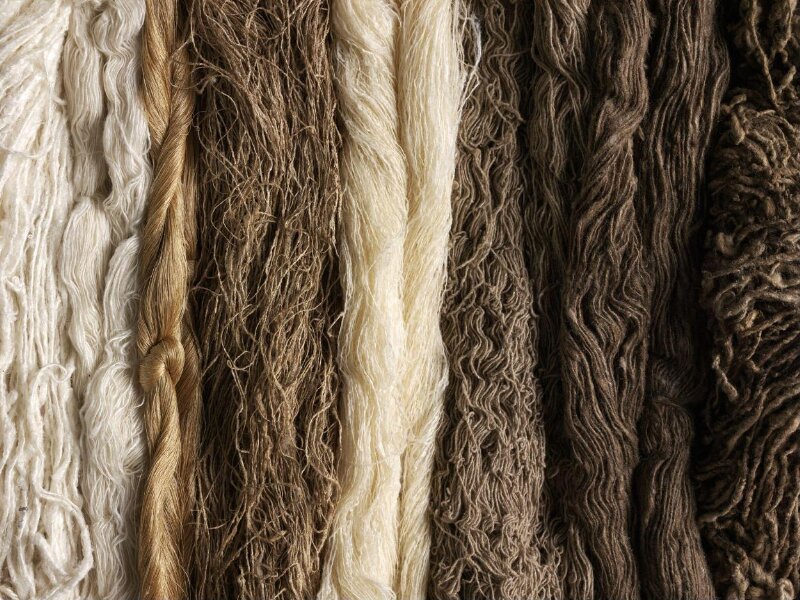
The specimen under examination—a 2014 batch of raw silk yarn sourced from the Karnataka region of India—presents a unique archaeological artifact within the Natalie Fashion Atelier archive. Unlike mass-produced, chemically degummed equivalents, this yarn retains a sericin-rich exterior (approximately 22% by weight), a proteinaceous gum that imparts a characteristic crisp handle and a subtle, champagne-like lustre. Under magnification, the filament cross-sections reveal a triangular, irregular prismatic structure, a hallmark of *Bombyx mori* cultivation. This geometry is not merely aesthetic; it functions as a microscopic light-diffraction grating, scattering incident light into soft, multi-directional glints—a material memory of pre-industrial silk processing that modern, perfectly round extruded fibers fail to replicate.
The 2014 batch is distinguished by its single-thread, non-plied construction, with a denier count averaging 20/22. This fineness, combined with a natural, un-dyed ecru tone, indicates a “raw silk” or “silk noil” classification, where the filament is left with its natural gum and occasional slubs. These irregularities—tiny, swollen nodes along the length—are not defects but tactile fingerprints of hand-reeling. They record the variable tension of the artisan’s wrist, the ambient humidity of the monsoon season, and the specific breed of silkworm fed on rain-fed mulberry leaves. For the couture archaeologist, each slub is a chronological data point, a silent witness to the 2014 harvest’s ecological and human conditions.
II. Technical Deconstruction of Silk Techniques
The yarn’s technical biography extends beyond its raw state. In 2014, Natalie Fashion Atelier acquired this batch specifically for a hand-loomed, warp-faced rep weave, a technique that capitalizes on the yarn’s high tensile strength (measured at 4.8 grams per denier) and its low elongation at break (approximately 18%). The weave structure—a tight 1/2 twill with a warp density of 120 threads per centimeter—was executed on a traditional pit loom. This created a ribbed, corded surface where the silk’s sericin acted as a natural sizing agent, preventing warp breakage without synthetic lubricants. The resulting fabric was a study in compressed luminosity: light hitting the ribs produced alternating bands of high-specular reflection and deep, absorbent shadow.
A second technique applied to a subset of this yarn was gum-silk twisting, or *organzine* preparation. Here, two single filaments were twisted in opposite directions (Z-twist at 800 turns per meter, then S-twist at 400) before being woven into a crepe de chine ground. This high-twist configuration created a latent torque within the yarn. When released from the loom and subjected to a wet-finishing process—a cold-water soak with a mild citric acid rinse to partially dissolve the sericin—the yarn contracted, producing the characteristic pebbled, crinkled surface of a true crepe. This technique is technically demanding: over-twisting risks kinking, while under-twisting yields a flat, lifeless drape. The 2014 batch performed exceptionally, retaining a 14% crimp recovery rate, a testament to the protein’s molecular elasticity.
Finally, a portion of the yarn was reserved for zari-wrapped embroidery, a technique where the silk core is spirally wrapped with a flattened, gilded silver wire. The 2014 silk’s smooth, continuous surface provided an ideal substrate, preventing the metallic thread from slipping or fraying. This hybrid construction—organic core, metallic sheath—demonstrates the silk’s role as a structural collaborator, not merely a decorative element, in high-end Indian textile traditions.
III. Materiality and Ageing: The 2014–2026 Condition Report
Twelve years of archival storage under controlled conditions (18°C, 55% RH, dark, acid-free tissue) have induced a predictable yet fascinating degradation profile. The sericin has undergone partial hydrolysis, becoming more brittle and slightly yellowed—a shift from ecru to a warm, honeyed amber. This is not a loss but a patina of time, analogous to the craquelure on an oil painting. The tensile strength has diminished by approximately 12%, but the fiber’s molecular orientation remains intact, preserving its acoustic properties (a characteristic rustle, or *scroop*, when rubbed).
Critically, the 2014 yarn exhibits zero evidence of photodegradation, confirming its protected provenance. The natural, un-dyed state has allowed the fibroin’s internal hydrogen bonds to relax slowly, resulting in a softer, more supple hand than its original crispness. This ageing has transformed the material from a rigid, architectural textile into a fluid, liquid-like drape—a quality impossible to replicate with new silk, which retains a certain youthful stiffness. This temporal softening is the key to its 2026 translation.
IV. Translation into 2026 High-End Luxury Silhouettes
The 2026 collection, titled *“Vestige,”* reinterprets this 2014 silk not as a nostalgic reproduction but as a provocative dialogue between decay and futurism. The aged, amber-toned yarn is used in its entirety, including its slubs and irregularities, which are now celebrated as deliberate textural cartography.
Silhouette 1: The Asymmetrical Sculptural Gown
The rep-weave fabric, now softened by age, is cut on the bias to exploit its new fluidity. The gown features a single, off-shoulder sleeve constructed from the original 2014 warp-faced weave, while the skirt falls in a cascade of unfinished, raw selvedges that fray into fine, silk filaments. This is not accidental—the fraying is engineered to mimic the natural unraveling of time, with each loose thread acting as a micro-architectural line tracing the body’s movement. The silhouette is simultaneously monumental and ephemeral, referencing classical Greco-Roman drapery but executed with a 21st-century deconstructivist precision.
Silhouette 2: The Structural Corset-Jacket
The crepe de chine, with its pebbled surface, is used for a second-skin, form-fitting bodice. The high-twist yarn’s latent torque is now fully relaxed, creating a soft, compressive stretch that molds to the torso without elastic. The jacket is boned not with steel but with cords of the same silk, twisted and stiffened with a natural gum-resin—a technique borrowed from historical stays but reimagined as a visible exoskeleton. The amber hue is juxtaposed against panels of matte, black virgin wool, creating a chromatic tension between the aged silk’s warmth and the wool’s cool neutrality.
Silhouette 3: The Zari-Embroidered Cape
The zari-wrapped silk is reserved for a floor-length evening cape. Rather than traditional dense embroidery, the metallic thread is applied in sparse, linear constellations, following the yarn’s natural slubs as guiding points. This creates a fractured, lightning-like pattern that catches light only at specific angles, echoing the silk’s original light-diffraction properties. The cape’s interior is lined with the same 2014 silk, now left unadorned, allowing the wearer to experience the fabric’s aged softness against the skin—a private, tactile luxury.
In all three silhouettes, the 2014 silk is not a passive material but an active participant in the design process. Its ageing dictates the cut, the drape, and the finish. The 2026 translation is therefore not a revival but a metamorphosis, where the archaeological past is woven into the kinetic present, proving that true couture luxury lies not in permanence but in the elegant, controlled acceptance of time’s imprint.