From Still Life to Structural Life: The Architectural Poetics of Ink and Wash in 2026 Couture
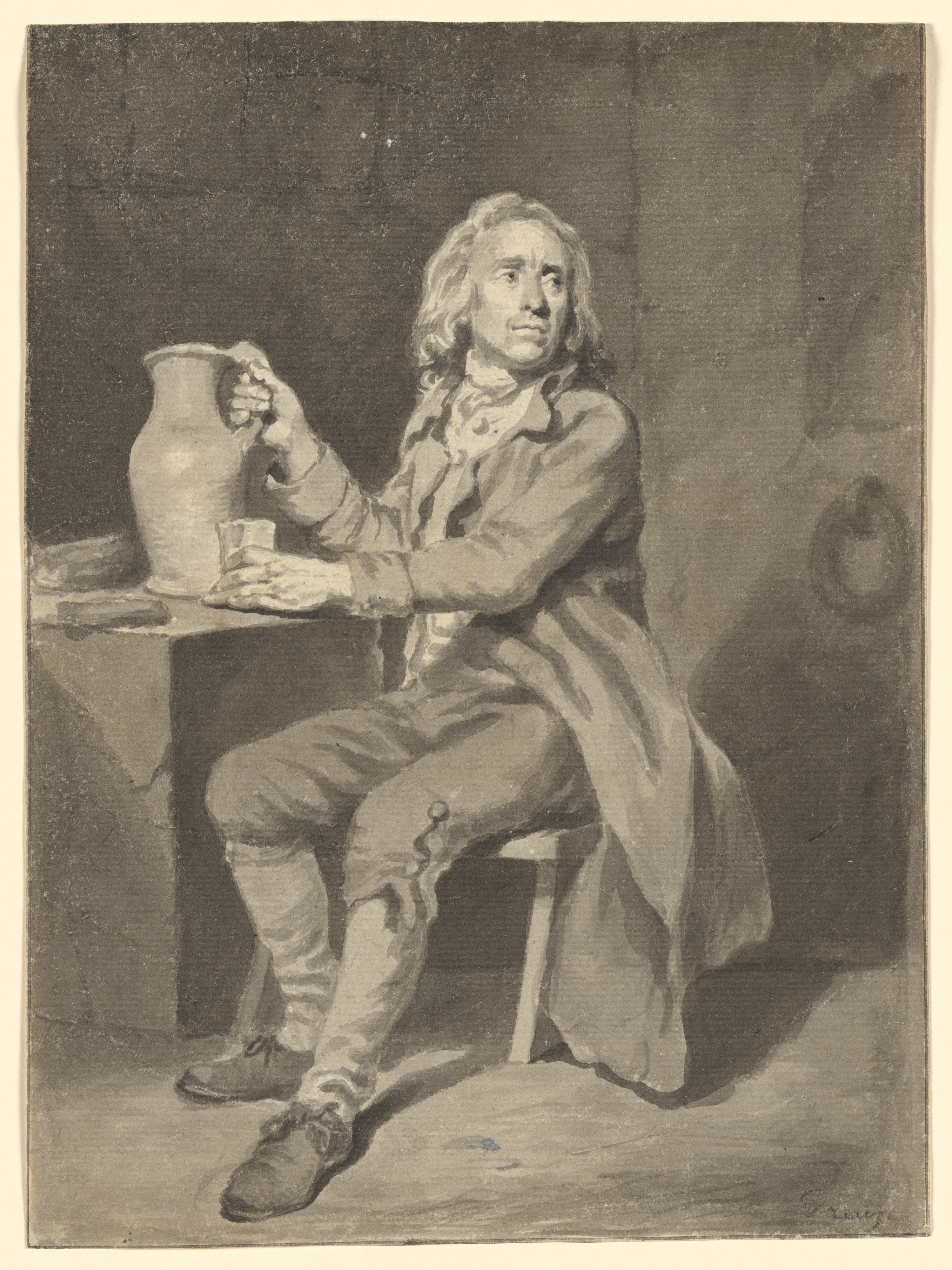
The archive presents a singular artifact: Seated Man with a Pitcher and a Glass, rendered in brush and black ink with gray wash. At first glance, this is a study in quietude—a figure in repose, domestic objects at his side. Yet, for the couture house, this work is not a scene; it is a blueprint of tension. The artist’s hand did not merely record a man; it constructed a dialogue between mass and void, between the opaque body and the translucent atmosphere. For 2026, this dialogue translates directly into silhouette architecture. We are not replicating a painting; we are extracting its gravitational logic and applying it to the human form.
Deconstructing the Classical: The Anatomy of a Gesture
The seated man is a study in controlled weight. His posture—neither rigid nor slumped—suggests a deliberate equilibrium. The pitcher, a vessel of volume, and the glass, a vessel of transparency, flank him as formal counterparts. In French academic tradition, this composition would be read as a moral allegory of temperance. But our aesthetic archaeology reads it differently: it is a study in material hierarchy. The black ink establishes the primary structure—the bones, the drapery folds, the decisive contour of the shoulder. The gray wash introduces the secondary layer—the softness of flesh, the ambient shadow, the air between the man and his objects.
The Ink as Skeletal Frame
In 2026, the black ink stroke becomes the seam line. We are designing garments where the structural stitching is not hidden but celebrated as a drawn line. A tailored jacket, for instance, will feature a single, unbroken seam that arcs from the nape of the neck to the hem, mimicking the artist’s confident brushstroke. This is not mere piping; it is a calligraphic intervention on the body. The stroke’s varying pressure—thick at the shoulder, thin at the wrist—informs the garment’s weight distribution. Heavy matte wool at the bodice, transitioning to a whisper-weight silk at the forearm, replicates the ink’s tapering energy. The silhouette becomes a living drawing, where every curve is a deliberate decision, not an accident of draping.
The Wash as Atmospheric Volume
The gray wash is the genius of this piece. It does not outline; it breathes. It creates a zone of uncertainty between the figure and the background. For the couture silhouette, this translates into negative space engineering. We are moving away from the rigid, corseted forms of previous seasons. Instead, the 2026 silhouette will feature floating panels—layers of organza or crepe that are anchored at the shoulder or hip but left to drift away from the body, creating a wash of fabric that echoes the painter’s blurred edges. The result is a garment that appears to be in a state of perpetual dissolution, where the boundary between the wearer and the environment is intentionally porous.
Materiality as a Translation Protocol
The physical medium—brush, ink, wash—is not a metaphor; it is a material instruction set. We must translate the behavior of these substances into textiles. The ink is viscous, glossy, and absolute. The wash is aqueous, matte, and diffusive. Our fabric research for 2026 focuses on developing textiles that possess dual-state properties.
From Viscosity to Drape
We are commissioning a new technical fabric: a liquid-metal jacquard that has the dense, reflective quality of wet ink on one side, and the dry, absorbent hand of paper on the reverse. When cut on the bias, this fabric will produce a silhouette that shifts from sharp, defined edges to fluid, blurred falls—exactly the transition seen between the pitcher’s rim and the glass’s base. The garment is not just worn; it is executed, stroke by stroke, on the body.
Monochrome as a Luxury Index
The palette is strictly monochromatic: black, white, and every gray in between. This is not a limitation; it is a purity test. In a world of chromatic excess, the 2026 couture client seeks visual silence. The absence of color forces the eye to engage with texture, proportion, and light. A gown inspired by the gray wash will use ombre-dyed silk tulle, where the pigment fades from a deep charcoal at the hem to an almost invisible pale gray at the neckline. This gradient mimics the wash’s atmospheric depth, creating a silhouette that feels weightless yet grounded—a paradox that is the hallmark of high craftsmanship.
Silhouette Architecture: The Seated Geometry
The most radical translation is the seated posture itself. The painting is a study of a body at rest, but couture is a study of a body in motion. Our 2026 collection introduces the "Pitcher Silhouette": a high, structured shoulder line that tapers dramatically to a narrow, columnar hip, echoing the vessel’s shape. Conversely, the "Glass Silhouette" is inverted—a narrow shoulder that flares into a wide, circular hem, mimicking the glass’s opening. These two forms are designed to be worn in dialogue, representing the tension between containment and release.
Structural Drapery and the Art of Rest
We are also exploring static draping. Unlike traditional draping that moves with the body, this technique creates folds that are pinned into permanence, as if the wearer has just risen from a chair and left the impression of their form behind. The fabric is treated with a micro-wax finish to hold these creases, creating a garment that is simultaneously rigid and soft—a wearable archaeological cast. This is couture as a still life, a moment frozen in time, yet designed for the modern, dynamic woman.
Conclusion: The 2026 Aesthetic Imperative
The Seated Man with a Pitcher and a Glass is not a historical relic; it is a prophetic instruction. It teaches us that elegance is not about ornamentation but about decisive restraint. The 2026 Natalie Fashion Atelier silhouette will be defined by its ability to hold opposing forces: the sharp and the soft, the opaque and the translucent, the static and the fluid. By mastering the grammar of the ink and the wash, we create garments that are not merely worn, but composed. Each piece is a masterclass in negative space, a tribute to the quiet power of a single, perfect line. This is the future of luxury—not louder, but more profound, drawing its strength from the silent, confident strokes of the past.