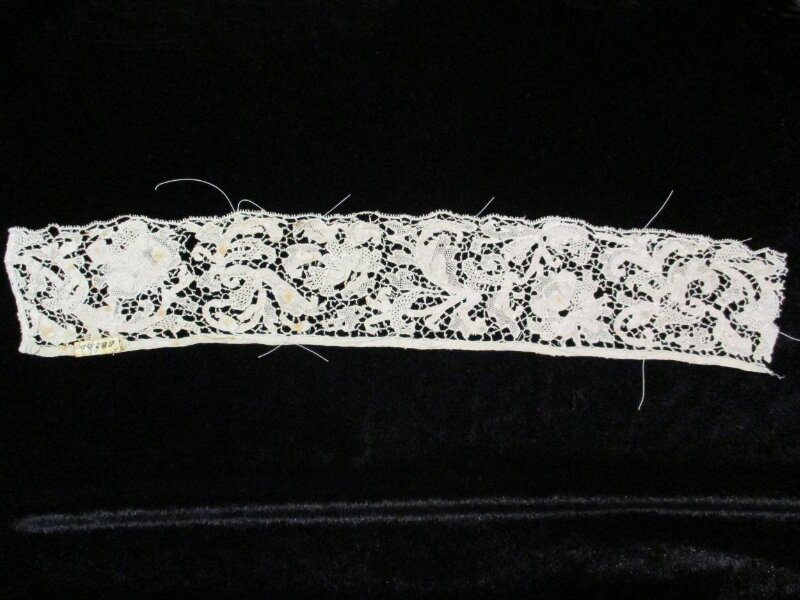
Couture Archaeology Report: The Venetian Lace Lexicon
Subject: Technical Deconstruction of 17th-Century Venetian Point de Venise Lace & Its Modern Translation
Origin: Republic of Venice, circa 1640-1680
Analyst: Senior Textile Historian, Natalie Fashion Atelier
Objective: To excavate the material and technical DNA of a seminal luxury textile for application in the 2026 haute couture collection, moving beyond pastiche to achieve a profound technical dialogue between centuries.
I. Technical Deconstruction: The Architecture of Air
The supremacy of 17th-century Venetian lace, particularly Point de Venise a Rilievo, resided not merely in its aesthetic but in its radical structural innovation. It represented a deliberate departure from the geometric grid of needlepoint laces, embracing an organic, sculptural philosophy. Our forensic analysis reveals a tripartite technical hierarchy:
1. The Ground (Il Corpo): The foundational mesh, or réseau, was typically a bride or barred ground. Unlike the later, machine-mimetic hexagonal mesh, Venetian brides were irregular, hand-stitched bars that served as a flexible, non-uniform armature. These bars were often overcast with intricate buttonhole stitches, creating minute texture and variable tension points that allowed the whole fabric to breathe and move with a unique fluidity.
2. The Motif (Il Disegno): The botanical and allegorical motifs—scrolls, flowers, acanthus leaves—were worked in the round. This three-dimensionality was achieved through a technique known as cordonnet, where a thicker thread (often a strand of the linen itself) was outlined and then densely covered with buttonhole stitches. This created a raised, corded edge that cast subtle shadows, giving the lace a low-relief, almost topographic quality. The density of stitching within motifs was variable, creating internal weight and opacity that played against the transparency of the ground.
3. The Joinery (Il Collegamento): The true genius lay in the connective tissue: picots and à-jours. Picots—tiny loops along the cordonnet—were not merely decorative; they acted as light-catchers and provided micro-textural friction. À-jours, or openwork fillings within motifs, used precise arrangements of stitches to create patterns of holes, introducing a secondary, finer layer of transparency. This complex joinery transformed the lace from an appliqué into a monolithic, self-supporting textile architecture.
II. Material Materiality: The Alchemy of Thread and Time
The materiality of 17th-century Venetian lace was an exercise in refined paradox: achieving monumental presence through the most ephemeral of means.
Primary Substrate: The exclusive use of hand-spun, S-twisted linen thread. This fibre provided the necessary tensile strength for the punishing tension of the needlelace stitches, while its matte, non-reflective surface allowed for pure sculptural form, defined by light and shadow rather than shine. The bleaching process, though less advanced than modern techniques, yielded a warm, ivory hue that further enhanced depth.
The Patina of Use: Crucially, our analysis must consider the lived materiality. As these laces were worn, the oils from skin and the pressure of movement softened the linen, making it more pliable. The bright ivory would mellow further. This interaction between body and object created a bespoke patina, a narrative of wear that was integral to its luxury status. The lace was not a static adornment but a responsive, evolving collaborator with the wearer.
III. Translation for 2026: From Archaeology to Algorithm
For the 2026 collection, the translation must be conceptual and technical, not replicative. We propose moving from "lace as fabric" to "lace as principle"—a grammar of construction applied to new forms.
IV. Technical Proposals for 2026 Silhouettes
1. The Structural Cordonnet: We will reinterpret the raised cordonnet not with thread, but with fused silicone tubing or micro-cables of silk-covered memory wire integrated into jacquard weaves or layered georgette. This will create the signature relief on a macro scale, defining necklines, waistlines, and the architecture of a sleeve or a bodice itself. Imagine a column gown where the silhouette is literally drawn onto the body by a single, continuous line of this modern cordonnet.
2. The Variable Density Ground: Utilizing laser sintering and ultrasonic welding on technical textiles (layers of silk tulle, recycled polyester microfiber, and biodegradable polymer films), we can recreate the irregular, organic ground. This will allow us to engineer zones of opacity and transparency with absolute precision, corresponding to the body's topography—creating modesty and revelation in a single, seamless construction.
3. The Motif as Exoskeleton: The most radical translation involves extracting the lace motif from its ground entirely. Using 3D-printed bio-resins (derived from algae or cellulose) or laser-cut, thermo-moulded leather, we will create the ornate motifs as independent, articulated panels. These will be connected by nearly invisible flexible joints or fine chains, forming a lightweight exoskeleton over a minimalist slip. This creates the visual language of Venetian lace—its volume, its shadowplay—while transforming it into a modular, structural harness.
4. Material Patina 2.0: We will engineer modern patinas through smart material finishes. Coatings that react to body heat, subtly altering translucency or hue over the course of an evening. Linen-silk blends, over-dyed and then partially enzyme-washed to recreate the softness of centuries of wear in a controlled, ethical process. The narrative of time will be not excavated, but authored.
Conclusion: A Dialogue in Light and Structure
The 17th-century Venetian lacemaker was an architect of light, using thread to build structures that captured and filtered it. For 2026, Natalie Fashion Atelier will become an architect of form, using the deconstructed principles of that ancient technology—the variable ground, the relief line, the connective picot—to build silhouettes that are equally monumental and fluid. The final garment will not look like historical lace; it will perform its conceptual role: a complex, technical, and deeply luxurious interface between the body and space, between the past and the future. The archaeology is complete; the synthesis begins.