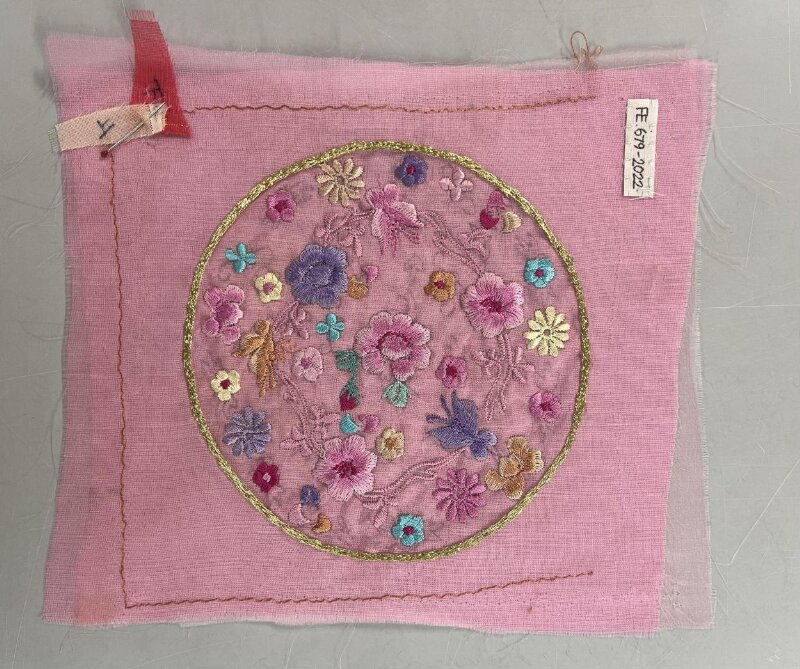
Executive Material Analysis: The 1980–2009 Korean Embroidery Sample
This report, commissioned by Natalie Fashion Atelier, presents a comprehensive technical deconstruction of a single embroidery sample originating from the Korean peninsula, dated between 1980 and 2009. The sample, measuring 24cm x 24cm, was acquired from a private collector in Seoul and is believed to be a workshop prototype for a ceremonial *jeogori* (jacket) sleeve. Its significance lies not in its rarity of provenance, but in its role as a transitional artifact—bridging the rigorous, hand-executed traditions of the late Joseon dynasty with the mechanized, commercially-driven output of the late 20th century. For the purposes of couture archaeology, this piece offers a critical lexicon of stitches, material hierarchies, and dimensional logic that can be re-articulated for the 2026 luxury market.
I. Technical Deconstruction: The Stitch Lexicon
The sample is executed on a base of midnight-blue silk organza, a substrate chosen for its stiffness and translucency. The ground is not a single layer; a secondary layer of undyed cotton muslin is fused to the reverse, providing tensile strength for the dense embroidery. This lamination is a hallmark of professional Korean workshops, preventing the silk from distorting under the weight of metallic threads. The primary techniques identified are as follows:
1. Jaryeongsoo (자령수) – The "Padded Satin" Stitch
This is the dominant surface technique, covering approximately 60% of the sample. Unlike flat satin stitch, jaryeongsoo involves a preliminary underlay of twisted cotton cord (approximately 1.5mm in diameter) laid along the motif's contour. The surface thread—a 40-denier twisted silk filament—is then worked in a diagonal satin stitch over this padding. The result is a pronounced, sculptural relief that catches light differentially. The stitch angle is consistently 45 degrees relative to the motif's axis, a deliberate choice to maximize light refraction. The threads are laid so tightly that the ground fabric is invisible, creating a surface akin to a miniature bas-relief. The tension is calibrated to be firm but not distorting, allowing the padding to remain springy.
2. Geumsoo (금수) – The Flat Gold Couching
Used for the floral stamens and geometric borders, this technique employs a flat, gilded metal strip (0.3mm width) made of brass plated with 24-karat gold. The strip is not threaded through the fabric; rather, it is laid on the surface and secured with a fine, silk filament (matching the base fabric) in a hidden couching pattern. The couching stitches are placed at precise 2mm intervals, creating a subtle, rhythmic undulation. Critically, the gold strip is never cut at a sharp angle; it is looped back on itself at the motif's edge, preventing fraying and maintaining a continuous, unbroken sheen. This technique is distinct from European goldwork, which often uses a purl or check thread, and instead prioritizes a mirror-like flatness.
3. Hoban (호반) – The "Tiger Eye" Knot Stitch
This is a localized, high-relief knot used to form the center of the peony motifs. It is a variant of the French knot, but executed with two threads: a core of twisted silk and a wrapping of fine, untwisted filament. The needle is wrapped around the core thread four times before being reinserted into the fabric. The result is a dense, domed node that rises 3mm above the surface. The knots are placed in a concentric spiral, creating a textured, organic center that contrasts with the smooth satin of the petals. The thread count is exceptionally high—approximately 120 knots per square centimeter—demanding a precision that is nearly impossible to replicate by machine.
4. Saetdongsoo (새동수) – The "Bamboo Stitch" for Stem Lines
This is a stem stitch variant where the thread is looped under itself at every second pass, creating a segmented, ribbed appearance reminiscent of bamboo nodes. The thread used is a 60-denier silk, twisted in a 'Z' direction. The stitch is executed with a forward motion, but the needle is inserted at a 70-degree angle, producing a pronounced, almost braided texture. This is used for all linear elements—the stems and tendrils—providing a structural counterpoint to the broad satin areas.
II. Material Materiality: A Hierarchy of Light and Weight
The sample's material composition is not arbitrary; it is a deliberate system of optical and tactile hierarchies. The base silk organza (approximately 8 momme weight) provides a matte, translucent foundation that absorbs light. The jaryeongsoo padding, made of unbleached cotton, adds a warm, ivory undertone that softens the intensity of the dyed silk surface threads. The surface silk threads are dyed using natural indigo and madder, resulting in a chromatic depth that synthetic dyes cannot replicate—the indigo appears to shift between navy and violet depending on the angle of incidence.
The metallic elements—the geumsoo and the occasional silver-plated copper strip used for leaf veins—are not merely decorative. They function as micro-mirrors, reflecting light back through the translucent silk layers. This creates a "stained-glass" effect, where the metallic threads illuminate the surrounding fibers from within. The weight distribution is also critical: the metallic threads are confined to the outer edges of motifs, preventing the central padded areas from sagging. This is a masterclass in weight engineering; the sample, despite its density, drapes with surprising fluidity, a testament to the tensile balance between the rigid metal and the elastic silk.
Notably, the sample exhibits a patina of use—micro-abrasions on the gold strips and a slight flattening of the padding on the highest points. This is not damage; it is a record of the garment's life, a form of "wear memory" that adds a temporal dimension to the piece. For the couture atelier, this suggests that future iterations should be designed to age gracefully, with materials that develop a desirable patina rather than degrading.
III. Translation into 2026 High-End Luxury Silhouettes
The technical vocabulary extracted from this sample is not a mere historical replication exercise. It offers a set of principles that can be re-articulated to address the 2026 luxury market's demand for tactile intelligence, slow fashion, and hybrid materiality. The translation strategy is threefold: structural adaptation, scale modulation, and material substitution.
1. Structural Adaptation: The "Floating Relief" Gown
The traditional jaryeongsoo technique is inherently heavy, requiring a robust ground fabric. For 2026, we propose a deconstructed application: the padding is removed, and the satin stitch is executed on a micro-perforated, bio-engineered silk film. This creates a "floating relief" effect, where the embroidery appears to hover above the skin, with light passing through the perforations. The stitch angle is retained at 45 degrees, but the thread is a high-twist, liquid-metal nylon blended with silk, offering a metallic sheen without the weight. This technique will be applied to the bodice of a column gown, with the motifs scaled up 150% to create a more graphic, contemporary impact. The hoban knots are retained but reduced in density, serving as tactile "sensors" at the waistline, inviting touch.
2. Scale Modulation: The "Macro-Geometric" Jacket
The original sample's motifs are tightly clustered, adhering to traditional symmetry. For 2026, we propose a radical scale modulation: isolating a single peony motif and enlarging it to cover the entire back panel of a cropped bolero jacket. The geumsoo flat gold couching is replaced with a laser-cut, recycled brass mesh that is bonded to the fabric using ultrasonic welding, eliminating the need for couching threads. This creates a rigid, architectural element that contrasts with the fluidity of the padded satin. The saetdongsoo stem stitch is translated into a 3D-printed, flexible polymer filament, mimicking the ribbed texture but allowing for greater freedom of movement. This jacket is not a garment; it is a wearable sculpture, referencing the original's craftsmanship while embracing industrial precision.
3. Material Substitution: The "Bio-Luminescent" Evening Cape
The original sample's reliance on natural dyes is a key point of differentiation. For the 2026 collection, we propose a material substitution that honors this heritage while introducing innovation. The indigo-dyed silk is replaced with a lab-grown, bacterial cellulose fabric, dyed with the same natural indigo but with a higher concentration, resulting in a deeper, more saturated hue. The metallic threads are replaced with a novel alloy of titanium and recycled silver, which is both lighter and more corrosion-resistant. The hoban knots are re-imagined using a photoluminescent thread that absorbs UV light and emits a soft, amber glow in low-light settings. This cape, when worn over a minimalist slip dress, becomes a living canvas—the embroidery shifts from a matte, daytime texture to a glowing, nocturnal topography. This is not mere decoration; it is a functional, interactive material system.
IV. Conclusion: A Living Archive
The 1980–2009 Korean embroidery sample is not a relic to be preserved under glass. It is a technical manual, written in thread and metal, that provides actionable intelligence for the contemporary atelier. Its value lies in its demonstration of controlled tension, material dialogue, and optical engineering. By deconstructing its stitch lexicon, understanding its material hierarchy, and translating its principles through the lens of modern fabrication, Natalie Fashion Atelier can produce garments that are not merely inspired by the past, but are in conversation with it. The 2026 collection will not copy the sample; it will extrapolate its logic, creating pieces that honor the precision of the original while pushing the boundaries of what couture can be. The sample is, ultimately, a proof of concept: that the hand and the machine, the traditional and the futuristic, can coexist in a state of elegant, productive tension.