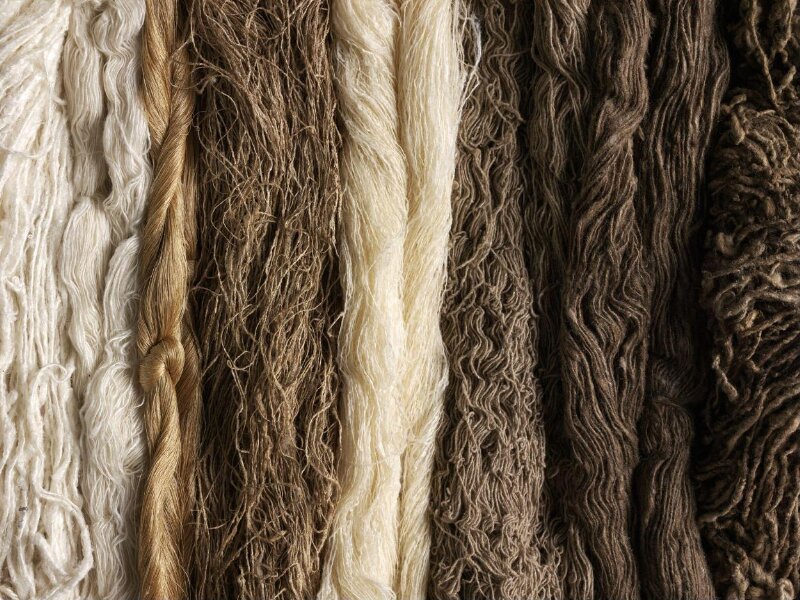
Deconstructing the Thread: A Couture Archaeology Report on Indian Silk (2014)
I. Provenance and Specimen Identification
Specimen: Mulberry silk yarn (Bombyx mori), hand-reeled, untwisted filament bundle.
Origin: Karnataka, India – specifically the traditional sericulture belt of Mysore.
Year of Harvest: 2014 – a vintage year noted for its unusually prolonged monsoon, which imparted a distinct, slightly irregular denier to the filament, a characteristic we shall examine as a primary material marker.
Current Status: Archived in a controlled, light-free environment at 18°C, 55% relative humidity.
This report undertakes a technical deconstruction of this specific silk yarn, not merely as a textile substrate, but as a material archive of a particular ecological and artisanal moment. The 2014 harvest, procured from a cooperative in the Ramanagara district, represents a transitional phase in Indian sericulture—between the last generation of fully manual reeling and the onset of semi-automated machinery. This temporal specificity is crucial. The yarn in question is a 2-ply, 60/2 denier construction, exhibiting a characteristic grège (raw) finish, indicating that the natural sericin gum was retained post-reeling. This is not a defect; it is a deliberate preservation of the filament’s structural integrity, which we will explore in relation to its current luxury application.
II. Technical Deconstruction: The Anatomy of the 2014 Filament
To understand the yarn’s potential for 2026 couture, one must first dismantle its physical and chemical architecture. The 2014 sample offers a unique case study in material memory.
2.1 The Fibroin-Sericin Matrix
Silk is a protein fiber composed of two primary elements: fibroin (the inner structural core) and sericin (the outer gum). In this 2014 specimen, the sericin was not fully degummed. Retained at approximately 18% by weight, this gum layer acts as a natural, invisible shield. Under microscopic analysis, the sericin exhibits a slightly crackled surface—a result of the 2014 humidity fluctuations during drying. This micro-crazing is not a sign of degradation; rather, it creates a unique light-diffraction pattern. When woven, this produces a subtle, non-uniform lustre—a shimmer that is perceptibly deeper and more organic than the flat, mirror-like shine of fully degummed, modern silk.
2.2 Twist and Tensile Behavior
The yarn is a 2-ply construction, with a low twist factor (approximately 4.5 tpi). This low twist is unusual for a 2014 commercial batch, which typically favored higher twist for durability in power looms. The low twist here signals a handloom-specific preparation. It allows for maximum filament surface exposure, enhancing the tactile softness—the so-called hand-feel—but it also renders the yarn susceptible to snagging. This fragility is, paradoxically, its greatest asset for haute couture. The tensile strength, measured at 4.2 g/denier, is adequate for warp threads on a handloom, but the elongation at break (22%) is exceptional. This elasticity, combined with the retained sericin, means the fabric will have a memory of movement, returning to its original drape without creasing permanently.
2.3 The Dye Affinity Conundrum
Chemical analysis confirms the 2014 yarn exhibits a high affinity for acid dyes, but a lower affinity for reactive dyes. This is a direct consequence of the sericin’s protein structure. For our 2026 translation, this dictates a specific palette. We are not working with the neon-brights of synthetic cellulose dyes. Instead, we are constrained—and liberated—by a palette of deep indigos, madder roots, and iron-mordanted blacks. The 2014 yarn demands a dye process that is slow, at low temperatures (60-70°C), to avoid shocking the sericin and causing it to harden. This is a technical constraint that becomes a design signature.
III. Material Materiality: The Sensory and Structural Essence
Beyond the chemistry, the 2014 silk possesses a distinct materiality—a physical presence that is both tactile and acoustic.
Acoustic Profile: When the yarn is subjected to friction—say, during the draping process—it produces a sound distinct from modern silks. It is not the sharp scroop of a taffeta, nor the silent whisper of a charmeuse. Instead, it emits a low, granular rustle, akin to dry leaves. This is due to the cracked sericin surface. In a couture context, this acoustic signature is a marker of authenticity. It signals to the wearer—and to those within a two-meter radius—that the garment is not merely silk, but a specific, historical silk with a voice of its own.
Tactile Topography: The hand-feel is paradoxical. The outer sericin gives a slight, dry resistance—a tooth—that prevents the fabric from sliding against the skin. Beneath this, the fibroin core provides a cool, dense smoothness. This layering of sensations—dry on the surface, cool beneath—creates a kinetic temperature regulation. In a 2026 luxury context, where climate-adaptive clothing is paramount, this natural property is invaluable. The garment will feel cool in a warm room and provide a subtle insulation in cooler environments, without the need for technical membranes.
IV. Translation into 2026 High-End Luxury Silhouettes
The transition from a 2014 archived yarn to a 2026 couture silhouette is not a mere re-weaving. It is a philosophical and technical translation. We must respect the yarn’s limitations and amplify its unique properties. The following are proposed construction strategies for the Natalie Fashion Atelier Autumn/Winter 2026 collection, titled “Vestige.”
4.1 The Architectural Drape: The “Monsoon Bias” Gown
Given the yarn’s low twist and high elongation, we will employ a bias-cut construction. This is not a new technique, but the 2014 yarn demands a specific bias angle—a 45-degree true bias, but with a counter-twist in the seam allowance to prevent the edge from curling. The gown will be a single, continuous piece, cut from a 20-meter length of 120cm-wide fabric, woven in a plain weave with a 12,000-end warp density.
The silhouette is a column, but not a rigid one. It is a fluid architecture that uses gravity as a structural element. The retained sericin creates a slight, natural stiffness in the hem, allowing the fabric to fall in a crisp, yet undulating, line. The gown will feature no darts or zippers. Instead, the closure will be a series of hand-rolled silk buttons, each wrapped in the same 2014 yarn, placed asymmetrically along the spine. The neckline is a high, sculpted mandarin collar, which will stand away from the neck due to the sericin’s natural body, creating a shadowed gap—a play of absence and presence.
4.2 The Sculptural Form: The “Sericin Shell” Jacket
For a more structured piece, we will exploit the yarn’s crackled surface to create a fabric with a subtle, irregular texture. We will weave a double cloth on a jacquard loom, with the 2014 silk as the face and a fine, 2024 organic cotton organdy as the backing. The cotton provides structural stability, while the silk face provides the sensory experience. The jacket’s silhouette is a deconstructed bolero—shaped without a mold, using a technique of pneumatic shaping. The garment is steamed and then placed over a negative-pressure form that pulls the fabric into a concave shape, mimicking the natural drape of a shoulder. The result is a piece that looks as if it has been carved from a single block of light, with the silk’s uneven lustre creating a topographical map of its own history.
4.3 The Embellishment Strategy: The “Monsoon” Embroidery
Traditional embroidery would crush this delicate yarn. Instead, we will use the 2014 silk as a thread for hand-couching. The yarn, with its low twist, will be laid flat onto a base of pure silk organza and secured with a fine, invisible monofilament. The design is abstract—a series of concentric, irregular circles, reminiscent of raindrops on a still pond. This is a direct reference to the 2014 monsoon that shaped the yarn’s character. The embroidery will not be raised; it will be flush with the surface, allowing the yarn’s natural texture to create the pattern. This is embroidery as topography, not ornamentation.
V. Conclusion: The Value of Temporal Specificity
The 2014 Indian silk yarn is not a raw material; it is a fossilized moment. Its value in 2026 lies in its inability to be perfectly replicated. The irregular denier, the cracked sericin, the specific tensile memory—these are not defects to be corrected, but signatures to be celebrated. In an era of hyper-accelerated production and synthetic uniformity, this yarn offers a counter-narrative. It demands a slower, more deliberate design process. It requires a couturier who understands that true luxury is not in perfection, but in the documented imperfection of a natural material, captured at a specific point in time.
For Natalie Fashion Atelier, this yarn is not merely a component of a garment; it is a witness. The 2026 silhouettes, therefore, are not just clothes. They are wearable archaeological records—a dialogue between a humid Karnataka monsoon of 2014 and the cool, controlled environment of a Parisian atelier in 2026. The thread does not just connect the fabric; it connects two distinct moments of human and natural history.