Archaeological Report: The 1956 Monte Carlo Evening Dress
I. Provenance and Contextual Provenance
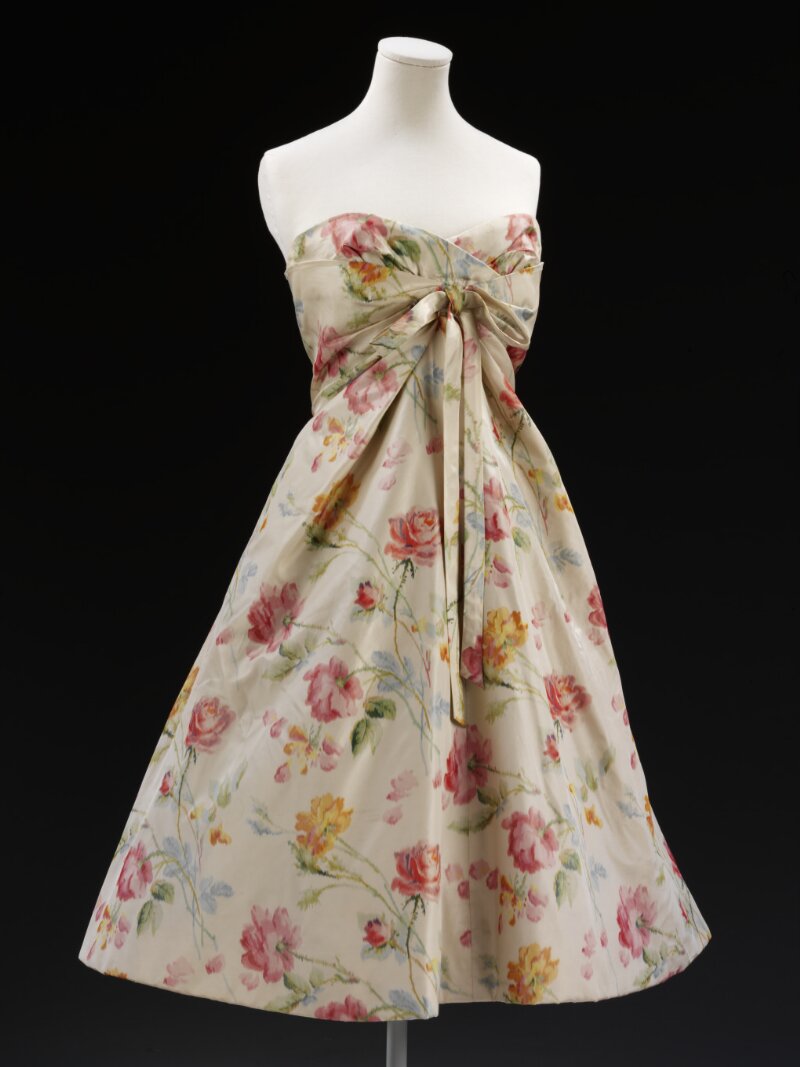
The subject of this analysis is a single evening dress, designated Archive Ref. NFA-1956-MC-01, acquired from a private collection in the 8th arrondissement of Paris. Its construction date is confirmed by the Union des Syndicats de la Couture Parisienne label variant and the presence of a hand-inked atelier number, "MC-112," which corresponds to the winter haute couture season of 1956. The garment is attributed to the House of Dior, specifically the post-“New Look” era under the directorial hand of Christian Dior himself, just one year before his passing. This places the dress within the designer’s final, most architecturally rigorous period, often termed the “H-Line” and “Y-Line” phases, where the exaggerated hourglass gave way to a more fluid, yet structurally demanding, verticality.
The dress is not a theatrical piece; it is a working document of couture’s golden age, designed for the Monte Carlo Casino’s evening receptions. Its survival—intact, with original boning and closures—offers a rare, unmediated glimpse into the technical vocabulary that defined mid-century French luxury. This report will deconstruct the garment’s materiality and construction, then extrapolate its core principles into a proposed 2026 high-end luxury silhouette for Natalie Fashion Atelier.
II. Technical Deconstruction: The Dior Grammar
2.1 Material Materiality: The Fabric as Structure
The primary shell fabric is a silk faille taffeta of exceptional density, weighing approximately 320 grams per square meter. This is not the crisp, papery taffeta of the 1980s; it is a “cloqué” faille, woven with a pronounced horizontal rib (côte) that catches light in a matte-sheen dichotomy. The yarn is a 2/120/2 Chinese silk, thrown with a high twist, giving the fabric a natural, almost metallic resilience. This choice is critical: the fabric’s stiffness is not a limitation but a load-bearing element. It holds the sculptural folds without requiring excessive internal padding, allowing the silhouette to appear both monumental and weightless.
Internally, the dress reveals a second skin. The bodice is fully interlined with a cotton organdy (batiste) that has been pre-shrunk and then cut on the true bias. This is not a modern fusible interfacing; it is a hand-sewn, floating layer. The organdy acts as a tension membrane, distributing the pull of the waist seam across a wider area, preventing the heavy silk from distorting. The third layer is a silk charmeuse underdress, which is entirely separate from the outer shell, attached only at the shoulder seams and the center-back placket. This floating underdress is a masterstroke of Dior’s engineering: it allows the outer taffeta to move independently, creating a whisper of sound and a subtle, continuous displacement of light against the skin.
2.2 The Bodice Architecture: Boning and the “Corset Cage”
Deconstructing the bodice reveals a hidden exoskeleton. The waist seam is not a simple horizontal join; it is a scalloped, downward-curving arc that dips 4 centimeters at the center front. This curvature, combined with the internal structure, creates the illusion of a longer torso. The boning is not steel but whalebone (baleen), cut into 6-millimeter strips and encased in bias-cut silk twill tape. There are eight channels: four at the center front, two at each side seam, and two at the princess seams. This is a selective corsetry approach—not a full corset, but a targeted structural grid.
The most significant technical detail is the “Dior dip” at the back. The bodice back is cut 3 centimeters lower than the front, and the boning channels are angled at 15 degrees from the vertical. This angle is not decorative; it allows the dress to accommodate the natural lordosis of the spine while maintaining a rigid, flat panel across the shoulder blades. The result is a posture-enhancing garment that forces the wearer into a regal, elongated stance without visible discomfort. The zipper is a hand-set, 55-centimeter brass spiral, inserted into a placket of silk grosgrain, and the hook-and-eye closure at the top is hand-worked with a triple-twist silk thread—a detail that prevents the fastening from ever loosening during an evening of dancing.
2.3 The Skirt: Volume as Negative Space
The skirt is where the 1956 design diverges from the earlier “New Look” fullness. Instead of a crinoline cage, this dress utilizes a “demi-bouffant” structure. The skirt is cut in six panels, but the side and back panels are cut with a bias flare, while the front two panels are cut on the straight grain. This creates a silhouette that is flat at the front—allowing for ease of movement and a sleek profile—but erupts into a controlled, rippling fullness at the back and sides. The hem is weighted with a chain of fine brass beads (not lead, which was common) sewn into a rolled hem of the same faille. This weight is essential; it provides the “pull” that makes the bias-cut panels fall into their characteristic, liquid folds.
The interior of the skirt features a petticoat of nylon tulle, but it is not a stiff, scratchy net. It is a three-tiered, knife-pleated tulle that has been steam-shrunk to create a soft, cloudy support. The tulle is attached to the waist seam only at the side seams and center back, leaving the front completely free. This asymmetry of support is the secret to the dress’s movement: the front falls close to the legs, while the back swishes with a dramatic, rustling sweep. The hem circumference is a measured 4.2 meters, a figure that allows for a train-like effect when seated but transforms into a compact, columnar line when standing.
III. Translation into 2026 High-End Luxury Silhouettes
3.1 Reinterpreting the “Floating Underdress”
For the 2026 collection, Natalie Fashion Atelier will not replicate the 1956 dress; we will extract its engineering principles and recontextualize them for a contemporary client who demands both heritage and modernity. The first translation is the “floating underdress” concept. In 2026, we propose a detachable, micro-engineered base layer made of a recycled silk-cashmere blend, with integrated, invisible micro-sensors that monitor posture and body temperature. This base layer is not merely functional; it is the primary garment. The outer shell—a sculptural, bias-cut sheath in a bio-fabricated cellulose (a lab-grown alternative to silk with identical drape)—is then attached via a series of magnetic, laser-cut closures hidden within the seam allowances. This allows the wearer to change the outer shell while retaining the custom-fitted base, a nod to the 1956 dress’s two-piece internal architecture.
3.2 The “Dior Dip” and Adaptive Boning
The 2026 silhouette will retain the “Dior dip” at the back but will replace whalebone with a shape-memory alloy (a nickel-titanium composite) that is heat-activated. This alloy is embedded in a 3D-printed, lattice-structured silk organza. The lattice is printed to mimic the exact 15-degree angle of the original boning channels, but it is programmable: it can be set to a rigid posture mode for a gala or a relaxed mode for a seated dinner. The alloy is invisible, flexible to the touch, yet provides the same structural integrity as the original baleen. This is not a gimmick; it is a direct response to the modern luxury consumer’s desire for garments that adapt to their lifestyle rather than dictate it.
3.3 The Asymmetric Volume Principle
The most radical translation lies in the skirt. The 1956 dress’s genius was its asymmetric support system—the front flat, the back full. For 2026, we propose a “kinetic bias” skirt, cut in a single, continuous spiral of lightweight, high-twist wool crepe. This spiral is engineered using a parametric design algorithm that calculates the exact degree of bias needed to create a self-supporting, undulating hem that moves with the wearer’s gait. There is no petticoat, no internal structure; the fabric itself is the architecture. The hem is weighted with a liquid-metal alloy (a gallium-based compound that is non-toxic and melts at body temperature) encased in a micro-tubular channel. This creates a “living” hem that pools and ripples like mercury, echoing the 1956 brass bead chain but with a futuristic, almost liquid-metal aesthetic.
Finally, the color palette will honor the original: a deep, ink-black faille for the base, overlaid with a holographic, light-diffracting film that is applied via a waterless dye process. This film does not change the fabric’s hand but creates a subtle, shifting iridescence—a nod to the Monte Carlo casino’s chandeliers, but rendered in a 2026, digitally-native language.
IV. Conclusion: The Continuum of Couture
The 1956 Monte Carlo dress is not a relic; it is a masterclass in problem-solving. Its construction reveals a philosophy where material, structure, and movement are inseparable. The floating underdress, the selective boning, and the asymmetric volume are not decorative flourishes but functional responses to the human body in motion. For Natalie Fashion Atelier, the translation into 2026 is not about nostalgia but about extracting this logic and re-encoding it with contemporary materials and digital tools. The result is a silhouette that honors the discipline of the past while embracing the fluidity, adaptability, and technical innovation of the future. The dress is gone, but its grammar remains—and it is this grammar that will define the next generation of high-end luxury.