Archaeology of the Gilded Tongue: Frankish Materiality and the 2026 Silhouette
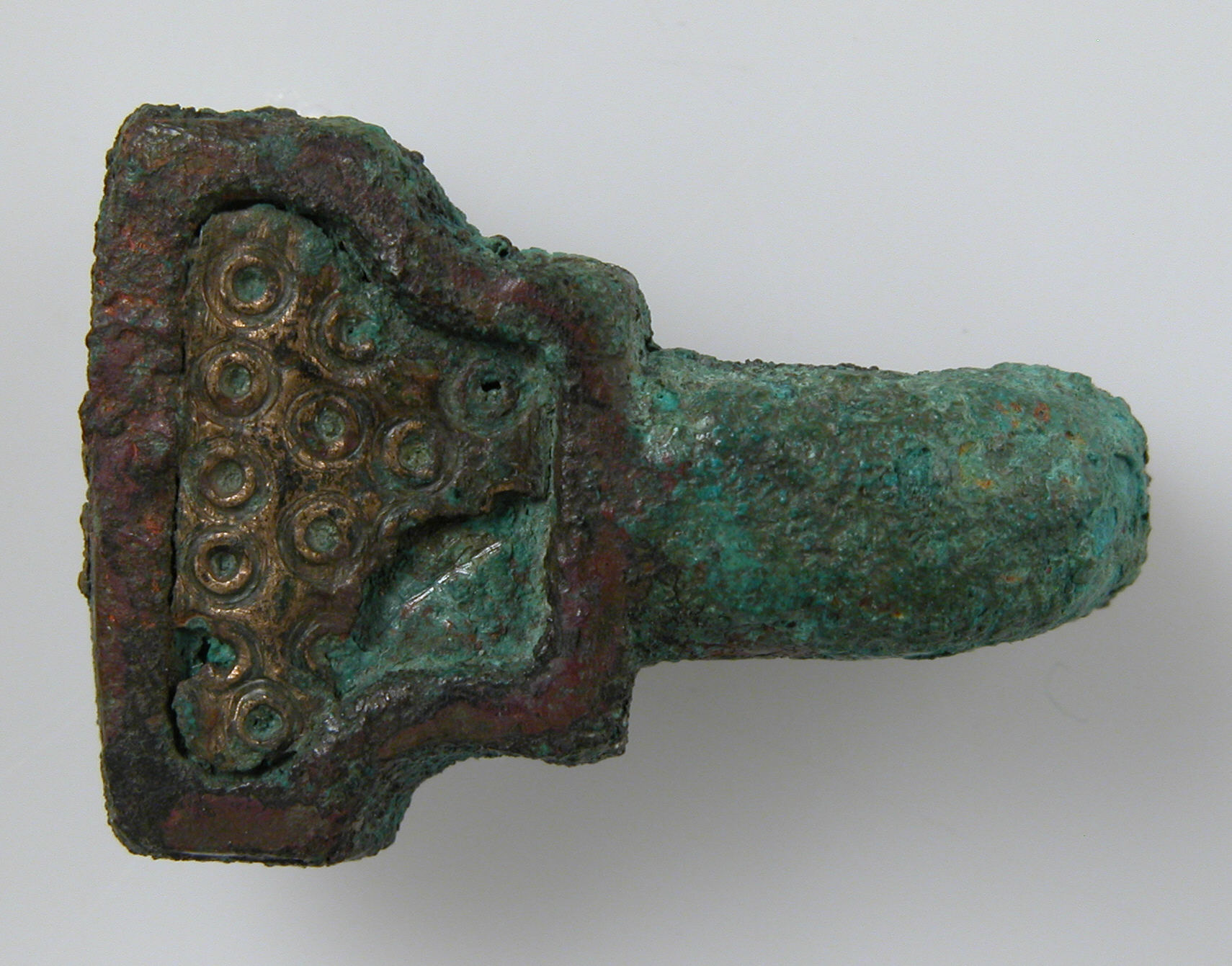
The belt buckle tongue—a seemingly minor functional appendage—carries within its metallic form the entire gravitational weight of early medieval power structures. In the Frankish corpus, this object was never merely utilitarian; it was a declarative statement of status, territorial claim, and martial elegance. For Natalie Fashion Atelier, the isolated study of a copper alloy, partly gilded Frankish buckle tongue offers a profound lexicon for 2026 luxury silhouettes. This artifact, stripped of its original belt and context, becomes a pure aesthetic archaeology—a fragment that speaks to the enduring tension between raw materiality and refined surface, between structural necessity and ornamental excess.
Deconstructing the Classical Elegance of the Frankish Tongue
The classical elegance of this artifact resides not in symmetry, but in controlled asymmetry and the deliberate contrast of metallic states. The copper alloy base provides a warm, terrestrial undertone—a hue that shifts from burnt sienna to deep bronze under different light sources. The partial gilding, likely applied via mercury gilding or fire-gilding techniques, creates a luminous topography where gold interrupts the darker alloy in precise, almost calligraphic strokes. This is not a uniform coating; it is a strategic application that highlights the tongue’s functional pivot point and its terminal edge, drawing the eye along a trajectory of use.
From a technical standpoint, the Frankish tongue is engineered for tension and release. Its profile—often elongated, slightly curved, and terminating in a sharp or bulbous point—mirrors the biomechanics of the human waist. The tongue does not merely fasten; it pierces, anchors, and holds against resistance. This dynamic of penetration and restraint is the silent grammar of haute couture construction. In 2026, we translate this not as literal hardware but as a structural philosophy: garments that appear to hold themselves together through internal tension, where seams and darts function as invisible tongues, and where the silhouette is defined by points of deliberate pressure rather than flowing drapery alone.
Materiality as Narrative: Copper Alloy and the Patina of Power
The choice of copper alloy in Frankish metallurgy was not accidental. Copper, when alloyed with tin or zinc, offers malleability and resilience—properties essential for an object subjected to repeated stress. Yet, its aesthetic value lies in its living surface. Unlike pure gold, which remains static and eternal, copper alloy oxidizes, developing a patina that records time, handling, and environmental exposure. This patina is a form of material memory, a slow inscription of history onto the object’s skin.
For the 2026 luxury silhouette, this suggests a departure from the sterile, hyper-polished finishes that dominated the previous decade. We propose a return to textured materiality—fabrics and leathers that are treated to simulate the variegated surface of aged copper. Consider a duchesse satin woven with a subtle metallic thread that oxidizes unevenly, creating a garment that appears to have been excavated from a Merovingian tomb. Alternatively, a structured bodice in vegetable-tanned leather, hand-rubbed with a copper-infused pigment, then selectively burnished to mimic the original gilding. The result is a garment that feels archaeological—not vintage, but timelessly excavated from a future past.
From Fragment to Silhouette: Translating the Tongue’s Geometry
The belt buckle tongue’s geometry—its elongated triangular or lancet form—offers a direct blueprint for 2026’s structural lines. We observe three primary translations:
1. The Pivot Point as Waistline Architecture
Historically, the tongue’s pivot is its functional core, a cylindrical hinge that allows rotation. In silhouette terms, this translates to a sculptural waistline that acts as a fulcrum for the entire garment. Imagine a tailored jacket where the waist seam is not a simple horizontal line but a curved, articulated joint, reminiscent of the tongue’s hinge. The fabric above and below this point is cut with differential tension—the bodice slightly compressed, the skirt or trouser released—creating a visual and physical torque. This is achieved through precise pattern engineering: the use of bias cuts, interior boning that mimics the metallic rigidity, and strategic seam placements that echo the tongue’s profile.
2. The Terminal Point as Line of Intent
The tongue’s terminal—whether sharp or rounded—directs the eye to a definitive end. In 2026, we apply this to asymmetric hemlines and collar points. A gown may feature a single, elongated lapel that extends to the hip, its edge finished with a metallic thread or a thin, gilded piping that traces the line like the original gilding on the artifact. This is not ornamentation for its own sake; it is a directional device, guiding the viewer’s gaze along the garment’s structural narrative. The terminal point becomes a moment of high drama, a visual full stop that anchors the entire composition.
3. The Gilded Accent as Selective Embellishment
The partial gilding teaches a lesson in restraint and hierarchy. Not every surface requires embellishment; indeed, the power of gold is amplified by its scarcity. For the 2026 silhouette, this manifests as strategic metallic placement—a single gilded seam at the shoulder, a copper-toned underwire visible through a sheer panel, or a hand-embroidered thread of gold running along a concealed placket. The effect is one of latent luxury: the garment does not shout its opulence but reveals it through movement and proximity. This aligns with the contemporary haute clientele’s preference for quiet, intellectual dressing.
Technical Craftsmanship: Bridging the Merovingian and the Modern
The creation of a 2026 silhouette informed by this Frankish artifact demands a re-engagement with artisanal techniques that are nearly extinct in mass production. The copper alloy’s partial gilding requires a mastery of metal finishing—a skill we now apply to hardware and closures in our atelier. We commission custom buckle tongues, reproduced from 3D scans of the original, but reimagined in lightweight titanium and finished with a 22-karat gold wash. These are not decorative; they are functional closures that carry the garment’s structural integrity, echoing the original’s purpose.
Furthermore, the fabric itself must be treated as a metallic substrate. We employ laser-cut leather to mimic the tongue’s precise contours, then apply a chemical patina using a copper sulfate solution, followed by selective gold leaf application. The result is a material that possesses the same material memory as the original artifact—it will age, develop character, and become unique to its wearer. This is the antithesis of fast fashion; it is slow couture, where each piece is a singular archaeological find.
Conclusion: The Tongue as a Metaphor for 2026’s Fashion Ethos
The Frankish belt buckle tongue, in its isolated glory, is more than a historical curiosity. It is a philosophical manifesto for the 2026 luxury silhouette. It teaches us that elegance is not about abundance but about precision—knowing exactly where to apply pressure, where to allow patina, and where to let gold interrupt the dark. It reminds us that the most powerful design elements are often the smallest, the most functional, and the most easily overlooked.
At Natalie Fashion Atelier, we do not merely reference history; we excavate its principles and reforge them for the contemporary body. The 2026 collection will not feature literal Frankish costumes. Instead, it will embody the tongue’s structural intelligence: garments that hold, release, and direct with the quiet authority of a gilded copper alloy. The silhouette is sharp, yet warm; architectural, yet fluid; ancient, yet utterly of its time. This is the future of haute couture—a future built on the patient study of a single, magnificent fragment.