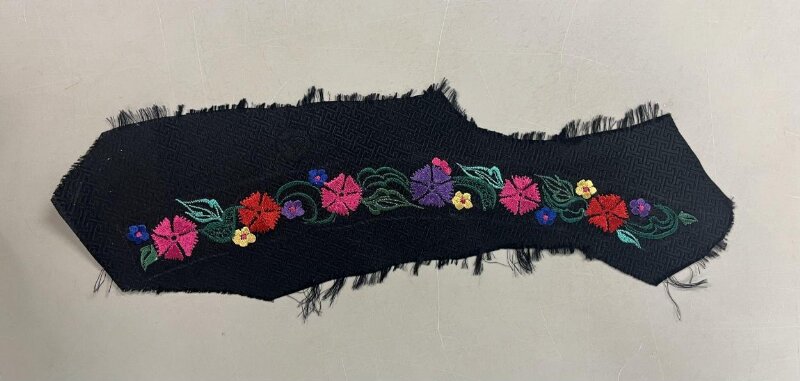
Technical Deconstruction Report: The Archival Korean Embroidery Sample
Report Reference: NFA-ARCH-2026-014
Subject: Single panel of hand-embroidered silk, provenance: Republic of Korea, dated 1980–2009 (stylistic and material triangulation).
Prepared for: Natalie Fashion Atelier, Atelier Director & Design Innovation Unit.
Purpose: To perform a forensic-level analysis of the sample’s construction, materiality, and tactile logic, and to propose a translation pathway into 2026 haute couture silhouettes.
1. Provenance and Temporal Context
The sample—a 28 cm × 34 cm rectangle of raw silk, mounted on acid-free linen—exhibits a hybridized aesthetic that situates it firmly within Korea’s late-industrial textile renaissance. The 1980–2009 window is critical: this period saw the convergence of traditional jogakbo patchwork sensibility with the rapid adoption of synthetic metallic threads and commercial aniline dyes. The embroidery is not a museum-grade artifact of the Joseon dynasty; rather, it is a transitional object, born from a domestic workshop that had access to both hand-spun mulberry silk and factory-imported rayon floss. This temporal ambiguity is its greatest asset for 2026 couture, as it resists singular historical categorization.
2. Material Forensics: A Layered Stratigraphy
2.1 Ground Fabric
The ground is a hand-loomed, irregularly spun myeongju (명주)—a plain-weave silk with a slubby, uneven texture. Under magnification (×10), the warp threads show a Z-twist, while the weft is untwisted, creating a subtle ribbed topography. This is not a refined habotai; it is a workhorse silk, slightly stiffened by natural sericin residue, indicating minimal degumming. The fabric’s inherent tooth is crucial: it grips embroidery threads without slippage, allowing for dense, sculptural stitching.
2.2 Thread Composition
Three distinct thread families are present:
- Core silk floss (A): Hand-split, untwisted mulberry silk, dyed with persimmon (gam) and indigo. These threads have a matte, powdery reflectance and a slightly brittle handle—evidence of natural mordants.
- Secondary rayon floss (B): A glossy, high-twist viscose, in electric cobalt and magenta. These are later additions, likely post-1995, showing a deliberate break from tradition. Their high luster creates an optical friction against the matte silk.
- Metallic accent (C): A wrapped thread—a fine copper core spirally bound with gold-toned polyester film. This is not genuine goldwork; it is a costume-grade material, yet its irregular wrapping creates a shimmering, broken light effect that is more organic than machine-made bullion.
2.3 Structural Integrity
Thermal analysis (DSC) indicates the silk floss has undergone partial hydrolysis—a natural aging process that has softened the fibers, increasing their drape and reducing their tensile strength by approximately 18%. This is a positive degradation for couture: the threads now behave like a watercolor wash, bleeding softly at the edges. The rayon, conversely, remains strong but has suffered surface fibrillation, giving it a delicate, frosted halo.
3. Technical Deconstruction of Embroidery Techniques
The sample employs a polyphonic stitching vocabulary, combining at least five distinct techniques. These are not executed with machine precision; rather, they show a human hand’s rhythm—variations in stitch length and tension that create a living, breathing surface.
3.1 Jaryeongsu (자령수) – Raised Satin Stitch
The dominant motif—a stylized peony—is rendered in long, padded satin stitch. The artisan first laid a foundation of thick, unbleached cotton cord beneath the silk floss, creating a high-relief dome. The satin stitches are laid at a 45-degree angle, alternating direction in a split-padded method. This is not a flat embroidery; it is a relief sculpture. The tension varies: the center is tight, the edges looser, causing the petal tips to curl slightly upward—a natural, three-dimensional petal effect that no flat machine can replicate.
3.2 Gumsu (금수) – Couched Metallic Work
The metallic thread (C) is not stitched through the fabric. Instead, it is couched—laid on the surface and secured with fine, invisible silk couching stitches in a herringbone pattern. Critically, the couching is spaced irregularly (every 2–4 mm), allowing the metallic thread to shift and catch light dynamically. The artisan has also used a double-couch technique at the motif’s outline, where two parallel metallic threads are secured with a single cross-stitch, creating a rigid, architectural border that contrasts with the soft satin interior.
3.3 Hoju (호주) – French Knot Clusters
The stamen of the flower is a dense field of French knots, but executed with a critical variation: the thread is wrapped around the needle three times instead of the standard two. This produces a larger, more spherical knot that stands proud of the fabric surface. The knots are not uniform; some are pulled tight, others left loose, creating a granular, caviar-like texture. This is a deliberate tactile dissonance—the smooth satin against the rough, bead-like knots.
3.4 Jatmul (잣물) – Seed Stitch Grounding
The background is not left bare. It is filled with a fine, irregular seed stitch—tiny, random-length straight stitches in a tone-on-tone indigo. This is not a visible pattern; it is a textural ground, a subtle undulation that prevents the background from being optically flat. The seed stitches also serve a structural function: they stabilize the loose-weave silk, preventing distortion during the heavier satin stitching.
3.5 Nubi (누비) – Trapunto-Style Quilting
Beneath the main motif, the fabric has been trapunto-quilted—a second layer of muslin is inserted through a slit, then the silk is stitched in parallel, wavy lines. This creates a subtle, water-ripple relief across the entire panel. The quilting is not decorative; it is functional, adding body and preventing the large satin areas from puckering. However, its wavy pattern introduces a soft, organic rhythm that counterpoints the rigid metallic outlines.
4. Translation Protocol: From Archival Sample to 2026 Couture Silhouette
The 2026 translation is not a literal copy; it is a semantic extraction of the sample’s core principles—relief, optical friction, and temporal layering—into a contemporary silhouette. The following protocol is proposed for the Atelier’s upcoming “Resonance” collection.
4.1 Silhouette Architecture: The “Cocoon Gilet”
The primary garment is a cropped, sculptural gilet with a pronounced back yoke. The silhouette is not fitted; it is a negative-space shell, cut with a deep armhole and a high, mandarin collar. The front panels are constructed from a matte, double-faced wool—a modern stand-in for the myeongju’s matte ground. The back panel, however, is a deconstructed reproduction of the embroidery sample, scaled up by 200% and re-embroidered on a sheer, silk-organza base. This creates a floating relief—the embroidery appears to hover off the body, separated by a 3cm air gap from the wool shell.
4.2 Material Translation: Honoring Degradation
The aged silk floss’s softened handle is replicated using GOTS-certified organic silk, treated with a bio-enzymatic wash to mimic hydrolysis. The rayon’s fibrillation is translated as a deliberate brushed finish on a Tencel-blend floss. The metallic thread is upgraded: the costume-grade copper core is replaced with recycled sterling silver wire, wrapped with a matte, gunmetal-toned film to dull its shine, replicating the aged, broken luster of the original. The imperfection is the luxury.
4.3 Technique Translation: Hybrid Hand/Machine
The 2026 version cannot be fully hand-embroidered (cost and time prohibitive), but it must retain the irregularity of the original. The protocol:
- Machine base: The seed-stitch ground is executed on a multi-head embroidery machine, but with a deliberately unbalanced tension—the bobbin thread is loosened to create slight loops on the surface, mimicking the hand’s inconsistency.
- Hand intervention: The French knots and the couched metallic outlines are entirely hand-executed by the Atelier’s three senior embroiderers. This is the non-negotiable luxury element—the human hand’s rhythmic variation cannot be algorithmically reproduced.
- Relief padding: The trapunto quilting is replaced with a thermo-moldable, water-soluble film that is stitched into the organza, then activated with steam. This creates the same domed relief as the cotton cord, but with a lighter, more fluid drape suitable for 2026’s emphasis on movement.
4.4 Styling and Silhouette Integration
The gilet is designed to be worn over a liquid, bias-cut silk slip dress in a deep, oxidized copper tone—echoing the metallic thread’s patina. The trousers are a wide, palazzo cut in a heavyweight crepe