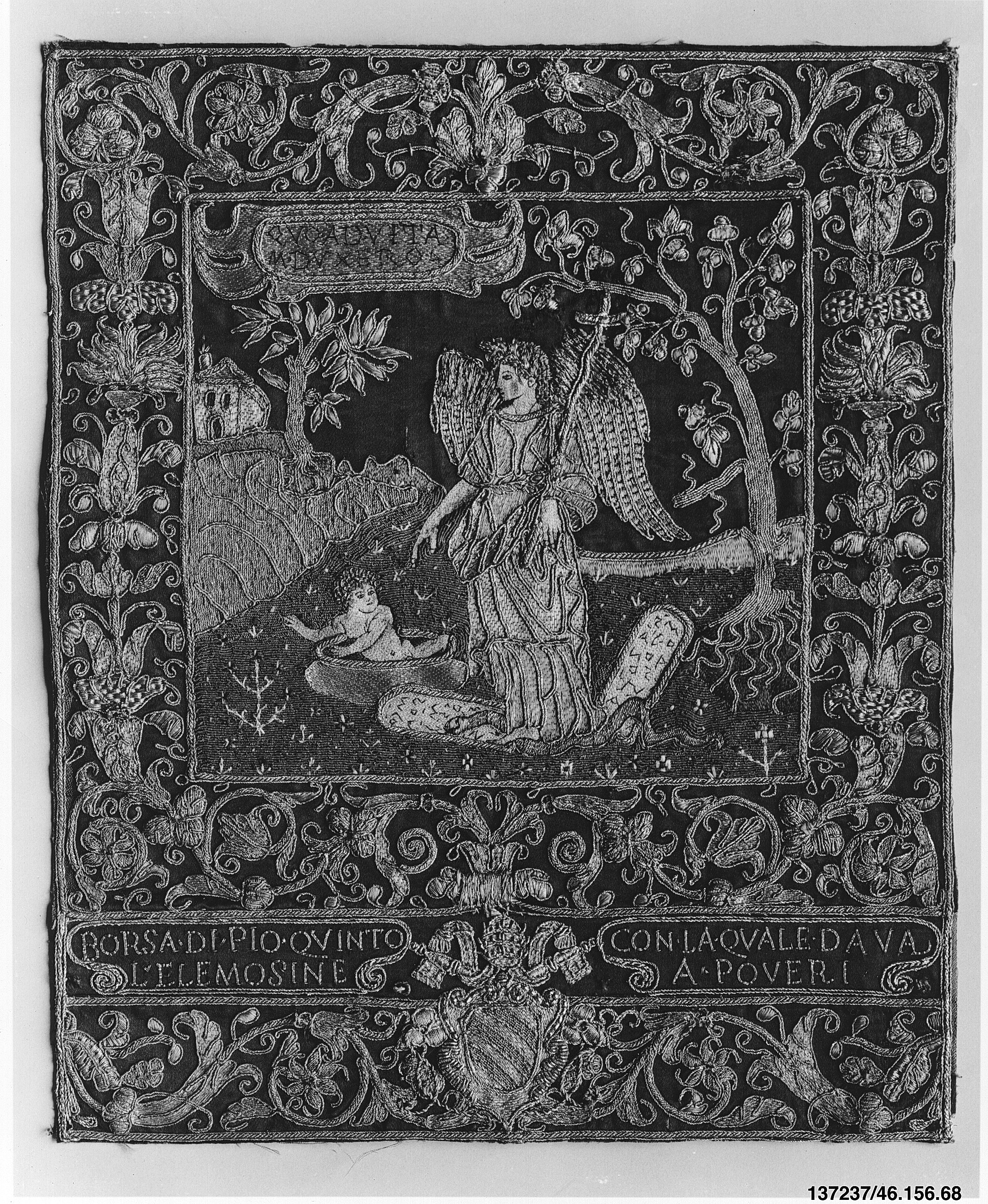
Archival Excavation: The Triumph as a Textile Manifesto
The Triumph of the Church over the Synagogue, a masterwork of medieval ecclesiastical embroidery, is not merely a theological allegory rendered in thread; it is a treatise on structural tension, material hierarchy, and the politics of luminosity. Within the isolated context of our aesthetic archaeology, we strip away its doctrinal narrative to reveal a purely formal lexicon. The piece, executed in silk and metal thread on a silk ground, operates on a principle of dialectical opposition—the soft, absorbent matte of the silk against the hard, reflective brilliance of the metal. For Natalie Fashion Atelier, this is not a relic but a blueprint. The 2026 silhouette must not imitate its iconography, but rather internalize its structural dialectic: the way a rigid metallic line can subjugate a flowing organic field, and how that very tension creates a new definition of luxury.
Material Antagonism: The Silk-Metal Interface
The technical genius of the original artifact lies in its refusal to blend materials. The silk ground is not a canvas; it is an active participant, a passive resistance against which the metal thread performs. In our 2026 haute couture proposition, we translate this into a dual-skin construction. The primary layer—a fluid, high-twist silk charmeuse or a mikado with a liquid drape—serves as the "synagogue," the terrestrial, yielding body. The secondary layer, the "church," is an architectural exoskeleton of lacquered metal mesh or hand-embroidered metallic gimp, applied not as decoration but as a load-bearing element. This is not embroidery as embellishment; it is embroidery as armature. The garment’s silhouette is defined by the points where the metal thread cinches, suspends, or panels the silk, creating a controlled collapse. The 2026 form, therefore, is not a simple A-line or hourglass, but a topographic contour—a landscape of peaks and valleys determined by the strategic, almost brutalist, placement of metallic seams.
Deconstructing the Classical Silhouette: From Allegory to Abstraction
Classical elegance, as exemplified by this artifact, is often misread as symmetry and repose. A closer technical reading reveals a dynamic of asymmetric victory. The composition is inherently unbalanced—one figure triumphs, the other yields. For our atelier, this translates into a deliberate deconstruction of the tailored jacket and the column dress. We propose a “Victory Seam”—a diagonal, metallic-ribbed line that bisects the torso, not to divide, but to create a visual and physical torque. One side of the garment is constructed from a heavier, opaque silk faille, suggesting solidity; the opposing side is a diaphanous silk organza, suggesting vulnerability. The metal thread, running along the seam, acts as the fulcrum, the point of power. The 2026 silhouette is thus a study in controlled asymmetry, where the garment appears to be in a state of perpetual, elegant motion, frozen mid-declaration. This is not the static elegance of the 19th century, but a kinetic elegance derived from medieval dynamism.
The Luminosity Quotient: Engineering Radiance
The power of the original work is its manipulation of light. The metal thread does not merely shine; it interrupts the light absorbed by the silk. This creates a visual frequency, a chiaroscuro of texture. In 2026, we apply this principle through a process we term “Luminance Grading.” The silhouette is no longer defined by color alone, but by its reflective index. We engineer garments where the primary mass is a matte, deep-dyed silk—perhaps an ink-black or a blood-crimson—while the architectural elements are woven with oxidized silver or gold thread. The oxidation is key; it is not a brilliant polish but a tarnished, historical gleam. This allows the metallic elements to absorb and reflect light in a manner that feels ancient, not futuristic. The resulting silhouette, when caught in movement, appears to be a living artifact, its surface shifting between the plush darkness of the silk and the fractured, historical light of the metal. This is luxury as a temporal experience, not a static display.
Structural Grammar: The Rib and the Veil
To translate this to a wearable, high-end form, we must define a new structural grammar. We reject the modern reliance on stretch and elastic. Instead, we return to a bespoke, corseted infrastructure, but one that is visible and celebrated. The metal thread becomes the “rib”—a series of parallel, semi-rigid lines that dictate the garment’s posture. The silk becomes the “veil”—the flesh that drapes between these ribs. The 2026 silhouette is therefore a hybrid: a modern, streamlined sheath that is internally articulated by a metallic skeleton. The ribs are not hidden; they are exposed at the seams, at the hem, and at the neckline, creating a deliberate decorative structuralism. This is a direct homage to the medieval embroiderer’s technique of or nué, where metal threads are laid flat and silk threads are couched over them to create shading. We invert this: the metal is laid thick, and the silk is the interstitial material. The result is a garment that feels both armored and vulnerable, a paradox that defines the contemporary powerful woman.
Conclusion: A Silhouette for the Neo-Monumental Era
The Triumph artifact, isolated from its religious context, offers a profound lesson in material honesty and structural narrative. For Natalie Fashion Atelier’s 2026 collection, it informs a silhouette that is monumental yet fluid, authoritative yet sensual. The high-end garment of the future is not about minimalism or excess, but about tension—the visible, physical tension between the yielding silk and the unyielding metal. This is the new classical elegance: a silhouette that carries its history not as a costume, but as a skeletal memory. It is a garment that speaks of power, not through volume, but through the precise, deliberate placement of a single, shining, unbroken line of metallic thread against a sea of silent, dark silk. This is the triumph of craft over trend, of architecture over decoration.