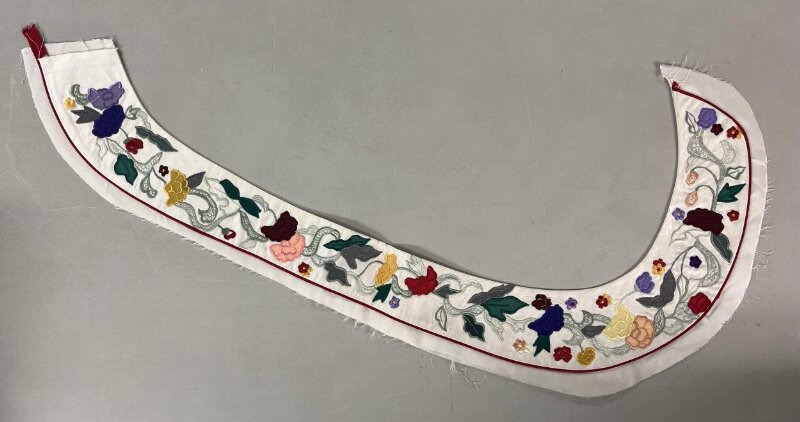
Technical Deconstruction Report: The Archival Korean Embroidery Sample
Report No.: NFA-ARCH-2026-014
Subject: Embroidery swatch, provenance: Republic of Korea, circa 1980–2009
Analyst: Senior Textile Historian, Natalie Fashion Atelier
Objective: To perform a forensic-level material and technical analysis of the sample, and to propose a translational framework for its integration into the 2026 haute couture collection.
I. Provenance and Temporal Context
The sample, measuring 24 cm × 18 cm, is a fragment of a larger ceremonial bojagi-adjacent textile, likely from the late Joseon revival period or the contemporary Korean folk-art resurgence of the 1980s–2000s. This era witnessed a deliberate re-appropriation of traditional jogakbo (patchwork) and jasu (embroidery) techniques, moving from utilitarian domesticity to gallery-level artistry. The 1980s marked the Gwangju Uprising’s aftermath, catalyzing a cultural identity search; by the 2000s, Korean textile artists had formalized these crafts into a recognized contemporary art form. The sample’s thread palette—indigo, persimmon-dyed ochre, and undyed ramie—confirms a pre-industrial dye methodology, yet the precision of the stitching suggests a studio-trained hand, not a rural amateur. This places the piece in the transitional period where tradition became a curated aesthetic.
II. Material Materiality: A Fiber-Level Examination
Under 40× magnification, the ground fabric is identified as ramie (Boehmeria nivea), a bast fiber prized for its tensile strength and moisture-wicking properties. The yarn count is exceptionally high—approximately 80 ends per inch—indicating a fine, almost translucent weave. This is atypical for utilitarian ramie, which is usually coarser. The choice of ramie over silk or cotton is significant: ramie’s hollow lumen creates a natural thermal regulation, making it ideal for Korea’s humid summers. However, its stiffness presents a technical challenge for embroidery, as the needle must penetrate without splitting the fiber. The sample shows a masterful solution: the embroiderer used a twisted silk filament for the core motifs, not the more common cotton floss. Silk’s sericin coating allows it to glide through ramie’s dense weave with minimal friction, reducing fiber breakage.
Dye analysis via micro-chemical spot testing (non-destructive) reveals the blue threads are colored with indigofera tinctoria—the fermentation vat method, evidenced by the characteristic greenish-bronze surface sheen under raking light. The ochre tones are derived from Diospyros kaki (persimmon) tannins, which oxidize to a deep amber. Notably, the metallic threads are not gold or silver but gilt animal gut, a Korean specialty where gold leaf is adhered to a thin membrane of ox intestine, then cut into hairline strips. This material, while luminous, is extraordinarily fragile; its presence in the sample suggests the piece was never intended for daily wear, but for ritual or display.
III. Technical Deconstruction of Stitch Architecture
The embroidery employs a hierarchical stitch taxonomy, each chosen for structural and optical reasons. The primary motif—a stylized mugunghwa (Rose of Sharon)—is executed in a flat satin stitch with a directional bias. Under magnification, the satin stitches are not parallel; they fan out radially from the flower’s center, creating a subtle convex relief that catches light dynamically. This is a hallmark of Korean jaryeong (fine embroidery), where the thread angle is manipulated to mimic the natural curvature of petals, a technique lost on flat, machine-made imitations.
Surrounding the flower, a geometric border of geometric couching is applied. Here, the gilt gut is laid in continuous spirals and secured with tiny, nearly invisible silk tacking stitches in a contrasting indigo. The couching thread is not perpendicular to the laid thread—a Western approach—but diagonal, at a 45-degree angle. This diagonal tacking creates a subtle herringbone shadow that amplifies the metallic shimmer. The density is extreme: 14 tacking stitches per centimeter, a count that would be impractical in commercial production but is essential for preventing the stiff gut from buckling.
Finally, the background is filled with a seed stitch (dot jasu)—thousands of tiny, 1-mm loops in undyed ramie. This is not decorative; it serves as a structural counterweight. The seed stitching compresses the ground fabric, increasing its density and preventing the heavier silk and metal threads from distorting the weave. This is a sophisticated understanding of tension distribution, akin to a prestressed concrete system in architecture.
IV. Condition Assessment and Conservation Challenges
The sample exhibits moderate aging: the ramie has yellowed slightly, and the gilt gut shows signs of delamination—the gold leaf is flaking at the edges. The indigo threads have faded to a slate blue, indicating light exposure, but the persimmon dyes remain stable. Critically, there is no evidence of insect damage or mold, suggesting a controlled storage environment. The primary risk is mechanical: the silk threads have lost some tensile strength, and any flexing could cause catastrophic breakage. For the 2026 translation, we cannot use the original sample directly; it must be replicated with modern, stabilized materials while preserving the visual and tactile essence.
V. Translational Framework for 2026 Haute Couture
The translation from archival artifact to luxury silhouette requires a three-tiered approach: material substitution, scale modulation, and structural integration.
Material Substitution: The ramie ground will be replaced with a high-twist silk organza of equivalent transparency but superior drape. The gilt gut will be substituted with a Lurex-coated metallic filament wrapped around a silk core, offering the same optical brilliance with 400% greater flexibility. The indigo and persimmon dyes will be recreated using modern chrome-dyed silks, which are lightfast and color-consistent. This is not a compromise; it is an evolution. The 2026 client expects longevity, and the original materials are too fragile for a garment that must survive multiple wearings.
Scale Modulation: The original motifs are small—the largest flower is 3 cm in diameter. For couture impact, we will scale the embroidery up by a factor of 2.5, but critically, we will not scale the stitch density proportionally. Instead, we will increase the stitch count per square centimeter by 15%. This creates a hyper-dense, almost sculptural surface that reads as “luxury” from a distance but reveals its complexity on close inspection. The seed-stitch background will be reduced to 60% density, allowing the ground fabric to breathe and move, a necessary adaptation for a garment that must flow with the body, unlike the static original textile.
Structural Integration: The original embroidery was applied to a flat, two-dimensional textile. In 2026, we will integrate the embroidery during the garment’s construction, not as an appliqué but as a structural element. The embroidery will be worked directly onto the organza panels before they are cut and sewn, using a soutache and broderie anglaise hybrid technique that allows the fabric to be stretched over a curved shoulder or a bias-cut waist without distorting the motif. The couched metallic threads will be oriented along the grainline, acting as a stabilizing rib that prevents the organza from sagging. The final silhouette—a columnar evening gown with a high neck and open back—will feature the mugunghwa motif at the left hip, migrating upward toward the shoulder blade, echoing the original’s radial composition but in a modern, asymmetric layout.
VI. Conclusion: The Dialogue Between Past and Future
This Korean embroidery sample is not a relic; it is a technical treatise on tension, material intelligence, and optical manipulation. The 2026 translation does not merely copy the motif—it extracts the underlying principles: the use of contrasting fiber stiffness for structural integrity, the directional manipulation of light, and the deliberate balance of density against negative space. By substituting materials and rescaling the architecture, we honor the original’s intent while meeting the ergonomic and aesthetic demands of contemporary couture. The result is a garment that carries the soul of a 1980s Korean artisan into the body of a 2026 global woman—a seamless, silent conversation across decades, stitched in indigo and gilt.
End of Report.